
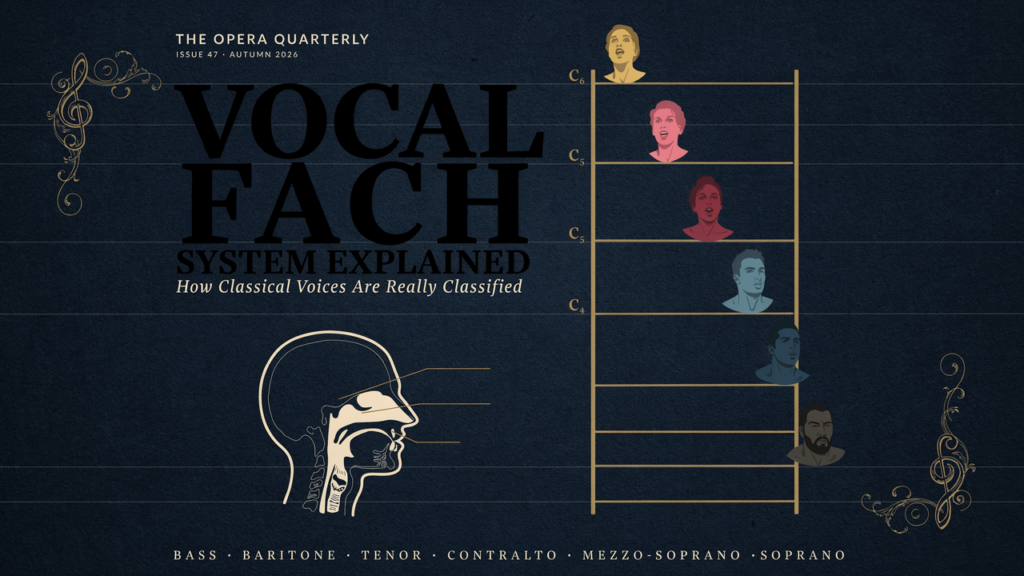
The vocal Fach system is a method of classifying opera singers according to the roles their voices can perform successfully. It considers much more than the highest and lowest notes a singer can produce. Tessitura, vocal weight, tone color, agility, projection, stamina, and dramatic suitability can all influence a singer’s Fach.
This makes Fach more specific than the familiar categories of soprano, mezzo-soprano, contralto, tenor, baritone, and bass. Two singers may share the same basic voice type yet belong to different Fächer because their voices behave differently in an operatic setting.
What Does Fach Mean in Singing?
“Fach” is a German word meaning compartment, field, or specialization. Its plural is “Fächer,” and its pronunciation is approximately “fakh.”
In opera, a Fach connects a particular kind of voice with a suitable group of roles. The system became especially important in German-speaking repertory theaters, where companies needed an organized way to assign singers to appropriate parts throughout a season.
A singer’s Fach may indicate whether the voice is light or powerful, bright or dark, flexible or weighty. It can also reflect the singer’s ability to project over an orchestra and sustain the demands of a complete role.
Voice Type vs Fach
A voice type is a broad classification, while a Fach is a more detailed operatic specialization.
| Voice type | Fach |
|---|---|
| Broad category such as soprano, tenor, or bass | Specific classification such as lyric soprano or dramatic tenor |
| Often based partly on range, tessitura, and tone | Includes weight, agility, projection, stamina, and suitable roles |
| Used in opera, choirs, contemporary singing, and education | Used mainly for opera and classical repertoire |
| Provides a general description of the voice | Helps guide repertoire and casting decisions |
The difference matters because vocal range alone cannot reveal how a voice will function during a demanding performance. A singer might reach the notes of a role without being comfortable in the role’s tessitura, which is the area where most of its notes are concentrated.
What Determines a Singer’s Fach?
There is no single measurement that determines Fach. Teachers, coaches, conductors, and casting professionals normally consider several connected qualities.
Range: The singer must be able to produce the required notes reliably, but isolated extreme notes carry less importance than usable notes. A vocal range chart can provide helpful context, but it cannot assign an operatic Fach.
Tessitura: A role may repeatedly remain high, low, or in the middle of the voice. The singer must be comfortable in that region for extended periods.
Passaggi: These are transition areas where the voice changes coordination between registers. Their approximate location may help trained professionals understand the instrument.
Timbre: A voice may sound bright, warm, metallic, dark, velvety, or brilliant. These descriptions are subjective, but tone color affects how audiences perceive the singer in different roles.
Vocal weight and projection: Some voices carry a light, agile quality, while others create a denser or more powerful impression. In opera, the voice must also project through an acoustic space without a microphone.
Agility and stamina: Coloratura roles require rapid runs, ornaments, and precise movement. Dramatic roles may demand greater power and endurance over a large orchestration.
Dramatic suitability: Character, stage presence, acting ability, language skills, and artistic temperament may also affect casting. Fach therefore describes practical suitability for repertoire—not anatomy alone.
Main Vocal Fach Categories
Individual opera houses and teachers do not always use Fach labels identically. However, the following families provide a useful introduction.
| Voice family | Common Fächer |
|---|---|
| Soprano | Soubrette, lyric coloratura, dramatic coloratura, lyric, spinto, dramatic |
| Mezzo-soprano and contralto | Coloratura mezzo, lyric mezzo, dramatic mezzo, contralto |
| Tenor | Light lyric, lyric, spinto, dramatic, Heldentenor, character tenor |
| Baritone | Lyric baritone, Kavalierbariton, Verdi baritone, dramatic baritone, character baritone |
| Bass and bass-baritone | Bass-baritone, basso cantante, dramatic bass, basso profondo, bass buffo |
These labels are descriptive rather than perfectly rigid. Adjacent Fächer frequently overlap, and a singer may perform selected roles from more than one category.
Knowing how to find your vocal range can be a useful starting point, but singers should not assign themselves a Fach based only on their highest and lowest notes.
How Is a Singer’s Fach Determined?
Fach identification is usually a gradual, collaborative process. A qualified voice teacher may first evaluate the singer’s comfortable range, tessitura, register transitions, tone, and current technical development. Coaches and conductors can then observe how the voice responds to specific repertoire.
Professional experience provides further evidence. A singer may test appropriate arias, rehearse complete scenes, and eventually perform roles under controlled conditions. The most convincing classification is the one supported by consistent vocal function over time.
Register balance also matters. Understanding chest voice vs head voice can help a singer recognize changes in coordination, but those sensations should not be used as a substitute for professional assessment.
Young and developing singers should be especially cautious about accepting narrow labels too early. Their voices may continue to mature, and premature classification can encourage them to imitate a sound that does not fit their current instrument.
Can a Singer Have More Than One Fach?
Yes. Fach boundaries are not walls, and many singers are suitable for roles in neighboring categories. A lyric soprano may sing selected coloratura or spinto repertoire, for example, depending on the role’s orchestration, tessitura, length, and dramatic demands.
A singer may also be classified differently by separate opera houses or traditions. The appropriate decision depends on the individual voice and the actual role, not merely the label printed beside it.
Classifications used in ensembles can be broader still. Choral vocal ranges normally organize singers by section and do not correspond precisely to operatic Fächer.
Can Your Fach Change Over Time?
A singer’s Fach can evolve. Training may improve coordination, resonance, endurance, and access to different parts of the range. Physical maturation, hormonal changes, health, and aging may also influence how the voice functions.
However, singers should not deliberately force their voices to sound heavier, darker, or lighter to enter a preferred category. Healthy development is usually gradual. Working with an experienced teacher is safer than selecting repertoire according to ambition or comparison. If you are considering professional guidance, learning whether vocal coaching works can help you set realistic expectations.
Is Singing Outside Your Fach Dangerous?
Singing a role outside your presumed Fach does not automatically damage your voice. The label itself is not a medical boundary.
The risk comes from the role’s practical demands. A part may sit too high, require more volume than the singer can comfortably produce, or demand greater stamina than the voice currently has. Repeatedly forcing the voice through such conditions may cause fatigue, tension, hoarseness, or loss of control.
Warning signs include pain, persistent hoarseness, reduced range, frequent voice breaks, or unusual effort. A singer experiencing persistent symptoms should stop pushing and consult a qualified medical professional, ideally one experienced in voice care.
Is Fach Used Outside Opera?
The complete Fach system is mainly associated with opera. Musical theater, pop, rock, country, and other contemporary genres typically classify voices less rigidly because amplification, stylistic techniques, song keys, and performance conditions differ.
Classical singers may still find Fach concepts useful when discussing tessitura, vocal weight, and repertoire demands. Nevertheless, non-operatic singers are usually better served by identifying their comfortable working range and stylistic strengths than by adopting a precise operatic label. Comparing typical vocal ranges may offer general context without imposing an unsuitable category.
Limitations of the Fach System
The Fach system is a practical guide, not an exact science. Terminology can vary between countries, teachers, opera houses, and historical traditions. Some categories overlap considerably, while certain roles are classified differently by different sources.
Fach also cannot fully describe an artist. Musicianship, expression, acting, diction, technical consistency, and interpretation remain essential. Nor should Fach be treated as a medical diagnosis or a guaranteed method of preventing injury.
Its greatest value lies in matching a singer with repertoire that supports comfortable, sustainable, and artistically convincing performance.
Frequently Asked Questions
Can an online test identify my Fach?
No online test can determine Fach definitively. It may estimate your range or broad voice type, but Fach requires evaluation of tessitura, timbre, projection, agility, stamina, passaggi, and repertoire suitability.
Is Fach based on vocal range?
Range is one factor, but it is not enough by itself. Two singers with similar note ranges can have different tessituras, tone colors, vocal weights, and performance capabilities.
Do all opera singers have one permanent Fach?
Not necessarily. A singer may perform roles in neighboring Fächer, and classification can evolve as the voice matures. Some artists remain difficult to place within a single category.
Can I choose my own Fach?
You can explore repertoire and learn about your voice, but reliable classification usually requires feedback from experienced teachers, coaches, and opera professionals. It should emerge from consistent vocal behavior rather than personal preference.
Is a heavier Fach better than a lighter Fach?
No. Light, lyric, spinto, and dramatic voices serve different musical purposes. A healthy, expressive voice suited to its repertoire is more valuable than a voice forced to sound larger or heavier.
Final Thoughts
The vocal Fach system helps opera professionals connect individual voices with suitable roles. It considers range, but also examines where the voice is most comfortable, how it moves, how it projects, how long it can sustain a role, and what kind of dramatic character it can portray.
Treat Fach as a flexible professional framework rather than a permanent identity. The right classification should support the voice you have—not pressure you to manufacture a different one.

Conan is a vocal analysis and singing tools writer specializing in vocal range testing, pitch recognition, voice classification, and music education for singers, musicians, and beginners. He creates practical, easy-to-understand content focused on vocal analysis tools, singing improvement, and voice training resources.