
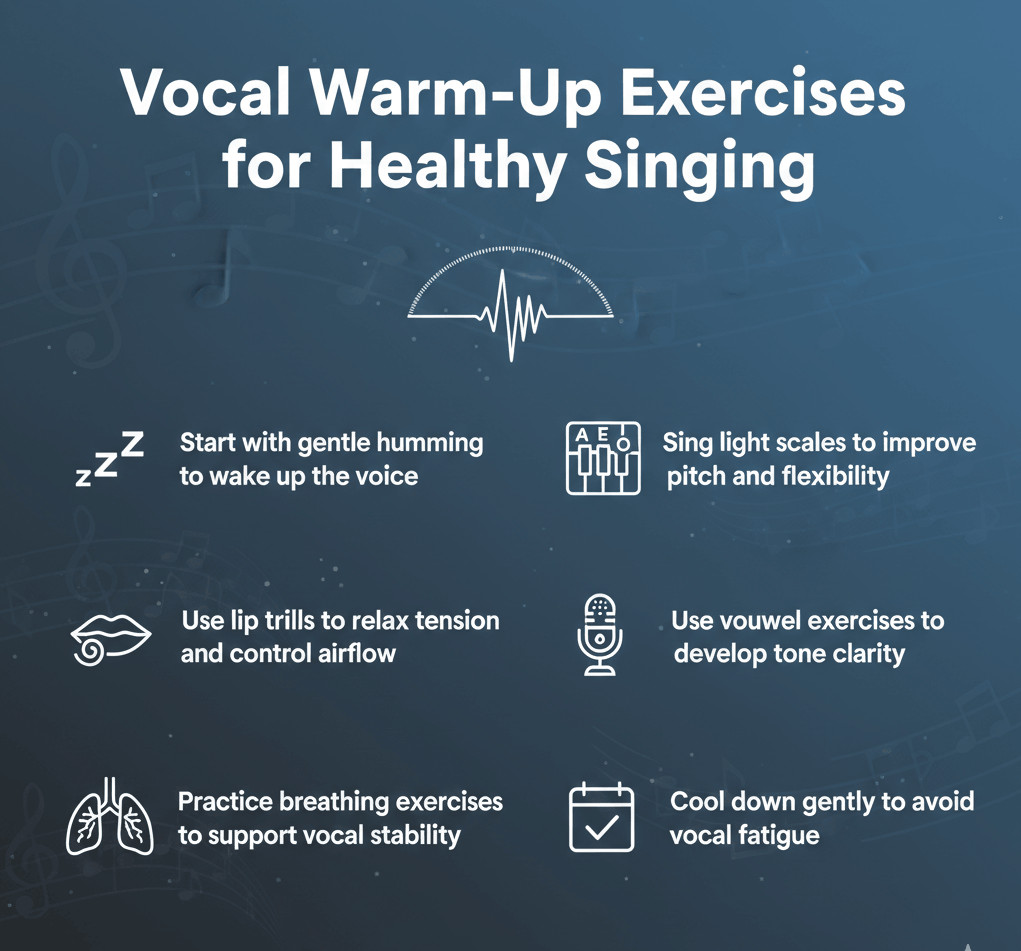
Vocal warm-up exercises prepare the coordination used for singing: airflow, vocal-fold vibration, resonance, pitch movement and articulation. A useful routine begins with easy sounds, expands gradually through a comfortable range and finishes with phrases similar to the music you are about to sing.
Warm-ups may make phonation feel easier and improve immediate readiness, but they cannot guarantee injury prevention or permanent range growth. The correct routine depends on your voice, current condition and upcoming vocal demands.
You can use this vocal range test to identify your lowest and highest singing notes.
What Vocal Warm-Ups Can—and Cannot—Do
A vocal warm-up is a short period of gentle preparation before rehearsal, performance, recording, speaking or range testing.
A well-matched routine may help you:
- Establish an easier vocal onset
- Coordinate airflow with sound
- Move between pitches more predictably
- Explore register transitions at low intensity
- Prepare vowels and articulation
- Check how your voice is responding that day
- Approach the demands of an upcoming song gradually
Warm-ups should not be used to:
- Force unavailable high or low notes
- Cover up pain or significant hoarseness
- Replace technical training
- Diagnose a voice problem
- Guarantee protection from vocal injury
- Permanently expand range in one session
Understanding how vocal folds produce pitch helps explain why efficient coordination matters more than pushing additional air.
Before You Start: Check Your Voice
Speak a short sentence at your normal volume. Then produce an easy hum near your speaking pitch.
Notice whether your voice feels:
- Similar to its usual condition
- Comfortable at an ordinary speaking volume
- Free from pain or burning
- Able to begin sound without unusual effort
- Stable enough for a gentle warm-up
Do not try to override pain, sudden voice loss or significant difficulty speaking. Persistent or recurring hoarseness, reduced range, pain or increasing vocal effort deserves evaluation from a qualified healthcare professional. The American Speech-Language-Hearing Association provides information about voice-disorder symptoms and assessment.
Quick 10-Minute Vocal Warm-Up Routine
The times below are flexible. Move forward when the current stage feels easy; shorten or stop the routine if effort increases.
| Stage | Approximate Time | Exercise | Main Goal |
|---|---|---|---|
| Release | 1 minute | Jaw, tongue and shoulder release | Reduce unnecessary external tension |
| Airflow | 1 minute | Easy exhale and “sss–vvv” | Coordinate breath and voicing |
| SOVT | 2 minutes | Lip trill, straw, “v” or “z” | Establish easy phonation |
| Glides | 2 minutes | Humming, “ng–oo” and sirens | Connect comfortable pitches |
| Patterns | 2 minutes | Three- and five-note scales | Prepare pitch and vowels |
| Task match | 2 minutes | Short song phrases | Prepare for actual singing demands |
You do not need to perform every SOVT variation. Choose the one that feels easiest and produces the most consistent response.
10 Vocal Warm-Up Exercises: Step by Step
1. Gentle jaw, tongue and shoulder release
Roll your shoulders slowly, let your jaw hang without forcing it downward and allow the tongue to rest near the lower front teeth. Gently move the jaw from side to side.
Continue for 30–60 seconds. The aim is comfortable movement, not an intense neck or jaw stretch.
Common mistake: pressing on the jaw or making large neck circles that cause discomfort.
2. Quiet low-rib breath
Inhale silently without lifting your shoulders or taking the largest breath possible. Allow the lower ribs and abdomen to respond naturally. Exhale easily for four to six seconds.
Repeat three times. Avoid holding your breath before the exhale.
Common mistake: overfilling the lungs, which can make the following sound feel pressurized.
3. “Sss” to “vvv” transition
Release a steady “sss” for three or four seconds. Repeat the exhale using a voiced “vvv” at an easy speaking pitch.
The transition introduces vocal-fold vibration without demanding a wide range. Keep the sound moderate and even.
Common mistake: pushing more air through “vvv” until the lips or throat feel tight.
4. Lip trill
Let loosely closed lips vibrate on a gentle “brrr.” Add a comfortable pitch, then glide slightly upward and downward.
If the trill repeatedly stops, support the cheeks lightly with your fingers or choose “vvv” instead. A lip trill is an option, not a test you must pass.
Common mistake: blowing forcefully to keep the lips moving.
5. Straw phonation or voiced-fricative substitute
Phonate gently through a regular drinking straw on one comfortable pitch, then perform a small glide. Keep the sound easy and the airflow steady.
If you do not have a straw, use “vv,” “zz” or a lip trill. These are semi-occluded vocal-tract exercises because the vocal tract is partly narrowed at or near the lips. The University of Iowa’s vocal-health resource summarizes their use and underlying research.
Common mistake: treating a smaller or more resistant straw as automatically better. Excess resistance or effort is unnecessary.
6. Easy humming
Hum “mm” on a comfortable note with your lips together, teeth apart and jaw relaxed. Move through a small three-note pattern.
A light vibration around the lips or face may occur, but do not chase a specific physical sensation. The sound should remain clear and easy.
Common mistake: clenching the jaw or pressing the tongue backward.
7. “Ng–oo” glide
Produce “ng,” as at the end of “sing,” and slide through a small comfortable interval. Open gently into “oo” without changing the pitch abruptly.
This helps connect tongue position, resonance and vowel transition. Keep the volume light to moderate.
Common mistake: holding the tongue or squeezing the throat when opening to “oo.”
8. Comfortable vocal siren
Glide from a comfortable low-middle pitch to an easy upper pitch and return. Use “woo,” a lip trill or a straw.
The siren should pass through the range smoothly without requiring the same tone quality everywhere. Let the sound adjust as pitch rises. Learning how chest and head voice differ can make these register changes less confusing.
Common mistake: turning the siren into a maximum-range test.
9. Three- or five-note scale
Sing a short ascending and descending pattern on “oo,” “ee” or “mum.” Begin near the middle of your range and move by semitones only while the exercise remains comfortable.
Use a moderate volume and listen for stable pitch rather than maximum power. Broader singing exercises can follow after the warm-up if you plan a longer technical session.
Common mistake: continuing upward after the jaw, tongue or neck begins to tighten.
10. Song-specific phrase
Choose a short phrase from the song you are preparing. Begin below performance intensity, then gradually approach the required vowel, articulation, pitch and volume.
If the phrase is difficult, isolate a smaller pattern or transpose it temporarily rather than attacking the hardest note repeatedly.
Common mistake: completing a gentle warm-up and then immediately singing the most demanding passage at full intensity.
How to Adapt the Routine
A generic routine should finish by preparing the specific task ahead.
For a high song
Spend more time on light glides and gradually ascending patterns. Reduce volume before increasing pitch. Use the dedicated techniques for singing high notes without straining rather than pulling a heavy sound upward.
For a low song
Begin in the middle instead of forcing low notes immediately. Descend gradually while maintaining a clear, unpressed tone.
For loud or belt-oriented material
Establish easy phonation first. Add intensity only after moderate-volume phrases feel coordinated. A warm-up should not begin with repeated belts.
For soft studio singing
Practise gentle onset, sustained vowels and the exact consonants required by the song. Very soft singing still needs stable coordination.
For choir rehearsal
Include humming, vowel matching, short scales and articulation. Do not compete with surrounding voices by increasing volume unnecessarily.
Before testing vocal range
Warm up without visiting your extremes repeatedly. Follow the full method for finding your vocal range, then use an online vocal range test only after ordinary notes feel stable.
How Long Should a Vocal Warm-Up Last?
There is no universal duration. Five minutes may be enough before light singing on one day, while demanding repertoire may require a longer progression on another.
Readiness matters more than reaching a fixed number of minutes. Your voice may be sufficiently prepared when:
- Sound begins without increasing effort
- Comfortable notes respond predictably
- Pitch glides become smoother
- Register transitions feel manageable
- Speech remains normal
- The upcoming musical phrases feel easier
- The routine has not caused fatigue
A longer warm-up is not automatically more effective. Once the routine becomes tiring or repeatedly challenges the extremes, it has shifted from preparation toward training.
Vocal Warm-Up vs Vocal Training
| Feature | Vocal Warm-Up | Vocal Training |
|---|---|---|
| Primary goal | Prepare for immediate voice use | Develop coordination or skill over time |
| Intensity | Low and gradually progressive | Varies with the training goal |
| Duration | Usually short | Often longer |
| Range | Comfortable, approaching task demands | May systematically challenge current ability |
| Fatigue | Should not noticeably accumulate | Requires appropriate workload and recovery |
| Examples | Easy hums, SOVT sounds, light scales | Register work, agility drills, range development |
The same exercise can serve either purpose. A two-minute lip trill in a comfortable range may be a warm-up; repeated high-intensity patterns could become technical training.
Use targeted vocal exercises for increasing range as a separate, gradual practice goal rather than turning every warm-up into a range-extension session.
When to Stop Warming Up
Stop or reduce the exercise if you notice:
- Pain, burning or sharp discomfort
- Increasing throat or neck effort
- Sudden loss of vocal control
- Worsening hoarseness
- Dizziness from exaggerated breathing
- A speaking voice that feels worse afterward
- Fatigue increasing with each repetition
If the voice feels mildly sluggish but otherwise normal, begin more gently and reassess. If it is painful, significantly hoarse or unusually limited, do not assume a longer warm-up will fix it.
Daily response can vary because of recent voice use, sleep, illness, environment and other factors. Understanding why vocal range changes can help you separate ordinary variation from symptoms that should not be ignored.
Common Vocal Warm-Up Mistakes
- Starting with the highest or loudest notes
- Taking oversized breaths before every sound
- Blowing too hard through a straw or lip trill
- Performing every exercise regardless of how the voice responds
- Using only one vowel when the upcoming song requires others
- Treating cracks as a reason to push harder
- Extending the routine until the voice feels tired
- Using warm-ups to test maximum range every day
- Ignoring pain or worsening hoarseness
- Failing to prepare the actual phrases and articulation required
Frequently Asked Questions
What are the best vocal warm-up exercises?
Lip trills, straw phonation, humming, voiced fricatives, gentle sirens and short scales are useful options. The best choice is one that feels easy and prepares the demands of your upcoming task.
How long should I warm up before singing?
There is no required duration. A short routine may be sufficient for light use, while demanding singing may need a longer, gradual progression. Stop before preparation becomes fatigue.
Should I warm up every time I sing?
A brief check-in and gradual start are useful before demanding voice use. Light, casual singing may require less preparation than a performance or extended rehearsal.
Can vocal warm-ups increase range?
A warm-up may make currently available notes easier to access. Permanent range development requires consistent training over time and cannot be guaranteed by one routine.
Are lip trills necessary?
No. If lip trills are difficult, use humming, “vv,” “zz” or straw phonation instead.
Should a warm-up include high notes?
It can gradually approach higher notes required by the upcoming music, but it should not begin at the extremes or force unavailable pitches.
Can warming up prevent vocal injury?
Warm-ups may support readiness and efficient coordination, but they cannot guarantee injury prevention. Vocal load, technique, health, recovery and environmental factors also matter.
Should I warm up when my voice is hoarse?
Do not use warm-ups to push through significant or persistent hoarseness. Gentle voice use may be appropriate in some situations, but recurring symptoms, pain or sudden voice changes should be evaluated professionally.