
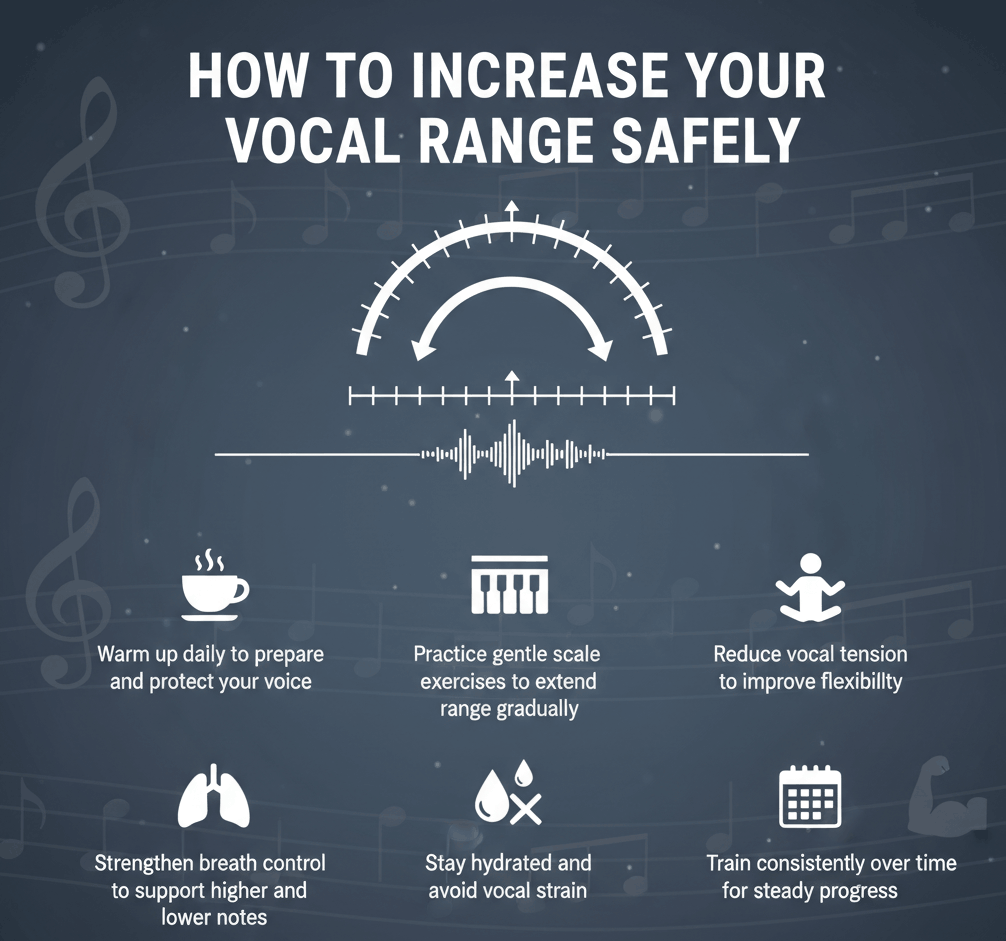
You can increase your usable vocal range by improving coordination, reducing unnecessary tension, and gradually stabilizing notes above and below your current comfortable range. The goal is not to force your voice toward extreme pitches. It is to make additional notes clear, repeatable, controlled, and usable in actual singing.
Your anatomy influences the broad limits of your voice, so no exercise can guarantee a particular number of extra notes. Progress also varies with technique, training history, age, vocal condition, practice habits, and recovery.
The safest approach is to measure your current range, practice short and controlled exercises, expand only a small distance at a time, and track whether each new note becomes easier across multiple sessions. You can check your vocal range here and see which notes you can produce.
What Counts as a Real Increase in Vocal Range?
Touching a note once does not mean that your usable range has expanded. A new boundary note should become increasingly repeatable and controllable.
| Stage | What it means |
|---|---|
| Touched | You reached the note once |
| Repeated | You produced it several times |
| Controlled | You sustained it with stable pitch and manageable effort |
| Connected | You could move into and away from it smoothly |
| Usable | You could sing it in an exercise or musical phrase |
| Stable | It remained available across multiple sessions |
Extreme notes may be useful for exploring your voice, but they should not automatically define your comfortable range.
Before starting a range-building program, follow the site’s guide on how to find your vocal range and record your lowest and highest repeatable notes.
What Can Change With Vocal Training?
Training may improve how efficiently you coordinate airflow, vocal-fold vibration, resonance, vowels, and register transitions. These changes can make previously difficult pitches more accessible.
You may improve:
- Access to higher or lower notes
- Pitch stability near your boundaries
- Transitions between registers
- Control at quieter and moderate volumes
- Endurance within your usable range
- Recovery after demanding singing
- The tone and consistency of existing notes
Training does not remove every anatomical limitation. It also cannot guarantee that all extreme pitches will become suitable for songs or performances.
Some apparent improvement happens because a warm-up temporarily restores notes that were already available. Durable improvement takes longer: the notes must become repeatable, connected, and usable without unwanted symptoms afterward.
Start With a Gentle Vocal Warm-Up
Do not begin a range session by immediately testing your highest or lowest note. Start in the middle of your comfortable voice and gradually move outward.
A short preparation may include:
- Relaxed breathing without lifting the shoulders
- Gentle humming on an easy pitch
- Lip trills through a small pitch range
- Light “woo” slides
- Easy five-note scales near your speaking range
The warm-up should make singing feel easier—not tired, pressed, or scratchy. You can use the complete vocal warm-up exercises guide before beginning the targeted exercises below.
Five Safe Ways to Improve Your Vocal Range
1. Reduce Unnecessary Effort
Trying harder is not always the same as coordinating better. Excessive jaw, tongue, neck, or throat tension can make boundary notes less reliable.
Check that:
- Your jaw can move freely
- Your tongue is not pulling backward
- Your chin is not reaching upward
- Your shoulders remain relaxed
- Your volume is manageable
- You are not holding your breath before the note
If tension increases as the pitch rises or falls, return to an easier note and rebuild the pattern with less effort.
2. Use Semi-Occluded Exercises
Lip trills, humming and straw phonation partially narrow the vocal tract at the lips. Many singers use these exercises to explore pitch with less perceived effort.
Start with a comfortable note and glide through a small range. Keep the sound steady and light. Gradually widen the glide only while it remains easy.
These exercises are preparation and coordination tools. They do not guarantee a permanent range increase by themselves.
3. Practice Smooth Pitch Slides
Sirens help you move continuously between lower and higher pitches without treating every register change as a barrier.
Use “woo,” a lip trill, or a gentle “ng” sound:
- Begin near the middle of your range.
- Glide upward until the first sign of pressure.
- Turn around before you need to force.
- Return smoothly to the starting pitch.
- Repeat with a slightly wider glide only if the previous one remained comfortable.
The purpose is a connected movement, not the highest possible endpoint.
4. Coordinate Your Registers
Many singers encounter difficulty where the voice changes coordination between chest-dominant and head-dominant production. Attempting to carry the same weight and volume through the entire range may increase effort.
Practice moving through the transition at a moderate or lighter intensity. Let the sound adjust rather than trying to make every note feel identical.
The guide to chest voice vs head voice explains how the registers differ and why the transition matters when expanding your usable range.
5. Expand in Small Steps
Choose one or two notes just outside your current comfortable boundary rather than repeatedly attempting your absolute extreme.
Approach the note through a short scale or glide. Once you reach it:
- Keep the volume manageable
- Avoid squeezing or shouting
- Hold it only briefly at first
- Return to an easier pitch
- Repeat only while the voice remains responsive
Do not keep raising or lowering the exercise simply because one repetition worked. Stabilize the current pitch before progressing.
Exercises for Increasing Your Higher Range
Lip-Trill Five-Note Scale
Sing a five-note ascending and descending pattern on a lip trill.
Move the pattern upward by one semitone at a time. Stop when the trill collapses, the pitch becomes unstable, or your throat begins to tighten.
Gentle “Woo” Siren
Use a light “woo” and glide from a comfortable pitch into your upper range. Allow the sound to become lighter as you ascend.
Do not increase volume to reach the endpoint. Turn around before the sound becomes pressed.
“NG” to Vowel
Begin with the final sound in “sing.” Glide upward on “ng,” then open gently into a vowel such as “oo” without changing the pitch.
If opening the vowel creates pressure, return to “ng” and work lower.
Short Ascending Scale
Use a comfortable syllable on a three- or five-note ascending scale. Keep the first attempts within your established range.
Raise the pattern gradually. A pitch should feel increasingly coordinated before it becomes a regular training boundary.
For a larger exercise library, use the dedicated guide to vocal exercises for increasing range.
Exercises for Increasing Your Lower Range
Low notes should be developed through clarity and ease—not by pushing the larynx downward or manufacturing a growling sound.
Descending Five-Note Pattern
Start in a comfortable middle area and sing a five-note descending pattern on “oo,” “oh,” or “mum.”
Move downward by one semitone at a time. Stop when the pitch becomes mostly air, fry, or an unstable rumble.
Humming Slides
Hum gently from a comfortable pitch downward. Keep the sound clear enough to identify as a musical note.
If the tone disappears, return to the previous repeatable pitch rather than adding more pressure.
Speech-to-Singing Pattern
Speak a comfortable word or syllable, then sustain its pitch briefly. Move gradually downward while preserving the same easy speaking quality.
Do not artificially darken the sound to imitate a lower voice. The useful boundary is the lowest note you can produce clearly and repeatably.
A Practical 10–12 Minute Range Routine
This routine is a general starting framework, not a universal prescription. Shorten it if your voice tires or feels less responsive.
| Time | Activity |
|---|---|
| 0–2 minutes | Gentle humming and easy middle-range slides |
| 2–4 minutes | Lip-trill sirens through a comfortable range |
| 4–6 minutes | Light “woo” or “ng” slides across register transitions |
| 6–9 minutes | Three- or five-note scales moving gradually outward |
| 9–11 minutes | One targeted upper or lower boundary exercise |
| 11–12 minutes | Easy descending hum and result notes |
Do not work aggressively on both extremes in every session. You may focus on upper-range coordination during one session and lower-range clarity during another.
A few short, focused sessions each week may be more manageable than occasional long sessions. Your appropriate frequency depends on how your voice responds and whether you have other rehearsals, performances, teaching, or speaking demands.
How to Progress Without Forcing
Use the following progression for each new note:
- Touch the note lightly.
- Repeat it on different attempts.
- Sustain it briefly with stable pitch.
- Approach it through a scale.
- Move away from it without a crack or collapse.
- Use it in a short phrase.
- Confirm that it remains available in later sessions.
Only move the exercise higher or lower when the current boundary feels manageable. If yesterday’s new note is unavailable today, return to the previous stable boundary.
Range naturally varies with vocal load, warm-up, sleep, illness, technique, and testing conditions. The guide on why vocal range changes explains why one session should not define your progress.
How to Track Vocal Range Progress
Test under comparable conditions rather than measuring your extremes after every exercise.
Record:
- Date and approximate time
- Lowest repeatable note
- Highest repeatable note
- Registers included
- Exercise used
- Effort level
- Pitch stability
- Any tightness or fatigue
- How the voice felt later or the next day
Use the vocal range tester to measure the same type of range each time. If one session includes falsetto or another register and the next does not, label the results instead of comparing them as if they were identical.
A new note is more meaningful when it remains available across multiple sessions and becomes easier to use in short musical phrases.
Temporary Access vs Stable Improvement
A warm-up may give you immediate access to notes that were unavailable at the beginning of the session. This can be useful, but it does not necessarily represent lasting expansion.
| Temporary access | Stable improvement |
|---|---|
| Appears only after a long warm-up | Appears after normal preparation |
| Can be produced once | Can be repeated |
| Requires concentration or extra effort | Feels increasingly coordinated |
| Cannot be used in a phrase | Connects with nearby notes |
| Disappears by the next session | Returns across multiple sessions |
Do not judge progress only by the widest measurement obtained after an intense practice session.
Common Mistakes That Limit Progress
| Mistake | Why it causes problems |
|---|---|
| Forcing chest voice upward | May increase effort near register transitions |
| Singing louder to reach higher | Can replace coordination with pressure |
| Pushing low notes downward | Often produces fry or an unstable pitch |
| Practicing only extremes | Neglects the transitions needed to connect them |
| Changing exercises constantly | Makes progress difficult to evaluate |
| Testing range every day | Encourages chasing numbers instead of control |
| Ignoring fatigue | Makes results inconsistent and may prolong recovery |
| Copying another singer’s range | Creates targets unrelated to your own voice |
| Counting every sound | Inflates the measurement without improving usable range |
How Long Does It Take to Increase Vocal Range?
There is no reliable timeline that applies to every singer.
Some people quickly recover notes that were limited by an incomplete warm-up, recent fatigue, or inefficient coordination. Stabilizing genuinely new notes may take longer because the singer must develop control, repeatability, register connection, and endurance.
Avoid programs that guarantee a specific number of semitones or octaves within a fixed period. Progress should be judged by improved ease and consistency, not only by how far the endpoint moves.
When to Stop Practicing
Stop the session if you experience:
- Pain or burning
- Increasing throat pressure
- Sudden hoarseness
- Loss of speaking comfort
- A rapidly shrinking range during practice
- Difficulty producing notes that were easy before the session
- Discomfort that continues after singing
Do not train range extremes while ill, hoarse, or unusually fatigued. Persistent hoarseness, recurring pain, or a sudden unexplained loss of range should be evaluated by an appropriate healthcare professional.
Vocal exercises are educational training tools. They are not a diagnosis or treatment for a voice disorder.
Frequently Asked Questions
Can you really increase your vocal range?
You may increase your usable range by improving coordination, reducing unnecessary effort, and stabilizing additional notes. The amount of possible improvement varies between singers.
Can adults increase their vocal range?
Adults may improve vocal coordination and access to notes, but age, training history, anatomy, vocal health, and other factors affect the result.
Should I practice range exercises every day?
Not necessarily. Practice only when your voice feels recovered and responsive. Your total singing and speaking workload matters more than following a fixed daily schedule.
How can I increase my upper range without straining?
Use moderate volume, lighter coordination, smooth slides, semi-occluded exercises, and gradual semitone progression. Stop before tightness turns into force.
Can I make my lower range deeper?
You may improve access and clarity at the lower boundary, but anatomy strongly influences how low your voice can go. Do not push the larynx downward or count unstable fry as a clear sung note.
Does falsetto count when increasing vocal range?
Falsetto may count in a full demonstrated range when it is clear and repeatable. Record it separately if you are tracking modal, comfortable, or performance range.
How do I know if a new note is usable?
A usable note can be repeated, sustained briefly, connected to nearby notes, and produced without pain or excessive effort across more than one session.
Will warm-ups permanently increase my range?
A warm-up may temporarily improve access and coordination. Permanent improvement requires the notes to become stable and usable through continued training.
Should I stop if my voice feels tight?
Yes. Return to an easier pitch or end the session. Increasing pressure is not evidence that the exercise is working.