
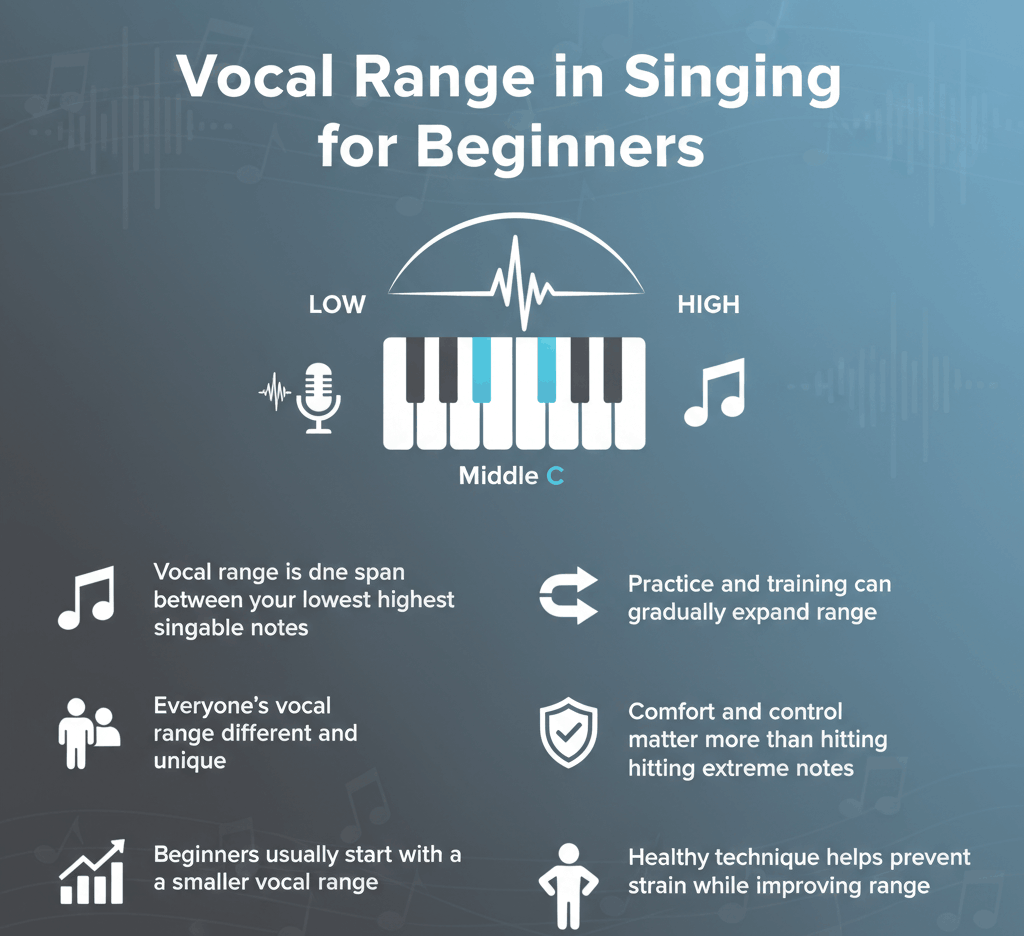
Vocal range is the span from the lowest to the highest pitch a voice can produce. A singer might report a range such as C3–G5, meaning C3 is the lowest note and G5 is the highest.
That broad definition includes every identifiable pitch produced under the chosen testing conditions. In practical singing, however, people often use “vocal range” to mean the narrower span of notes they can repeat with adequate control, stable pitch and useful tone. This distinction between total range and usable range makes a result much easier to interpret.
If you’re not sure what notes you can comfortably sing, take an online vocal range test to find out.
What Is Vocal Range?
A vocal range is defined by two endpoints:
- The lowest pitch a person can produce
- The highest pitch a person can produce
The distance between these notes can be expressed in semitones, octaves or both. Musical note names such as E2–A4 are normally more informative than saying “two octaves” because they show where the range sits as well as how wide it is.
The meaning of the endpoints depends on why the range is being measured. A physiological assessment may include nearly every phonatable pitch. A singer choosing repertoire will care more about notes that can be sustained, controlled and used musically.
For that reason, a complete range result should ideally identify:
- The lowest and highest notes
- The total distance in semitones or octaves
- Whether the notes were repeatable
- Which vocal registers were used
- Whether the result represents total or usable range
- The conditions under which the test was performed
Total Range vs Usable Singing Range
A note can be technically producible without being suitable for a song. Separating total range from usable singing range prevents an isolated squeak, fry sound or strained note from exaggerating practical ability.
| Feature | Total or Demonstrated Range | Usable Singing Range |
|---|---|---|
| Definition | Every identifiable pitch produced under defined conditions | Notes that can be repeated with adequate control and useful tone |
| Includes extremes? | It may | Only when the extremes remain functional |
| Main purpose | Documenting maximum capability | Selecting songs and evaluating practical singing |
| Pitch stability | May include brief or less stable pitches if disclosed | Should generally remain stable enough to use musically |
| Tone quality | May vary significantly | Appropriate for the intended musical context |
| Register | May include fry, modal, falsetto or whistle production | Depends on the singer’s style and repertoire |
| Usually narrower? | No | Yes |
Neither measurement is automatically more correct. They answer different questions.
If you are documenting the broadest sound a person can phonate, total range is appropriate. If you want to know which songs can be performed comfortably, usable range is usually more relevant.
How Vocal Range Is Written
Vocal ranges are normally written from the lowest note to the highest note:
Lowest note–highest note
Examples include:
- E2–E4
- A3–C6
- C3–G5
The letter identifies the musical note, while the number identifies its octave in scientific pitch notation. Middle C is written as C4. The B immediately below it is B3, and the next C above it is C5.
The octave number changes at C, not at A. This matters when counting the distance between notes. B3 to C4 is only one semitone even though the numbers differ.
Accidentals should be included when necessary:
- F♯3 is one semitone above F3.
- B♭4 is one semitone below B4.
- F♯3 and G♭3 represent the same piano key in standard equal temperament, although the preferred spelling depends on musical context.
How Vocal Range Is Measured in Semitones and Octaves
A semitone is the distance between two adjacent keys on a piano, including black keys. Twelve semitones make one octave.
The basic calculation is:
Total semitones ÷ 12 = octaves plus any remaining semitones
Consider these examples:
| Reported Range | Semitone Span | Exact Width |
|---|---|---|
| C3–C4 | 12 | 1 octave |
| C3–C5 | 24 | 2 octaves |
| C3–G5 | 31 | 2 octaves + 7 semitones |
| A2–C5 | 27 | 2 octaves + 3 semitones |
| E2–A4 | 29 | 2 octaves + 5 semitones |
A range of two octaves and seven semitones should not be rounded up and presented as three octaves. The exact measurement protects accuracy when comparing results.
The guide to octave ranges explains these intervals and octave relationships in more detail.
What Counts as a Vocal-Range Note?
A pitch detector may recognize a sound even when it would not function as a reliable singing note. Before counting an endpoint as usable, consider whether you can:
- Produce the note without pain
- Hold it long enough to confirm the pitch
- Repeat it more than once
- Approach and leave it with reasonable control
- Maintain an appropriate tone for your style
- Use it at a practical volume
- Sing it without immediately becoming hoarse or fatigued
The standard does not have to be identical for every genre. A quiet breathy note may be musically useful in recorded pop but unsuitable for an unamplified classical performance. A short whistle note may be a deliberate effect even though it would not support an entire melodic phrase.
When reporting extreme notes, add context instead of silently treating every sound as equivalent. For example:
Total demonstrated range: A2–E6, including falsetto
Consistent usable range: C3–B5
That statement communicates much more than a single octave count.
Does Falsetto, Head Voice or Whistle Register Count?
There is no universal rule requiring every range measurement to include or exclude a particular register. The correct approach depends on the purpose of the measurement.
- Chest and modal voice: Usually included because they cover much of ordinary speaking and singing.
- Head voice: Normally included when it is a functional part of the singer’s technique.
- Falsetto: May be included in total or stylistically useful range, but it should be identified when register matters.
- Whistle register: Can be included in a demonstrated range if the notes are identifiable, although these pitches may not represent ordinary singing range.
- Vocal fry: Extremely low pulses may be measurable but are not always treated as pitched, musically usable notes.
Terminology also varies among voice teachers. Some distinguish head voice sharply from falsetto, while others use broader register labels. Understanding chest voice and head voice can help you describe how the endpoints were produced.
When comparing two singers, apply the same inclusion rules to both. Comparing one singer’s modal range with another singer’s range including fry, falsetto and whistle notes produces a misleading result.
Vocal Range vs Tessitura
Vocal range and tessitura are related but not interchangeable.
| Concept | Vocal Range | Tessitura |
|---|---|---|
| Main question | What is the lowest-to-highest span? | Where does the voice or musical part function most comfortably and characteristically? |
| Includes extremes? | It can | Usually not |
| Describes width? | Yes | Not primarily |
| Useful for | Documenting pitch limits | Choosing keys, roles and repertoire |
| Determines stamina? | Not by itself | More closely related to sustained comfort |
A singer might be able to produce C3–C6 but feel most secure through G3–E5. The broader span is the singer’s range under the selected criteria; the narrower, comfortable area helps describe the singer’s tessitura.
Tessitura can also describe a composition. Two songs may contain the same lowest and highest notes, yet one may stay near the top for most of its duration and feel considerably harder.
A dedicated explanation of what tessitura means provides more detail about this distinction.
Vocal Range vs Voice Type
Vocal range does not determine voice type by itself. Soprano, mezzo-soprano, contralto, tenor, baritone and bass classifications consider more than two endpoint notes.
Relevant factors may include:
- Tessitura
- Vocal timbre
- Vocal weight
- Passaggio locations
- Register behavior
- Comfortable volume
- Repertoire demands
- Training and stylistic context
Two singers can have the same total range but different voice types. One may be most comfortable in the upper portion, while the other may have a lower tessitura and a different tonal character.
Classical voice classifications were developed for particular repertoire and performance requirements. They should not be treated as rigid biological boxes for every contemporary singer. The overview of singing voice types explains how range interacts with the other classification factors.
Vocal Range vs the Range of a Song
Songs also have vocal ranges. A song’s range is the distance from its lowest written or performed note to its highest.
A singer may technically possess all the notes required by a song but still find it uncomfortable because:
- Most phrases remain near the top of the range.
- A high note must be held for a long time.
- The song repeatedly crosses a passaggio.
- The required volume or tone is demanding.
- The original key places the melody outside the singer’s tessitura.
Therefore, matching only the lowest and highest notes is not enough when choosing repertoire. Range tells you whether the pitches may be available; tessitura and musical demands indicate whether the song is likely to fit well.
What Is a Normal or Good Vocal Range?
There is no single octave count that every singer should have. Published averages vary because researchers, teachers and websites do not always use the same:
- Participant population
- Training level
- Register rules
- Testing method
- Loudness requirements
- Definition of a valid endpoint
A range can be useful without being unusually wide. Many songs occupy a relatively limited span, and a singer with reliable control across that span may perform them more effectively than someone with wider but unstable extremes.
A “good” range is one that supports the singer’s goals. Important qualities include:
- Reliable pitch
- Consistent tone
- Dynamic control
- Smooth register transitions
- Endurance
- Musical expression
- Freedom from pain
For population estimates and general comparisons, use the dedicated guide to typical vocal ranges rather than treating one number as universal.
How to Find Your Vocal Range
A basic range check involves moving gradually from a comfortable middle note toward lower and higher pitches.
- Warm up gently.
- Begin near a comfortable speaking or singing pitch.
- Descend by semitones until the pitch becomes unstable or uncomfortable.
- Return to the middle and ascend gradually.
- Record the last repeatable note in each direction.
- Note which register was used at each endpoint.
- Repeat the test on another day before treating the result as established.
The full guide to finding your vocal range explains the process and common testing mistakes. You can also use an online vocal range test to identify pitches, but software cannot decide whether every detected sound is comfortable, healthy or musically useful.
Stop if testing causes pain, burning or persistent throat tightness. Do not continue forcing the sound merely to add another note to the result.
Why Vocal Range Can Change
A measured range is not perfectly identical every day. Short-term access to certain notes may be affected by:
- Fatigue
- Recent heavy voice use
- Illness or inflammation
- Sleep
- Hydration status
- Warm-up
- Stress and muscular tension
- Time of day
- Testing technique
- Microphone and background noise
Longer-term changes may occur with maturation, aging, hormonal changes, training, reduced practice or changes affecting vocal-fold function.
Small variations between tests are not automatically concerning. A sudden or persistent loss of notes—especially with pain, hoarseness or increased effort—should not be dismissed as ordinary fluctuation. The guide to why vocal range changes examines temporary and longer-term influences in greater detail.
Common Vocal-Range Mistakes
- Counting a one-time sound as a reliable note: Record whether the pitch can be repeated and controlled.
- Rounding upward: Two octaves and ten semitones is not three octaves.
- Ignoring register: Label falsetto, whistle or fry endpoints when they affect interpretation.
- Comparing unlike measurements: Use consistent rules when comparing different singers or test sessions.
- Testing without a stable pitch reference: An approximate sound is not enough for an exact note label.
- Equating range with skill: Range width does not measure rhythm, intonation, tone, phrasing or expression.
- Assigning voice type from two notes: Classification requires tessitura, timbre, passaggi and other evidence.
- Forcing the extremes: Painful notes should not be pursued for a larger result.
- Confusing song range with song difficulty: Tessitura, duration, volume and register transitions also matter.
Frequently Asked Questions
What does vocal range mean?
Vocal range is the span between the lowest and highest pitches a voice can produce under defined conditions. In practical singing, it may refer specifically to notes that are repeatable and musically useful.
How is vocal range measured?
It is normally recorded using lowest and highest note names, such as C3–G5, and calculated in semitones or octaves. Twelve semitones equal one octave.
What is the difference between vocal range and tessitura?
Range covers the full lowest-to-highest span. Tessitura describes the area where a voice or musical part remains most comfortable and characteristic.
Does falsetto count toward vocal range?
It can count when measuring total demonstrated range or when falsetto is musically useful. The register should be disclosed when it changes how the result is interpreted.
Is a two-octave vocal range good?
It can be entirely sufficient for many songs and singing goals. Control, tone, stamina and the position of the range matter more than the octave count alone.
Does a wide vocal range make someone a better singer?
No. Singing quality also depends on pitch accuracy, rhythm, tone, control, expression, register coordination and musical judgment.
Can vocal range change?
Yes. Test results can fluctuate temporarily, and range can also change over longer periods because of training, maturation, aging, health and vocal use.
Does vocal range determine voice type?
No. Range is only one factor. Tessitura, timbre, vocal weight, passaggi, register behavior and repertoire are also important.