
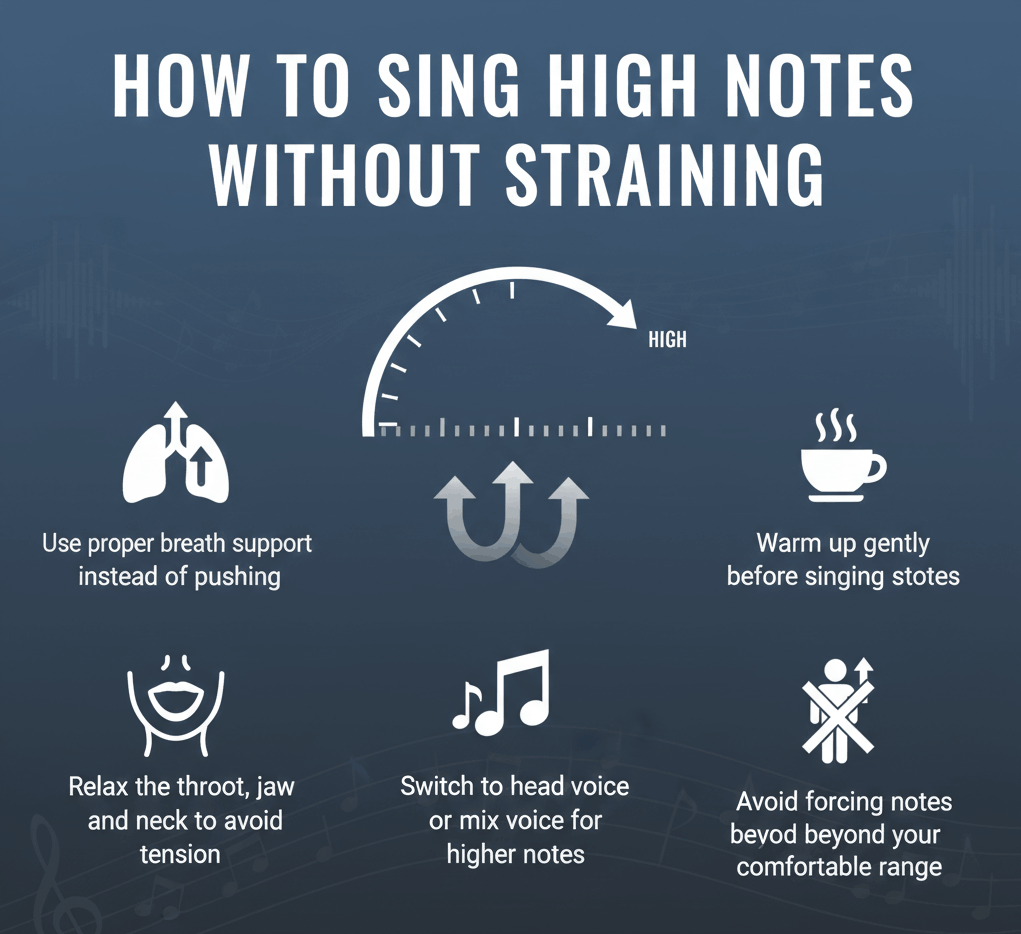
To sing high notes without straining, reduce unnecessary volume, keep your jaw and neck free, manage the breath steadily, and allow your vocal coordination to become lighter as the pitch rises. Approach difficult notes through gentle slides or semi-occluded exercises before singing them with full lyrics.
Do not force a high note by shouting, lifting your chin, or pushing a heavy chest-dominant sound beyond where it remains comfortable. If a note causes pain, burning, sudden hoarseness, or increasing tightness, stop rather than treating the discomfort as something to overcome.
Before comparing your range with different voice types, try an online vocal range calculator to determine your actual range.
What Vocal Strain Feels and Sounds Like
Singing a challenging note can require concentration, but challenge and strain are not the same.
A developing high note may initially feel unfamiliar or less stable. You may need to reduce the volume, modify the vowel slightly, or repeat the coordination slowly. None of these sensations should involve pain.
Possible signs of excessive strain include:
- A squeezed or pressed sound
- Tightness in the throat or under the jaw
- A raised chin or rigid neck
- Increasing volume without better pitch accuracy
- Burning, scratching, or pain
- Hoarseness after practising
- Loss of notes that were available before the session
- Difficulty speaking normally after singing
- A note that becomes harder with each attempt
Voice cracks are not automatically evidence of injury. They can happen during register transitions, when airflow changes, or when a singer attempts an unfamiliar coordination. However, repeated cracking accompanied by discomfort or declining vocal control is a reason to stop and reassess.
Why High Notes Become Difficult
As pitch rises, the vocal folds and surrounding muscles adjust the length, tension, and pattern of vibration. The vocal tract also changes shape as the tongue, lips, jaw, and other structures form different vowels and tone qualities.
Several factors can interfere with this process:
- Carrying too much vocal weight upward
- Using more volume than the note requires
- Blasting or holding back the breath
- Locking the jaw, tongue, neck, or shoulders
- Attempting a note outside the singer’s current usable range
- Singing a vowel that becomes inefficient at that pitch
- Anticipating the note and tensing before it arrives
- Practising while hoarse, tired, or ill
High notes are not produced by one universal register or sensation. Depending on the singer and musical style, a high note may use head-dominant coordination, falsetto, mixed coordination, or a belt-like quality.
Learning the practical differences between chest voice and head voice can help you understand why the voice often needs to adjust as it moves upward.
How to Sing High Notes Without Straining
1. Check Whether the Song Is in the Right Key
Technique cannot make every song suitable for every voice in its original key.
If the highest phrase repeatedly causes squeezing, shouting, or complete loss of tone, transpose the song down. Begin in a key where you can coordinate the phrase without pain, then decide whether moving it upward is appropriate.
Lowering the key is not failure. Professional singers regularly change keys to match their voices, current condition, arrangement, and performance demands.
2. Release Unnecessary Body Tension
Balanced alignment gives the ribs, jaw, tongue, and neck room to respond without becoming rigid.
Before singing:
- Let your shoulders rest naturally.
- Keep your head balanced instead of reaching upward with your chin.
- Release your jaw without forcing it excessively open.
- Allow your knees to remain unlocked.
- Check that your tongue is not pulling backward.
Good singing alignment should feel stable but movable. The guide to the best posture for singing explains how to stand or sit without creating stiffness.
3. Warm Up Before Approaching the Upper Range
Do not begin a session by repeatedly testing your highest possible note.
Start in the comfortable middle of your voice. Gradually add small slides, lip trills, humming, and easy scales before moving higher. A structured set of vocal warm-up exercises can help you prepare without turning the warm-up into an exhausting range test.
A warm-up may improve immediate coordination and readiness, but it does not guarantee protection from strain. You must still monitor volume, comfort, and fatigue.
4. Find a Lighter Version of the Note
If a note feels impossible with lyrics, first remove the full volume and complex articulation.
Try the target pitch using:
- A lip trill
- Straw phonation
- A gentle “woo”
- An “ng” sound
- A light hum that opens to a vowel
Begin below the difficult note and glide upward. Do not attack it repeatedly from silence at maximum intensity.
Once the note becomes repeatable with a lighter sound, gradually introduce the intended vowel and tone. This progression is more useful than trying to force the finished performance sound immediately.
5. Manage the Breath Instead of Pushing It
High notes do not always require universally more or less air. The appropriate airflow and pressure depend on the pitch, vowel, register, volume, and style.
The practical goal is a steady, coordinated exhale.
Avoid:
- Taking an unnecessarily large breath
- Holding the breath before the note
- Blasting air through the phrase
- Contracting the abdomen as hard as possible
- Allowing all the air to escape at the beginning
Try inhaling quietly, beginning the note cleanly, and releasing only the air the sound needs. If increasing the breath makes the note louder but not easier, more airflow is probably not solving the coordination problem.
6. Let the Vowel Adjust Gradually
A vowel that works comfortably in the middle of your range may need a subtle adjustment at a higher pitch. This does not mean replacing every vowel with a fixed alternative.
Instead:
- Speak the word naturally.
- Sustain its main vowel on a comfortable pitch.
- Slide the vowel toward the target note.
- Notice when the jaw, tongue, or lips become rigid.
- Make the smallest adjustment that restores ease.
- Return to the complete word without losing the coordination.
Avoid spreading the lips into an extreme smile or forcing the mouth as wide as possible. The best adjustment depends on the singer, pitch, volume, and intended style.
7. Add Volume Only After the Note Is Stable
A lightly coordinated high note is not automatically the finished artistic sound. However, stability should come before power.
Use this progression:
- Produce the note lightly.
- Repeat it at the same pitch.
- Connect it to the notes before and after it.
- Add the original vowel and consonants.
- Increase the volume gradually.
- Restore the intended emotional delivery.
If the note becomes squeezed as it gets louder, return to the last level that remained controlled. Do not assume that louder practice will eventually remove the tension.
Exercises for Easier High Notes
These exercises should remain inside a comfortable, controllable range. Transpose them for your voice instead of using a universal starting note.
| Exercise | Pattern | Main purpose |
|---|---|---|
| Lip-trill siren | Low–high–low glide | Explore register transitions with reduced articulation |
| Straw or “woo” slide | Short upward and downward glide | Coordinate airflow and pitch |
| “NG” five-note scale | 1–2–3–4–5–4–3–2–1 | Develop resonance and pitch control |
| Light arpeggio | 1–3–5–8–5–3–1 | Approach wider upper intervals |
| Descending vowel scale | 5–4–3–2–1 | Stabilize a high starting note |
| Song-phrase substitution | Original melody on a trill or vowel | Transfer coordination into music |
Lip-Trill Sirens
Relax your lips and create a gentle “brrr.” Add a comfortable pitch, then slide upward and return.
Keep the sound even rather than trying to reach the top of your range. If the trill collapses, reset with less pressure and check for tension around the lips or jaw.
“Woo” or Straw Slides
Sing a gentle “woo” or phonate through a straw while moving through a short pitch range. Start with small slides before attempting a full siren.
The sound should remain easy and continuous. Do not force air through the straw or use it to test extreme notes.
Five-Note “NG” Scales
Sing 1–2–3–4–5–4–3–2–1 on the final sound of “sing.”
Begin at a comfortable pitch and move the pattern upward by semitones. Open from “ng” to a vowel only when the pattern remains stable.
Light Octave Arpeggios
Use 1–3–5–8–5–3–1 on a lip trill or “woo.” Approach the octave lightly and descend without dropping the tone suddenly.
If the octave is too wide, practise 1–3–5–3–1 first. Wider intervals are useful only when they remain accurate and comfortable.
For more general drills covering pitch, agility, breath coordination, and diction, use these structured vocal exercises for singers.
Head Voice, Mixed Voice and Belting
These terms describe different coordinations or sound qualities, but their definitions can vary across teaching methods.
| Coordination | General characteristic | Common challenge |
|---|---|---|
| Head-dominant voice | Lighter and flexible at higher pitches | May initially sound weak or disconnected |
| Falsetto | Often lighter or breathier, depending on coordination | Can be difficult to connect or strengthen |
| Mixed coordination | Blends qualities associated with lower and upper registers | Can become pressed when chased as one exact sensation |
| Belt-like quality | Brighter, speech-like and often louder | Requires careful control of pitch, vowel and intensity |
A powerful high note does not require dragging an unchanged chest-dominant sound upward. It also does not require making every note breathy or weak.
Belting is a more demanding coordination than a gentle head-voice exercise. If belt-like high notes repeatedly cause pain, hoarseness, or loss of control, personalised guidance from a qualified singing teacher is safer than experimenting with more force.
High-Note Troubleshooting Guide
| Problem | Possible contributor | First adjustment to try |
|---|---|---|
| Note sounds squeezed | Excessive volume or vocal weight | Reduce the volume and approach through a glide |
| Note is consistently flat | Target is too demanding or approached too heavily | Lower the key and use a lighter vowel |
| Voice cracks at one point | Register transition is unstable | Use a lip trill or “ng” slide through the area |
| Note becomes breathy | Airflow and vocal-fold closure are not balanced | Reduce excess air and use a clear, gentle onset |
| Jaw or tongue locks | Articulation is being used to reach the pitch | Slow the phrase and simplify the vowel |
| Exercise works but lyrics fail | Consonants, vowels or dynamics disrupt coordination | Practise the melody on one vowel before restoring words |
| Note works once but disappears | The pitch is not yet stable or the voice is fatiguing | Rest and train repeatability below maximum effort |
| High notes suddenly feel unavailable | Fatigue, illness, heavy voice use or another voice problem | Stop testing the range and allow recovery |
A pitch detector can confirm whether you are reaching the intended note. It cannot determine whether the sound is healthy, comfortable, stylistically appropriate, or ready for performance.
How to Practise a High Note in a Song
Choose one difficult phrase rather than repeatedly singing the entire song.
- Lower the song key until the phrase feels manageable.
- Speak the lyrics naturally.
- Sing the melody on a lip trill.
- Repeat it on “woo” or another easy vowel.
- Add the original lyrics at a moderate volume.
- Increase the key by one semitone if the phrase remains repeatable.
- Restore the original dynamics only after the coordination is stable.
If the phrase remains uncomfortable in the original key, perform it in the lower key. A suitable key allows you to communicate the song consistently rather than merely survive its highest note.
When Is a High Note Part of Your Usable Range?
Reaching a pitch once does not automatically make it part of your usable singing range.
A note normally progresses through several stages:
- Touched: You can produce the pitch briefly.
- Repeated: You can find it more than once.
- Controlled: You can sustain it with reasonable pitch and tone control.
- Connected: You can enter and leave the note inside a phrase.
- Usable: You can sing it with lyrics, dynamics, and reliable coordination.
- Stable: You can reproduce it across multiple rested sessions.
Long-term upper-range development should focus on making notes more controllable and connected, not simply touching increasingly extreme pitches. Follow a gradual plan if your broader goal is to increase your vocal range safely.
Signs You Are Singing High Notes More Efficiently
You are probably moving in the right direction when:
- The note becomes repeatable
- Pitch accuracy improves
- Your chin and neck remain neutral
- The jaw and tongue stay responsive
- You can sing the note without an abrupt volume increase
- The surrounding phrase becomes easier
- Your speaking voice feels normal afterward
- You can reproduce the result after appropriate rest
A sensation of vibration in the face or head may occur, but it is not a required measure of correct technique. Singers experience internal sensations differently.
When to Stop and Get Professional Help
Stop practising high notes if you experience pain, burning, increasing tightness, sudden hoarseness, voice loss, or a continuing decline in control.
Do not sing through hoarseness or repeatedly test notes that have suddenly disappeared. Loss of previously available high notes can be associated with fatigue or temporary illness, but it can also be a sign that the voice needs evaluation.
Consult an appropriate healthcare professional if:
- Hoarseness persists
- Speaking or singing becomes painful
- Your voice changes suddenly without an obvious explanation
- You repeatedly lose your voice
- You experience difficulty breathing or swallowing
- Your normal speaking voice remains affected after rest
An ear, nose, and throat doctor can evaluate possible medical causes. A voice-specialized speech-language pathologist or qualified singing teacher can provide individual help with vocal function or technique.
Frequently Asked Questions
Why does my throat tighten when I sing high notes?
You may be increasing volume, breath pressure, or vocal weight as the pitch rises. Anticipating the note can also create jaw, tongue, and neck tension before you sing it.
Should I use more breath for high notes?
Not necessarily. High notes require appropriately managed airflow and pressure, not the largest possible breath. Too much escaping air can make a note harder to stabilize.
Do I need head voice to sing high notes?
Head-dominant coordination is useful for many high notes, but it is not the only option. The appropriate coordination depends on your voice, pitch, volume, vowel, and musical style.
Why does my voice crack on high notes?
Cracking can occur during register transitions, when airflow changes, or when a singer carries too much vocal weight upward. Reduce the volume and practise sliding through the transition instead of forcing it.
Can everyone learn to sing higher?
Many singers can improve access and control near the upper edge of their current range. Anatomical differences and individual vocal conditions mean that everyone will not reach the same pitches.
Can I practise high notes every day?
Gentle upper-range coordination may be appropriate on days when your voice feels rested. Avoid daily maximum-range testing and skip demanding vocal work when you are hoarse, sick, or unusually fatigued.
How long does it take to sing high notes without straining?
There is no universal timeline. Progress depends on your starting coordination, practice quality, recovery, song difficulty, and whether a health issue is affecting the voice.
Can warm-ups prevent vocal strain?
Warm-ups can help prepare your voice and improve immediate coordination, but they cannot guarantee that strain will not occur. Technique, workload, recovery, health, and song choice also matter.
Is belting high notes dangerous?
Belting is not automatically harmful, but it is demanding and can become uncomfortable when volume, pitch, vowel, and vocal load are poorly coordinated. Stop if belting produces pain or persistent hoarseness.
Should high notes feel completely effortless?
High notes may require focus and refined coordination, especially in demanding styles. They should not require painful squeezing, shouting, or increasing force on every attempt.