
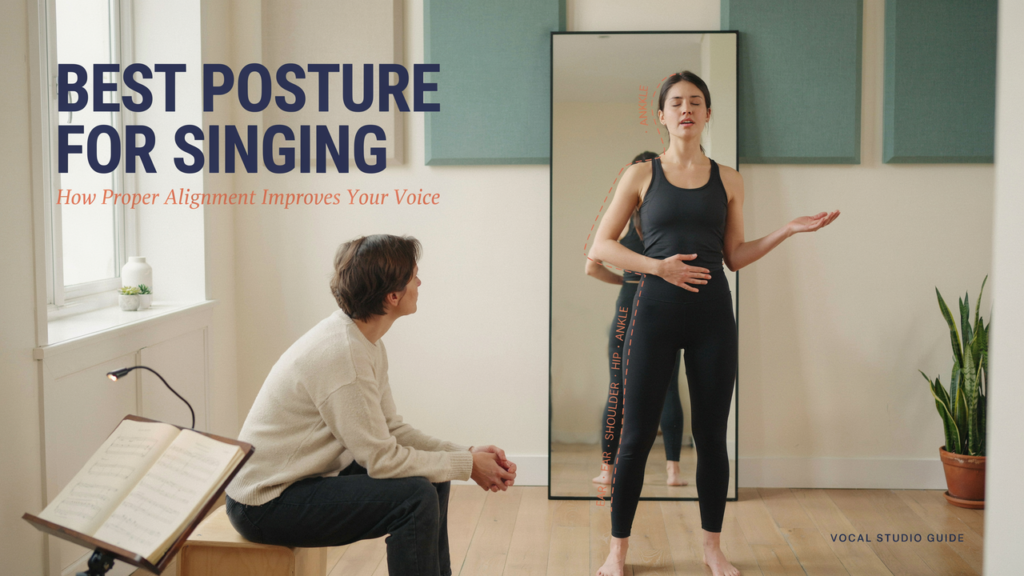
The best posture for singing is balanced, comfortable, and flexible. Your feet should feel supported, your knees should remain unlocked, your torso should have room to expand, and your head should balance naturally over your spine. You should feel ready to move—not frozen in a rigid “perfect” position.
Good alignment does not automatically give you a wider range or more powerful voice. Instead, it reduces unnecessary tension and gives your breathing, vocal folds, and vocal tract better conditions for working together. If you want to prepare your whole body before practicing, begin with gentle vocal warm-up exercises rather than forcing yourself into a stiff posture.
What Is the Best Posture for Singing?
A useful singing posture is often described as “tall but relaxed.” This does not mean pulling your shoulders back, pushing your chest forward, or standing like a soldier. It means allowing your body to organize itself around a stable base while keeping the joints free.
When your alignment is functional:
- Your ribs and abdomen can move during breathing.
- Your neck and jaw remain relatively free.
- You can shift your weight without losing balance.
- Your body supports expressive movement.
- You do not have to hold yourself upright with excessive muscular effort.
Posture is individual. Differences in height, body shape, mobility, footwear, injury history, and performance style mean that no single pose will look identical on every singer.
Proper Standing Posture for Singing
Build your standing position from the ground up instead of focusing only on your shoulders or chin.
Feet and Knees
Place your feet about hip-width apart or wherever you feel stable. Your weight should be distributed comfortably across both feet rather than pushed entirely into your heels or toes. One foot can sit slightly in front of the other if that feels more natural.
Keep your knees available for movement. They do not need to remain visibly bent, but avoid forcefully locking them. A stable yet responsive lower body helps prevent unnecessary effort from spreading into the hips, torso, and neck.
Pelvis and Torso
Allow your pelvis to rest in a comfortable middle position. Avoid deliberately tucking it under or exaggerating the curve in your lower back. Your spine should feel lengthened without being forced straight.
Keep your chest comfortably buoyant rather than lifted as high as possible. Singing requires coordinated movement of the ribs, abdomen, diaphragm, and other respiratory muscles. Balanced alignment can make that movement easier, but posture alone does not create breath support. Regular singing exercises are still needed to develop control over airflow, pitch, and phrasing.
Shoulders and Arms
Let your shoulders rest naturally over your rib cage. Do not pin them down or pull them back. Both actions can create as much tension as constantly raising them.
Allow your arms and hands to move freely. If you are holding a microphone, avoid lifting one shoulder toward your ear or tightening the elbow against your body.
Head, Neck, and Jaw
Your head should feel balanced over your spine, with the back of your neck free rather than compressed. Avoid pushing your chin forward or lifting it dramatically when approaching a high note.
Your jaw should be available to open without being forced downward. The tongue should also remain responsive instead of pulling backward. These details matter because the position of the vocal tract helps shape the sound produced by the vibrating vocal folds. Understanding how vocal cords produce pitch can help you separate pitch production from unnecessary head and neck movements.
Best Sitting Posture for Singing
You can sing effectively while sitting if your position allows you to breathe and move comfortably.
Choose a stable chair and place both feet on the floor. Sit on your sitting bones rather than collapsing backward onto your tailbone. Position yourself near the front or middle of the seat so the chair does not force you into a slouch.
Let your torso lengthen naturally above the pelvis. Avoid leaning heavily against the backrest unless you need physical support. If your feet do not reach the floor, use a footrest instead of letting your legs hang.
Standing is not automatically better than sitting. The better option is the one that lets you stay balanced, breathe comfortably, and sing without pain or excessive effort.
How Posture Affects Breathing and Voice
When the torso is severely collapsed or rigidly held, movement around the ribs and abdomen may become less comfortable. Head and neck positions can also influence the shape of the vocal tract and the amount of muscular effort a singer uses.
However, good posture does not make breathing coordination automatic. Breath management is a learned skill involving inhalation, controlled airflow, vocal-fold resistance, and the musical demands of each phrase.
Posture can also influence how accessible difficult notes feel, but it is only one part of the equation. If upper notes remain difficult after adjusting your alignment, use a structured approach to singing high notes without straining instead of assuming posture is the only problem.
Common Singing Posture Mistakes
Watch for these common habits:
- Locking the knees or gripping the thighs
- Forcing the chest upward
- Pulling the shoulders backward
- Tucking or arching the pelvis excessively
- Pushing the head forward
- Lifting the chin for high notes
- Collapsing while reading lyrics or sheet music
- Holding the body completely still
- Confusing physical tension with breath support
These habits do not always cause an immediate vocal problem, but they can make singing feel less efficient. Body-awareness methods such as the Alexander Technique for musicians may help some performers recognize habitual tension, although they should not be treated as a guaranteed vocal cure.
Try This 60-Second Posture Reset
Before singing, use this quick reset:
- Stand with your feet comfortably apart.
- Shift your weight gently forward, backward, and side to side.
- Settle where you feel centered rather than rigid.
- Release your knees without deliberately squatting.
- Roll your shoulders once, then let them rest naturally.
- Turn your head slowly from side to side without forcing the movement.
- Allow your jaw to loosen.
- Inhale quietly and notice movement around your ribs and abdomen.
- Exhale on a gentle hiss or lip trill.
- Sing an easy phrase while keeping the same sense of balance.
For additional body-awareness practice, try simple Alexander Method exercises without forcing your body into a prescribed shape.
How to Check Your Singing Posture
Use a mirror or record yourself from the front and side. Instead of asking whether you look perfectly straight, ask:
- Can I breathe without raising or pinning my shoulders?
- Does my jaw remain free when the pitch rises?
- Am I pushing my head toward the microphone?
- Can I move without losing vocal control?
- Do I feel pain, compression, or numbness?
- Does the sound become easier after releasing tension?
A wall can provide awareness, but do not force your heels, hips, shoulders, and head to touch it simultaneously. Natural spinal curves and body proportions vary.
A qualified teacher can also identify habits that are difficult to see alone. If you need individualized feedback, learning whether vocal coaching works can help you decide when professional instruction may be useful.
Posture While Using a Microphone or Music Stand
Bring the microphone toward your mouth instead of stretching your neck toward it. Adjust a fixed microphone stand to a height that lets your head remain comfortable.
Place sheet music or lyrics high enough that you do not have to look sharply downward. Your eyes can move more than your entire head. If you play an instrument while singing, arrange the strap, seat, keyboard, or music stand so you are not repeatedly twisting or collapsing to see it.
Good Singing Posture Allows Movement
Singers are performers, not statues. Natural gestures, walking, dancing, and emotional expression can all coexist with efficient vocal production. The goal is not to preserve one visual position throughout a song. It is to remain adaptable enough to return to balance while moving.
Sleep, stress, physical activity, hydration, illness, and daily habits can also affect how your body and voice feel. Posture should therefore be considered alongside the broader ways lifestyle can affect vocal range.
Frequently Asked Questions
Should I stand or sit when practicing singing?
Both can work. Standing may provide more freedom for movement, while supported sitting may be more practical during long rehearsals. Choose the position in which you can breathe and sing comfortably.
Does good posture increase vocal range?
Good posture does not create new notes by itself. It may reduce restrictions that make existing notes more difficult, but range development also depends on coordination, training, voice condition, and technique.
Should my shoulders stay down when I sing?
Your shoulders should rest naturally. Forcing them downward can create tension, just as constantly lifting them can.
Should I lift my chin for high notes?
Usually, no. Dramatically lifting the chin may tighten the neck and make the note more difficult. Keep the head comfortably balanced and address the underlying vocal coordination.
Can poor posture damage my voice?
Posture alone does not necessarily damage the vocal folds. However, persistent tension and inefficient singing habits may contribute to discomfort or fatigue. Ongoing hoarseness, pain, or sudden voice changes should be evaluated by an appropriate medical or voice professional.
How long does it take to improve singing posture?
You may feel an immediate difference after releasing unnecessary tension, but replacing long-established habits normally requires consistent awareness and practice.

Conan is a vocal analysis and singing tools writer specializing in vocal range testing, pitch recognition, voice classification, and music education for singers, musicians, and beginners. He creates practical, easy-to-understand content focused on vocal analysis tools, singing improvement, and voice training resources.