
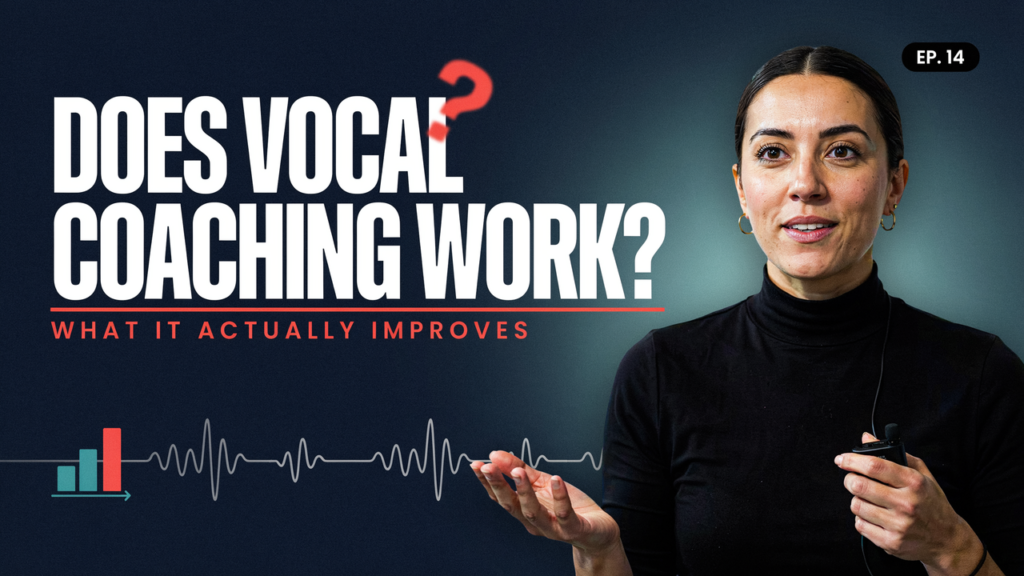
Yes, good vocal coaching can help many people become better singers. It may improve pitch accuracy, vocal control, register coordination, tone consistency, repertoire choices, and performance confidence. However, results depend on the teacher, your goals, your starting point, and how consistently you practice.
Vocal coaching is not an instant transformation. It cannot guarantee a specific range, remove every vocal limitation, give you another singer’s voice, or replace medical care. The most effective instruction provides accurate feedback, suitable exercises, realistic goals, and a clear way to measure progress.
Vocal Coach vs Singing Teacher vs Voice Therapist
These titles are often used interchangeably, but they can describe different roles.
- A singing or voice teacher usually works on vocal technique, including pitch, breathing coordination, resonance, registers, and efficient sound production.
- A vocal coach may concentrate on songs, style, diction, interpretation, auditions, and stage performance.
- A voice therapist is generally a qualified speech-language pathologist who evaluates and treats voice disorders within their professional scope.
Job titles are not always regulated, and some professionals combine technical teaching with performance coaching. Before booking lessons, ask what the instructor teaches, which singers they normally work with, and whether their experience matches your goals.
Understanding how the vocal cords produce pitch can also help you evaluate explanations without expecting a coach to physically “reshape” your voice.
Does Vocal Coaching Actually Work?
Research on singers suggests that structured vocal exercises can improve certain measures of vocal function. A 2025 scoping review reported benefits involving vocal comfort, resonance, phonation time, flexibility, and some acoustic measures, while also noting the need for stronger and more standardized research. Review indexed by PubMed
That evidence supports a qualified answer: well-designed training may improve trainable skills, but not every method, coach, or exercise produces the same result for every singer.
A coach is most useful when they can:
- Identify a specific coordination problem
- Explain it in language you understand
- Select an appropriate exercise
- Help you transfer the exercise into a song
- Monitor whether the adjustment improves singing
- Modify the approach when it is not helping
Lessons alone are not enough. Progress normally requires focused practice between sessions. A short, repeatable routine built from appropriate singing exercises is usually more useful than practicing for long periods without a clear purpose.
What Vocal Coaching Can and Cannot Improve
| Goal | Coaching may help by | What it cannot guarantee |
|---|---|---|
| Pitch accuracy | Developing listening and pitch-matching skills | Instant or perfect accuracy |
| Vocal range | Improving access to usable notes | A fixed number of new notes |
| High notes | Coordinating registers and reducing unnecessary effort | Effortless extreme notes |
| Tone | Exploring resonance, vowels, and stylistic choices | Another singer’s exact sound |
| Endurance | Improving coordination and planning vocal workload | Complete protection from fatigue |
| Performance | Developing phrasing, diction, interpretation, and confidence | Audition or career success |
A teacher may help you use more of the capacity you already possess. If range development is your goal, a realistic plan for increasing vocal range should focus on gradual coordination rather than promises of adding an octave within a fixed period.
Coaching can also help you approach upper notes more systematically. However, learning how to sing high notes without straining does not mean every high note will suit every voice, key, or song.
Who Can Benefit From Vocal Coaching?
Beginners may benefit from early guidance on pitch matching, practice habits, and basic coordination. Feedback can prevent them from spending months repeating an ineffective approach.
Intermediate singers often seek help because they can sing some songs successfully but struggle with register transitions, consistency, or particular vowels and pitches. Experienced performers may use coaching for audition preparation, demanding repertoire, stylistic details, or maintaining consistency during a recording or tour.
Vocal lessons can also help choir singers, hobbyists, actors, content creators, and other professional voice users. You do not need to plan a music career to justify learning how to use your voice more confidently.
The goals should still match the individual. A singer’s tessitura or comfortable working area is often more relevant to sustainable repertoire than one isolated high or low note.
How Long Does Vocal Coaching Take to Work?
There is no reliable universal timeline. One student may quickly correct a simple pitch-matching error, while another may need much longer to coordinate a register transition or replace an established habit.
Progress depends on:
- The specific skill being trained
- The student’s starting point
- Practice quality and frequency
- Lesson frequency
- Teacher–student compatibility
- Repertoire difficulty
- Hearing and musical experience
- Current vocal condition
- How progress is measured
Early lessons may produce a new sensation or easier phrase, but that does not mean the adjustment has become automatic. A technical change is more established when you can repeat it across different vowels, pitches, songs, volumes, and performance conditions.
Be cautious of anyone who guarantees a particular result within a fixed number of lessons.
Online vs In-Person Vocal Coaching
Both formats can be useful, but they have different practical strengths.
| Factor | Online coaching | In-person coaching |
|---|---|---|
| Access | Wider choice of teachers | Limited by location |
| Convenience | No travel required | Requires travel or studio access |
| Audio | Affected by microphone and internet quality | Teacher hears the room directly |
| Accompaniment | Internet delay limits simultaneous playing | Live accompaniment is easier |
| Environment | Student uses their normal practice space | Dedicated teaching room |
| Observation | Camera angle may limit visibility | Easier full-body observation |
The teacher’s skill and suitability may matter more than the format. Good alignment can be discussed in either setting, and a practical guide to singing posture can help you distinguish balanced coordination from rigid instructions.
How to Choose a Good Vocal Coach
Before committing to a long lesson package, consider booking a trial session. A suitable teacher should be able to explain how their approach relates to your goals.
Look for someone who:
- Has relevant teaching or coaching experience
- Understands the style you want to sing
- Sets specific and realistic goals
- Adapts exercises to your responses
- Explains why an exercise is being used
- Connects technical work to actual songs
- Welcomes appropriate questions
- Tracks progress over time
- Respects professional boundaries
- Refers medical concerns to qualified clinicians
Red flags include guaranteed octave expansion, pressure to imitate a celebrity exactly, encouraging you to sing through pain, diagnosing medical conditions, or using one rigid method for every student.
How to Know Whether Lessons Are Working
Do not measure improvement only by your highest note. Track a consistent set of practical outcomes:
- Can you match pitches more accurately?
- Do register transitions feel more coordinated?
- Can you repeat the same phrase reliably?
- Does a previously difficult passage require less effort?
- Can you control volume without losing tone?
- Are exercises transferring into songs?
- Can your teacher explain what has changed?
- Are your goals becoming more specific?
Record the same short song passage every few weeks under similar conditions. Compare pitch, rhythm, tone, effort, and consistency—not simply loudness or range. Online measurements can help, but the guide to vocal range test accuracy explains why automated results should not be treated as a complete assessment.
If lessons remain painful, confusing, directionless, or stagnant despite consistent practice and honest discussion, reassess the goals, teaching approach, or coach–student match.
When Vocal Coaching Is Not Enough
A coach or singing teacher is not a replacement for medical evaluation. Persistent hoarseness, pain while speaking or singing, sudden voice loss, unexplained breathing difficulty, or an abrupt reduction in range may require assessment by an appropriate healthcare professional.
The American Speech-Language-Hearing Association explains that voice disorders can involve changes in vocal quality, pitch, loudness, effort, or function and may require specialized assessment and treatment. ASHA Voice Disorders guidance
Do not assume that every vocal problem is caused by poor technique. Illness, heavy vocal use, medication, hormones, aging, sleep, and other factors may affect the voice. The guide to why vocal range changes covers several reasons your available notes may vary.
Frequently Asked Questions
Are vocal lessons worth it for beginners?
They can be worthwhile when the teacher provides clear feedback, manageable exercises, and realistic goals. A trial lesson can help you evaluate the teaching style before making a larger commitment.
Can anyone learn to sing better?
Many people can improve specific skills such as pitch matching, rhythm, coordination, diction, or interpretation. The degree and speed of improvement vary, and not everyone will reach the same technical or professional level.
Can vocal coaching increase range?
Coaching may help make some existing or developing notes more controlled and usable. It cannot guarantee a specific increase or override individual anatomical and physiological factors.
Can lessons help someone who sings off-key?
They may help when pitch difficulty responds to listening, matching, and coordination exercises. Because pitch problems can have different causes, improvement should not be guaranteed without assessment.
How often should I take lessons?
Lesson frequency depends on your goals, budget, experience, and ability to practice. Consistent, focused work between lessons matters more than booking frequent sessions without applying the feedback.
Can a vocal coach treat hoarseness?
A coach can recommend that you stop pushing and seek appropriate help, but should not diagnose or treat persistent hoarseness unless they also hold the relevant clinical qualifications.
Final Answer
Vocal coaching can work when the instruction matches the singer’s needs, the goals are realistic, and practice is consistent. Its value lies in individualized feedback: identifying what is happening, selecting a suitable adjustment, and helping the singer apply it reliably to real music.
A good coach cannot promise a new anatomy, instant range, perfect vocal health, or career success. They can help you understand your voice, develop trainable skills, and practice with greater purpose.

Conan is a vocal analysis and singing tools writer specializing in vocal range testing, pitch recognition, voice classification, and music education for singers, musicians, and beginners. He creates practical, easy-to-understand content focused on vocal analysis tools, singing improvement, and voice training resources.