
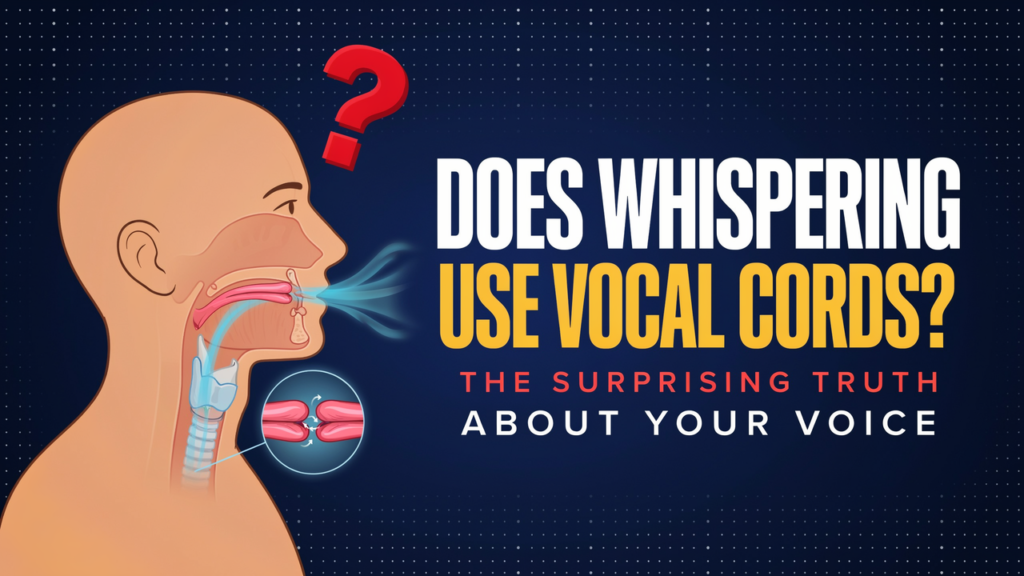
Yes, whispering uses the vocal cords—more accurately called vocal folds—but usually not through the regular vibration used for normal speech or singing. During a typical voiceless whisper, the folds are actively positioned inside the larynx while air moves through a narrow opening and creates turbulent noise.
This means whispering does not bypass the vocal folds, but it is also inaccurate to say that every whisper makes them vibrate normally. Whether whispering is harmful depends on how it is produced, how loud and prolonged it is, and whether the voice is already tired, hoarse, ill, or injured.
What Happens During Normal Speech?
During ordinary voiced speech, air travels from the lungs through the trachea to the larynx. Muscles bring the vocal folds close together, pressure builds beneath them, and airflow sets their flexible tissue into rapid vibration.
That vibration creates a complex sound source. The throat, mouth, nose, tongue, and lips then shape it into vowels, consonants, and recognizable words. A complete explanation of how the vocal cords work shows how breathing, vibration, resonance, and articulation cooperate.
The speed of vocal-fold vibration produces the fundamental frequency associated with pitch. Faster vibration generally creates a higher pitch, while slower vibration creates a lower one. Fold length, tension, and vibrating mass also influence pitch.
What Happens When You Whisper?
In a common voiceless whisper, the vocal folds do not vibrate with the regular periodic pattern heard in normal voiced speech. Instead, they are positioned so that air passing through the larynx creates turbulence.
The tongue, lips, jaw, and other articulators continue shaping that noise into understandable speech. This is why a whisper can communicate words even without a normal voiced pitch.
The exact laryngeal position is not identical in every person. Some people leave an opening near the back of the glottis, while others use greater vocal-fold contact or constriction above the folds. Whispering can therefore feel easy for one person and effortful for another.
The folds are still involved because laryngeal muscles must position them and regulate the airway. “No regular vibration” does not mean “no vocal-fold activity.”
Does Whispering Make the Vocal Cords Vibrate?
The answer depends on the type of whisper or breathy sound being produced.
| Voice mode | Regular vocal-fold vibration | Main sound source |
|---|---|---|
| Normal voiced speech | Usually yes | Periodic airflow interruption |
| Voiceless whisper | Usually no | Turbulent airflow |
| Voiced whisper | May be present | Vibration combined with breathy turbulence |
| Breathy voice | Yes | Vibration with greater air leakage |
A breathy voice is not necessarily a whisper. In breathy phonation, the folds still vibrate, but they may not close completely, allowing more air to escape.
A whisper is not a reliable input for a vocal range calculator: without regular vocal-fold vibration, a pitch detector may show no note or an unstable reading. Test with comfortable sung notes only when your voice feels healthy.
Is Whispering Bad for Your Voice?
Whispering can strain the voice, particularly when it is forced or prolonged. Whether an individual whisper causes harm cannot be judged from its volume alone. If your voice is already hoarse, do not assume that whispering lets you continue talking without adding vocal effort.
Quietness alone does not tell you how much effort a sound takes. Avoid treating whispering as a way to keep talking through hoarseness or discomfort.
The practical conclusion is nuanced:
- Whispering is not automatically harmless because it is quiet.
- It does not provide the same rest as silence.
- Loud or forced whispering may feel tiring.
- Individual whispering patterns differ.
- An existing illness or vocal disorder can change what is appropriate.
If whispering repeatedly leaves your throat tight, dry-feeling, tired, or uncomfortable, reduce the behavior rather than forcing it.
Whispering vs Speaking Softly
Soft speech and whispering are mechanically different.
In soft voiced speech, the vocal folds continue vibrating at a low intensity. In a voiceless whisper, turbulent air replaces regular vibration as the primary sound source.
A comfortable, quiet speaking voice may feel easier than whispering for some people. However, soft speech is not automatically safe if it is breathy, squeezed, unnaturally quiet, or continued for a long time while the voice is ill.
Use the option that requires the least effort, and avoid forcing either one. If a clinician has prescribed a specific form of voice rest, follow those instructions instead of substituting whispering or soft speech on your own.
Does Whispering Count as Vocal Rest?
Whispering is not complete vocal rest: it still deliberately uses the larynx to produce speech, even without regular vocal-fold vibration. Voice rest does not mean stopping normal breathing or swallowing; it means avoiding the voice activities specified by your clinician.
Voice rest can mean different things:
- Absolute voice rest: No speaking, whispering, singing, humming, or other deliberate voice production
- Relative voice rest: Reduced voice use with specific limits on duration, volume, or activity
- Ordinary voice conservation: Avoiding unnecessary talking, shouting, long calls, or communication over noise
Absolute rest is sometimes prescribed after particular procedures or injuries, but it is not automatically required for every tired or hoarse voice. The appropriate approach depends on the cause and should be determined by a qualified healthcare professional when a medical problem is involved.
Should You Whisper With Laryngitis or Hoarseness?
When your voice is hoarse or affected by illness, reduce unnecessary voice use. Avoid shouting, singing, loud whispering, and repeatedly testing whether your high notes have returned.
The National Institute on Deafness and Other Communication Disorders advises resting the voice when sick and avoiding both screaming and whispering. This is conservative general guidance, not a diagnosis or a personalized treatment plan.
When possible, communicate by:
- Texting or writing
- Using gestures
- Keeping necessary conversations brief
- Moving closer instead of increasing volume
- Using amplification in demanding environments
Avoid awkward positions during necessary conversations, such as holding a phone between your ear and shoulder. For singers returning to practice, our guide to comfortable singing posture explains setup without deliberately stiffening the neck or chest.
Seek medical evaluation if hoarseness lasts more than three weeks, keeps returning, or accompanies pain, swallowing problems, coughing blood, a neck lump, or complete voice loss lasting more than a few days. Breathing difficulty needs urgent care. Sudden voice loss after shouting or strenuous singing warrants prompt medical assessment; stop using your voice rather than testing it repeatedly.
Advice for Singers and Professional Voice Users
Whispering a song does not rehearse its sung pitches or register changes. If you need to prepare while resting your voice, review lyrics silently, listen to the arrangement, or mark entrances on the score without vocalizing.
If your voice is healthy but temporarily tired, reduce the total vocal load and allow recovery. Do not repeatedly check the upper range or force demanding sounds.
Resume training when ordinary voice use is comfortable and follow any clinical advice you have received. Save exercises to increase vocal range for a healthy voice; range training is not a treatment for hoarseness.
A qualified voice teacher can help with technique after medical concerns have been addressed. Understanding what vocal coaching can improve also helps distinguish training problems from symptoms requiring clinical evaluation.
When resuming demanding repertoire, avoid squeezing, excessive volume, and forceful airflow. Stop if pain or hoarseness returns.
Frequently Asked Questions
Does whispering vibrate the vocal cords?
Ordinary voiceless whisper usually does not produce the regular periodic vibration found in normal speech. Voiced whispers and breathy sounds may include some vibration.
Can whispering damage your voice?
Whispering can contribute to vocal strain, especially when it is prolonged or forced. Discomfort does not establish a diagnosis, but it is a reason to stop rather than push through. Persistent symptoms should be assessed by a clinician.
Is whispering worse than talking softly?
Not universally. Some people use greater constriction when whispering, while others do not. Comfortable soft speech may be preferable, but individual technique and medical context matter.
Why does whispering make my throat tired?
You may be using excessive airflow, loudness, or throat constriction. Stop if whispering becomes effortful or uncomfortable.
Should singers whisper when their voice is tired?
Singers should usually reduce unnecessary voice use rather than replacing normal speech or rehearsal with prolonged whispering.

Conan is a vocal analysis and singing tools writer specializing in vocal range testing, pitch recognition, voice classification, and music education for singers, musicians, and beginners. He creates practical, easy-to-understand content focused on vocal analysis tools, singing improvement, and voice training resources.