
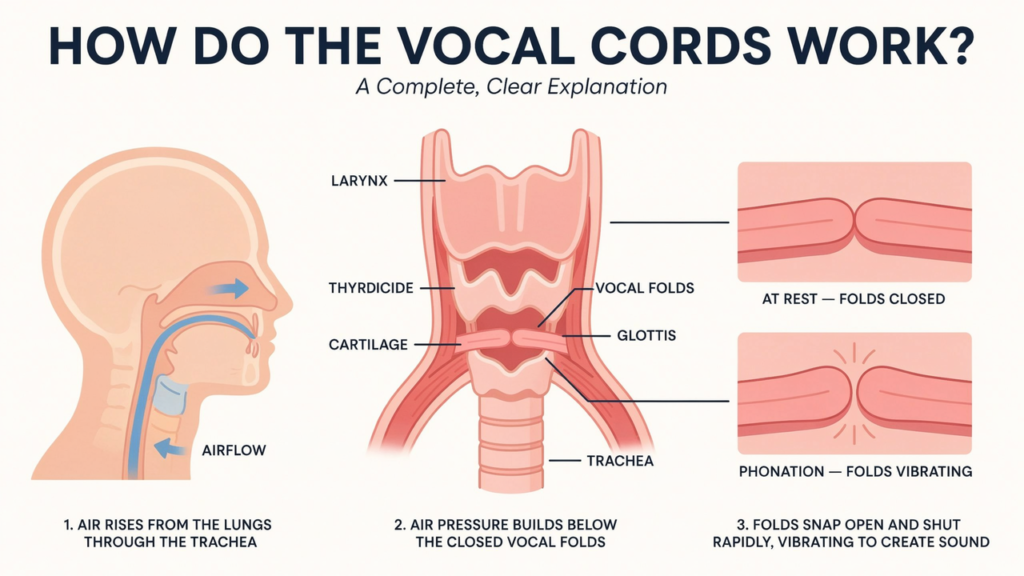
Vocal cords—more accurately called vocal folds—are two flexible bands of tissue inside the larynx, or voice box. They open for breathing, close to help protect the airway, and vibrate when you speak or sing.
Your voice begins when air from the lungs interacts with these folds. The resulting sound is then shaped by the throat, mouth, nose, tongue, and lips. Vocal folds create the sound source, but the rest of the vocal tract turns that source into a recognizable voice.
What Are the Vocal Cords?
The vocal folds sit inside the larynx at the top of the trachea. They stretch horizontally from the front to the back of the voice box. The space between them is called the glottis.
Although “vocal cords” is the familiar term, they are not strings like those on a guitar. Each fold has layered tissue, including a flexible outer covering and deeper muscle. This structure allows the surface to move in a wave-like pattern during phonation—the process of producing voiced sound.
The true vocal folds produce most ordinary voice. A separate pair of tissue folds sits above them and is commonly called the false or ventricular folds. These mainly help protect the airway and are not the primary sound source in normal speech or singing.
How Vocal Cords Produce Sound Step by Step
Voice production requires the respiratory system, larynx, and vocal tract to work together.
- Air leaves the lungs. The breathing muscles regulate the pressure and airflow traveling up the trachea.
- The vocal folds move toward each other. Muscles inside the larynx position them near the center of the airway.
- Pressure builds below the folds. The folds briefly resist the outgoing air.
- Air pushes the folds apart. A small amount of air passes through the glottis.
- The folds return toward each other. Tissue elasticity and aerodynamic forces help bring them back.
- The cycle repeats rapidly. These repeating interruptions of airflow create a complex sound wave.
- The vocal tract shapes the sound. The throat, mouth, and nose modify the source, while the tongue and lips help form recognizable vowels, consonants, and words.
The brain coordinates the muscles that position and adjust the folds, but it does not command each individual vibration. Once the correct conditions exist, airflow and tissue properties allow vibration to continue automatically.
What Vocal Folds Do During Different Activities
Vocal-fold behavior changes according to what you are doing.
| Activity | Typical vocal-fold behavior |
|---|---|
| Quiet breathing | Open to let air pass |
| Voiced speech | Close enough to vibrate |
| Singing | Vibrate while continuously adjusting for pitch, volume, and tone |
| Whispering | Usually positioned to create turbulent airflow without regular voicing |
| Swallowing | Close firmly to help protect the airway |
The vocal folds can vibrate hundreds of times per second, depending on the pitch. Each vibration cycle is extremely fast, even though singing may feel slow and controlled.
How Vocal Cords Control Pitch
Pitch mainly reflects the fundamental frequency of vocal-fold vibration. Faster vibration creates a higher pitch, while slower vibration creates a lower pitch.
Laryngeal muscles adjust the folds’ length, tension, shape, and effective vibrating mass. Higher notes generally involve a longer, thinner configuration. Lower notes generally use a shorter, thicker configuration, although real vocal coordination is more complex than a simple string analogy.
A singer’s pitch range is influenced by anatomy, coordination, register use, and training. The detailed relationship between fold vibration and frequency is explained in how vocal cords produce pitch.
Your vocal range includes the notes you can produce, but extreme notes do not show how comfortable, controlled, or musically useful those notes are.
How Vocal Volume and Tone Are Created
Pitch, loudness, and tone are related but different.
Loudness is influenced by pressure below the vocal folds, airflow, vocal-fold closure, vibration amplitude, and resonance. Simply pushing more air does not guarantee a stronger or safer voice. If the folds and vocal tract are poorly coordinated, extra pressure may create effort without useful volume.
Tone, or timbre, begins with the way the folds vibrate but is strongly shaped by the vocal tract. Changes in the tongue, lips, jaw, throat, and soft palate alter which frequencies are amplified or reduced. This filtering is why two people singing the same pitch at a similar volume can sound completely different.
Anatomical tendencies can influence a person’s sound, but voice types are also associated with comfortable tessitura, timbre, register transitions, and musical context—not vocal-fold length or extreme range alone.
What Happens in Different Vocal Registers?
Vocal registers describe recognizable patterns of sound and coordination. In chest voice, the folds generally maintain a thicker configuration and the sound often feels full or speech-like. In head voice, they typically lengthen and become thinner, supporting higher pitches with less vocal weight.
These are tendencies, not rigid mechanical settings. The same pitch may be produced with different qualities depending on the singer, vowel, volume, and technique. The differences between these coordinations are covered more fully in chest voice versus head voice.
High notes should not be created by squeezing the throat or forcing excessive air. Learning how to sing high notes without straining involves coordinating fold adjustment, airflow, vowels, and resonance.
Do Vocal Cords Vibrate When You Whisper?
Ordinary whispering usually does not use the same regular, periodic vocal-fold vibration heard in voiced speech. Instead, the folds are positioned so turbulent air creates the whisper sound.
However, whispering is not automatically the same as vocal rest. Some people whisper with considerable throat tension, and different types of whispering use the larynx differently. The full explanation of whether whispering uses the vocal cords helps clarify this common misconception.
If your voice is hoarse or painful, do not assume that prolonged whispering is always the safest alternative.
What Can Disrupt Vocal-Fold Vibration?
Clear voice depends on regular, coordinated vibration. Illness, swelling, dryness, irritation, lesions, incomplete closure, neurological conditions, and excessive vocal load can change how the folds move.
Possible signs of a voice problem include:
- Persistent hoarseness or raspiness
- Pain while speaking or singing
- Unexpected loss of high notes
- Increased effort when producing sound
- Frequent voice breaks
- Unusual breathiness
- Repeated throat clearing
- Voice loss that does not improve
These symptoms have many possible causes and cannot be diagnosed from sound alone. Persistent hoarseness, pain, sudden changes, breathing difficulty, or recurring voice loss should be evaluated by an appropriate medical professional, such as an ear, nose, and throat physician.
Supporting Healthy Vocal-Fold Function
Healthy voice use is based on coordination and appropriate workload rather than force.
Helpful practices include:
- Drinking enough fluids for general hydration
- Allowing recovery after demanding voice use
- Avoiding smoking and unnecessary irritants
- Using amplification instead of shouting over noise
- Practicing at a manageable intensity
- Stopping when singing becomes painful
- Treating illness and persistent symptoms appropriately
Use gradual vocal warm-up exercises before demanding singing. A warm-up prepares coordination; it does not permanently enlarge the folds or instantly expand your anatomical limits.
Sleep, illness, stress, hydration habits, and total voice use may affect day-to-day performance. Understanding how lifestyle affects vocal range can help singers distinguish temporary changes from longer-term development.
Common Myths About Vocal Cords
Vocal cords are strings.
They are layered folds of living tissue, not string-like objects that someone plucks.
More air always produces a better sound.
Efficient voice requires balanced airflow, pressure, vocal-fold closure, and resonance. Excessive air can make singing harder.
High notes come from squeezing the throat.
Higher pitches involve coordinated changes in fold length, tension, mass, vowels, and resonance—not brute force.
The vocal cords create the finished voice.
They create the initial sound source. The vocal tract shapes that source into a recognizable tone and speech.
Whispering always rests the voice.
Whispering differs from normal voicing, but it can still involve laryngeal effort and is not universally appropriate for every voice problem.
Frequently Asked Questions
Are vocal cords muscles?
They contain muscle but are not made entirely of muscle. Their layered structure includes an outer surface, connective tissue, ligament-like layers, and deeper muscle.
Do vocal cords touch when you sing?
They usually come together and separate repeatedly during ordinary voiced singing. The exact degree and pattern of contact vary with pitch, volume, register, and vocal quality.
How fast do vocal cords vibrate?
Their vibration rate depends on pitch and can range from fewer than 100 cycles per second on some low notes to hundreds or more on high notes.
What makes vocal cords produce a higher pitch?
Higher pitch generally involves faster vibration produced through coordinated changes in fold length, tension, shape, and effective mass.
Can vocal cords heal themselves?
Minor irritation may improve with time and appropriate voice management, but recovery depends on the cause. Persistent symptoms or suspected injury require professional assessment.

Conan is a vocal analysis and singing tools writer specializing in vocal range testing, pitch recognition, voice classification, and music education for singers, musicians, and beginners. He creates practical, easy-to-understand content focused on vocal analysis tools, singing improvement, and voice training resources.