
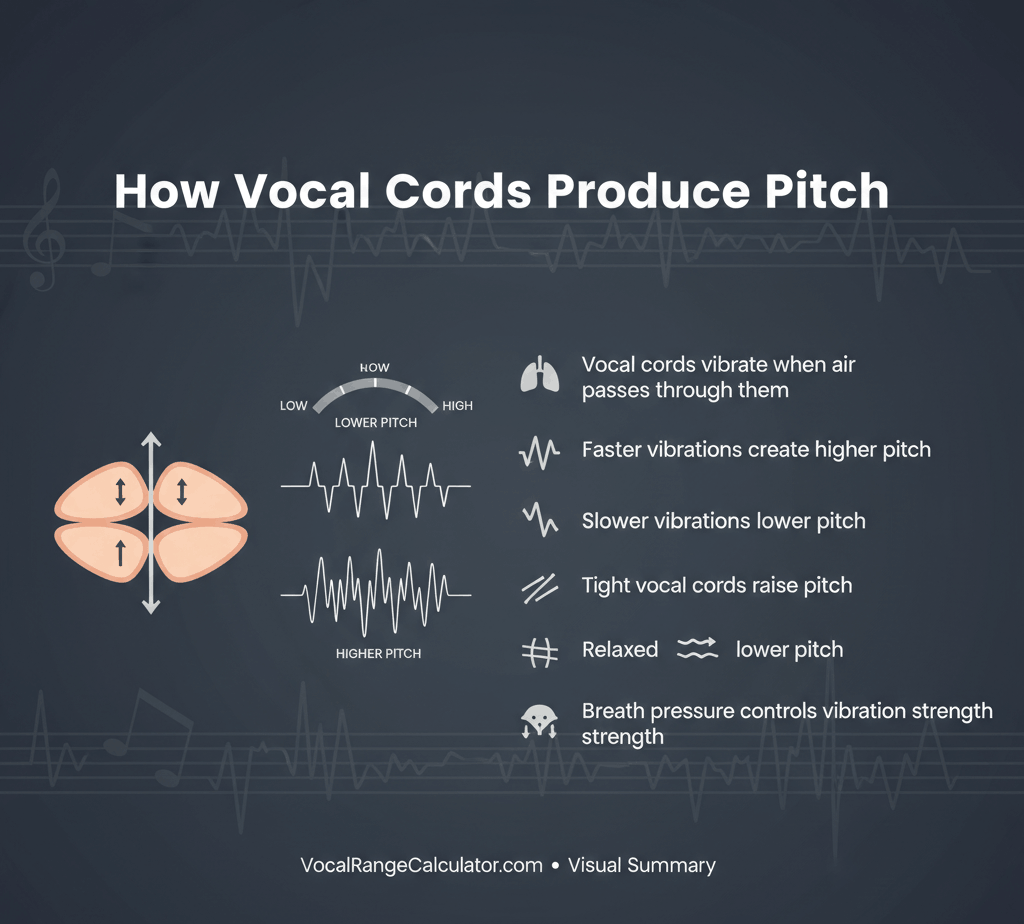
Vocal cords produce pitch by vibrating and repeatedly interrupting airflow from the lungs. The number of vibration cycles completed each second is the sound’s fundamental frequency, measured in Hertz. Faster vibration is generally perceived as a higher pitch, while slower vibration is perceived as a lower pitch.
The brain and muscles of the larynx adjust vocal-fold length, tension, stiffness, thickness and vibrating mass to control this rate. Airflow supplies the energy needed for vibration, but simply pushing out more air does not automatically produce a higher note.
You can find your vocal range by testing your lowest and highest notes with our free online tool.
How Vocal Cords Produce Pitch?
Your vocal cords—more accurately called vocal folds—create a complex sound as air flowing from the lungs causes them to oscillate. Each cycle briefly changes the airflow passing through the glottis, the opening between the folds.
The repetition rate of these cycles is called the fundamental frequency, or F0:
- 100 vibration cycles per second equal 100 Hz.
- A faster F0 is usually heard as a higher pitch.
- A slower F0 is usually heard as a lower pitch.
The vocal tract above the larynx then filters the sound, shaping its vowel and tone quality before it leaves the mouth.
What Are Vocal Cords?
The vocal folds are two bands of layered tissue inside the larynx, or voice box. They extend from the thyroid cartilage at the front of the larynx to the arytenoid cartilages at the back.
The folds perform several functions:
- They open to let air pass during breathing.
- They come closer together for speaking and singing.
- They vibrate to create the acoustic source of the voice.
- They help protect the airway during swallowing and coughing.
The folds are not simple strings. Each has a flexible outer covering over deeper tissue and muscle. Their layered structure permits a wave-like movement across the surface during ordinary phonation.
For a broader explanation of their anatomy, movement and airway functions, see how the vocal cords work.
How Airflow Becomes Vocal Sound
Vocal-fold vibration is often described through the myoelastic-aerodynamic principle: muscle activity positions and adjusts the folds, their elastic tissue responds to deformation, and aerodynamic forces help sustain oscillation.
The process can be summarized in five steps:
- The folds move toward the midline. Muscles in the larynx position them close enough for phonation.
- Pressure develops below the folds. Exhaled air from the lungs creates subglottal pressure.
- The folds are pushed apart. Air begins to move through the glottis.
- The tissue returns toward the midline. Elastic and aerodynamic forces contribute to closing the opening.
- The cycle repeats. Rapid changes in airflow create a complex acoustic signal containing a fundamental frequency and harmonics.
Your laryngeal muscles do not consciously open and close the folds once for every cycle. At singing pitches, the cycles occur far too quickly. Instead, the muscles establish the conditions under which airflow and tissue properties produce self-sustained oscillation.
How Vibration Frequency Determines Pitch
Fundamental frequency is the main acoustic measurement associated with perceived vocal pitch. If the folds complete 220 similar cycles in one second, the F0 is approximately 220 Hz.
Musical notes correspond to particular frequencies under a chosen tuning system. In standard equal temperament with A4 tuned to 440 Hz:
| Note | Fundamental Frequency | Relationship |
|---|---|---|
| A3 | 220 Hz | One octave below A4 |
| A4 | 440 Hz | Standard tuning reference |
| A5 | 880 Hz | One octave above A4 |
Each upward octave doubles the frequency, while each downward octave halves it. A frequency-to-note converter can translate a measured frequency into the nearest musical note.
Human pitch perception is more complex than reading one number, especially with irregular or breathy sounds. For a stable sung vowel, however, F0 usually provides a useful estimate of the note being produced.
What Changes When Vocal Pitch Goes Higher or Lower?
The folds must change their mechanical properties to alter their vibration rate. Length, tension, stiffness, thickness and the amount of tissue participating in vibration all matter.
| Feature | Higher-Pitch Adjustment | Lower-Pitch Adjustment |
|---|---|---|
| Vibration rate | Faster | Slower |
| Length | Often increases | Often decreases |
| Longitudinal tension | Generally increases | Generally decreases |
| Edge configuration | Usually becomes thinner | Usually becomes thicker |
| Vibrating mass | Often decreases | Often increases |
| Fundamental frequency | Higher | Lower |
These are general patterns, not independent switches. A singer can alter several variables at once, and the exact balance changes with register, volume, vowel and intended tone.
The doubling relationship between notes is explored further in the guide to octave ranges and frequency.
The Muscles That Help Control Vocal Pitch
Two intrinsic laryngeal muscle groups are especially important in pitch regulation: the cricothyroid and thyroarytenoid muscles.
Cricothyroid muscles
When the cricothyroid muscles contract, they change the relationship between the thyroid and cricoid cartilages. This generally lengthens the vocal folds and increases their longitudinal tension and stiffness, contributing to a higher fundamental frequency.
Thyroarytenoid muscles
The thyroarytenoid muscles form much of the body of the vocal folds. Their activity can shorten the folds and change their thickness, internal stiffness and vibrating mass. These effects contribute to lower, fuller coordination in many contexts, but their role is more complex than simply “lowering pitch.”
Both muscle groups can remain active at the same time. Skilled pitch control involves a coordinated balance rather than one muscle switching off while another switches on. This is one reason smooth register transitions require more than either “relaxing” or “tightening” the throat.
A peer-reviewed review of human voice production and control discusses how muscle activation, tissue properties, airflow and vocal-tract acoustics interact.
Do Longer Vocal Cords Produce Higher or Lower Pitch?
This question seems contradictory because “longer vocal folds” can describe two different comparisons.
Across different people, vocal folds that are anatomically longer and thicker generally correlate with a lower habitual pitch. Larger folds usually have more mass and tend to vibrate more slowly under comparable conditions.
Within one person, however, cricothyroid activity can lengthen the folds while also increasing their tension and stiffness. That coordinated adjustment can make them vibrate faster, producing a higher pitch.
Therefore:
- Greater resting length and mass across individuals generally favor a lower voice.
- Active lengthening with increased tension and stiffness within one voice can raise pitch.
Length alone does not determine the result. Mass, tension, stiffness, thickness and muscle coordination must be considered together.
Does More Air Make Vocal Pitch Higher?
Airflow is necessary for ordinary speaking and singing, but more airflow does not function like a button that selects a higher note. Pitch control depends mainly on the mechanical and vibratory state of the folds.
Increasing lung pressure often increases sound intensity, especially when other conditions remain similar. Pressure can also interact with vocal-fold vibration and may alter F0 to some degree. The relationship is therefore more nuanced than:
Air controls volume; tension controls pitch.
That statement is a useful beginner shortcut, but it is not a complete physiological model. Pitch, pressure, fold closure, register and resonance can influence one another.
Trying to force a high note with excessive breath pressure may increase loudness or instability without establishing the vocal-fold coordination required for the intended pitch.
Pitch vs Loudness vs Timbre
Pitch, loudness and timbre describe different aspects of a sound.
| Property | Main acoustic basis | What you perceive |
|---|---|---|
| Pitch | Fundamental frequency and harmonic context | How high or low a sound seems |
| Loudness | Sound-pressure level, spectral content and auditory response | How soft or loud it seems |
| Timbre | Harmonics, vocal-fold behavior and vocal-tract filtering | The sound’s tone or character |
Two singers can produce the same fundamental frequency but sound very different because their harmonic patterns and vocal-tract shapes differ. One singer can also sustain approximately the same pitch while changing volume or vowel.
The vocal tract is not merely a passive tube. Its shape can affect acoustic efficiency and interact with vocal-fold vibration, especially in singing. Its most obvious role, however, is shaping the laryngeal source into different vowels and tone qualities.
How Vocal Registers Affect Pitch Production
As singers move through their range, they may change how much vocal-fold tissue participates in vibration, how firmly the folds meet and how the vocal tract is configured. These adjustments contribute to perceived register changes.
Chest voice generally uses a fuller, thicker coordination, while head voice generally uses a lighter configuration suited to higher pitches. The difference between chest voice and head voice involves both laryngeal coordination and resonance—not sound being produced in two different body locations.
A voice crack can occur when the vibratory pattern changes abruptly. This does not mean that the folds have stopped producing pitch; it means their coordination has shifted in a way that creates a noticeable change in frequency or tone.
How Pitch Relates to Musical Notes and Vocal Range
Pitch refers to how high or low one sound is perceived. A musical note assigns that pitch a name within a tuning system. Vocal range describes the span between the lowest and highest pitches a person can produce under defined conditions.
A real-time pitch detector estimates F0 from the microphone signal and maps it to a note. It does not observe the folds directly, and breathy, noisy or unstable sounds can make the estimate less reliable.
Understanding what vocal range means also prevents a common mistake: treating one extreme detected pitch as proof of a comfortable, repeatable singing note.
The mechanism that creates pitch is the same throughout the range, but the required coordination changes. Singers learning to produce high notes without straining should focus on efficient adjustment rather than trying to generate height through force.
Fatigue, inflammation, hormones, age, technique and other factors can alter tissue behavior or coordination, which helps explain why vocal range changes temporarily or over time.
Common Misconceptions About Vocal Pitch
- “Vocal folds work exactly like guitar strings.” Both systems relate frequency to mass, tension and length, but vocal folds are layered biological tissue driven into self-sustained oscillation by airflow.
- “More breath automatically creates a higher note.” Air supplies energy, but the folds must be configured for the intended vibration rate.
- “The mouth creates the pitch.” The vocal tract strongly shapes timbre and vowels, while F0 usually originates at the vocal folds.
- “Longer folds always produce lower pitch.” Resting anatomical length and active lengthening with increased stiffness describe different situations.
- “High pitch requires maximum throat tension.” The laryngeal muscles make precise adjustments; visible neck tension and force are not reliable signs of efficient pitch production.
- “Pitch and frequency are identical.” Frequency is a measurable physical property. Pitch is the auditory perception associated with frequency and acoustic context.
Frequently Asked Questions
How do vocal cords produce pitch?
Airflow causes the positioned vocal folds to oscillate. Their vibration rate creates a fundamental frequency, which the listener perceives as pitch.
What makes vocal pitch higher?
Higher pitch generally involves faster vocal-fold vibration produced through coordinated changes in length, tension, stiffness, thickness and vibrating mass.
What makes vocal pitch lower?
Lower pitch generally involves slower vibration, often with a shorter, thicker configuration and more tissue participating in the vibratory pattern.
How many times per second do vocal folds vibrate?
The rate varies with the pitch. A fundamental frequency of 220 Hz represents approximately 220 cycles per second, while 440 Hz represents approximately 440 cycles per second.
Do vocal cords stretch for high notes?
They commonly lengthen and become more tense and stiff during higher-pitch adjustments. They are not passively stretched and plucked like instrument strings; muscles and airflow continuously coordinate their vibration.
Does more air increase vocal pitch?
Not by itself. Increased pressure may interact with F0 and loudness, but producing a specific higher note requires the appropriate vocal-fold configuration.
Why does an octave double in frequency?
Under standard musical acoustics, two pitches separated by an octave have a 2:1 frequency ratio. A4 at 440 Hz is therefore one octave above A3 at 220 Hz and one octave below A5 at 880 Hz.
What is the difference between pitch and tone?
Pitch describes how high or low a sound seems. Tone or timbre describes its character, which depends on vocal-fold behavior, harmonics and vocal-tract resonance.