
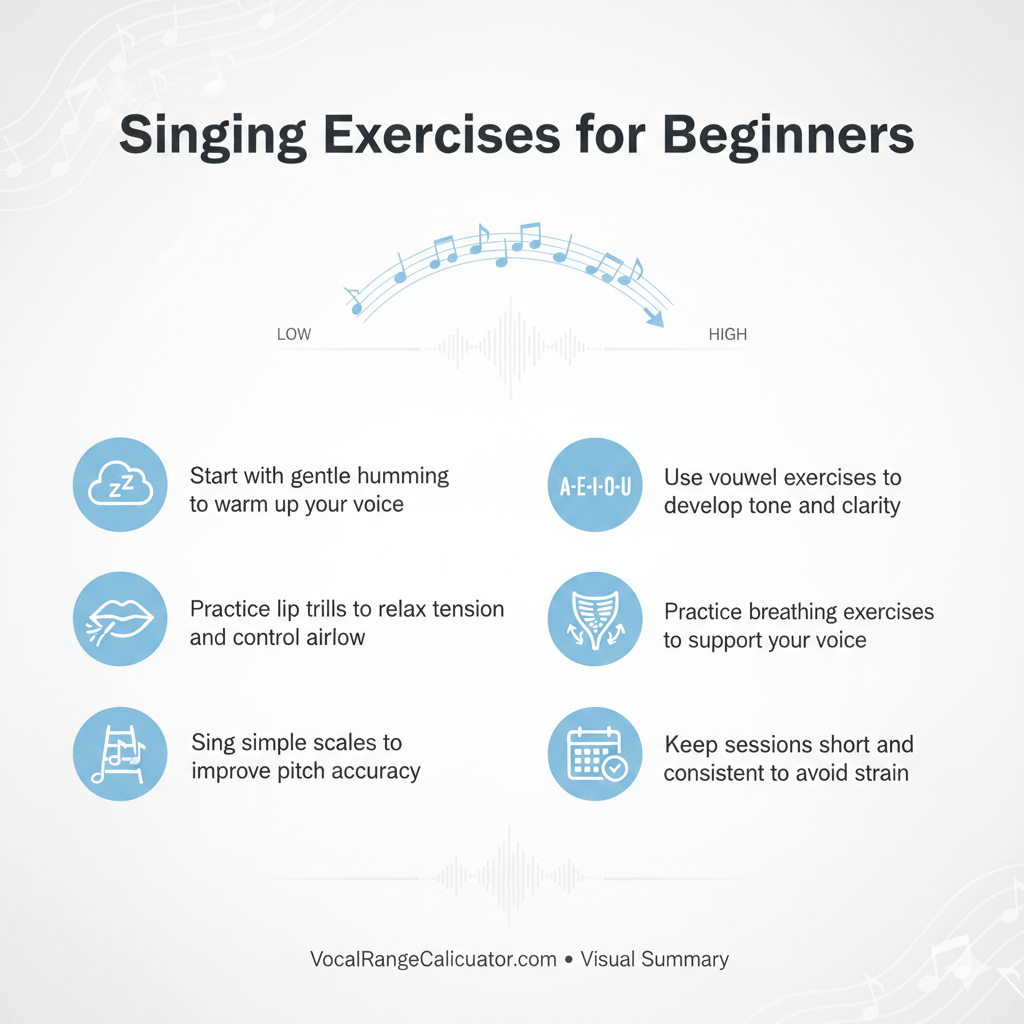
The best vocal exercises for singers include lip trills, humming, straw phonation, sirens, five-note scales, arpeggios, vowel drills, and pitch-matching exercises. Each drill develops a different skill, so an effective routine should combine exercises for breath coordination, pitch accuracy, resonance, agility, registers, and range.
Start in the comfortable middle of your voice, use a light-to-moderate volume, and stop before notes become strained. A controlled 10-minute session is more useful than repeating difficult exercises with poor technique. Not sure where your voice fits? Try our calculator to find your singing range.
Vocal Warm-Ups vs Vocal Exercises
Vocal warm-ups prepare your voice for singing. They usually involve gentle, low-effort sounds that help you coordinate airflow, vibration, and resonance before demanding vocal work.
Vocal exercises train a specific skill, such as:
- Matching pitches accurately
- Moving smoothly between notes
- Coordinating chest and head registers
- Sustaining a consistent tone
- Articulating lyrics clearly
- Developing a more usable range
- Applying technique to songs
Begin each session with a short vocal warm-up routine before moving to exercises that challenge a particular skill.
Choose a Vocal Exercise Based on Your Goal
| Singing goal | Useful exercise | What to monitor |
|---|---|---|
| Breath coordination | Controlled hiss | Steady, unforced airflow |
| Easy sound production | Lip trill or straw phonation | Consistent sound with minimal pressure |
| Resonance | Gentle humming | Clear tone without throat tension |
| Register transitions | Sirens or vocal slides | Smooth movement without pushing |
| Pitch accuracy | Five-note scales | Notes begin and remain in tune |
| Vocal agility | Faster scale patterns | Clean notes without jaw movement |
| Range development | Light scales and arpeggios | Repeatable notes without strain |
| Diction and vowel consistency | Vowel sequence | Clear words with an even tone |
| Interval accuracy | Arpeggios | Accurate movement between wider intervals |
| Song application | Melody on a trill or vowel | Easier coordination when lyrics return |
10 Effective Vocal Exercises for Singers
1. Controlled Hiss for Breath Coordination
This exercise helps you release air steadily instead of using too much breath at the beginning of a phrase.
- Stand or sit comfortably with your ribs free to expand.
- Inhale quietly without lifting your shoulders.
- Exhale on a soft, consistent “sss.”
- Keep the airflow even until the end.
- Repeat three to five times without trying to empty your lungs completely.
Begin with an easy exhale of about 8–12 seconds. Duration matters less than steadiness. Avoid tightening your abdomen, throat, or jaw to make the hiss last longer.
Balanced alignment makes breathing and phonation easier to coordinate. Review the best posture for singing if your shoulders rise, your chin lifts, or your torso collapses during exercises.
2. Lip Trills for Easy Phonation
A lip trill creates a relaxed “brrr” sound as the lips flutter. It is a semi-occluded vocal tract exercise, meaning the vocal tract is partially closed while you make sound.
- Relax your jaw and lips.
- Blow a gentle stream of air until your lips flutter.
- Add a comfortable pitch without increasing pressure.
- Sing a short
1–3–5–3–1pattern. - Move the pattern by one semitone while it remains easy.
You may lightly support your cheeks with your fingers if the trill is difficult. If it stops, the cause may be excessive pressure, insufficient airflow, or tension around the lips—not necessarily one single problem.
The trill should feel easy and consistent. It should not require a powerful sound.
3. Straw Phonation for Vocal Coordination
Straw phonation is another semi-occluded exercise. It can help singers explore sound with relatively low effort.
- Place an ordinary straw between your lips.
- Keep a comfortable seal around it.
- Produce a soft “oo” through the straw.
- Sustain an easy note for a few seconds.
- Add small slides or a simple five-note pattern.
Use a comfortable volume and avoid forcing air through the straw. If you feel pressure building in your throat, pause and reset with a softer sound.
Two or three minutes is enough for most practice sessions. The goal is easier coordination, not vocal fatigue.
4. Gentle Humming for Resonance
Humming can help you explore a clear tone without beginning with an open vowel.
- Rest your lips together without pressing them.
- Hum “mm” on a comfortable note.
- Keep your jaw loose and your tongue relaxed.
- Sing a
1–2–3–2–1pattern. - Open gently from “mm” to a vowel, such as “mee.”
You may notice vibration around the lips or front of the face, but do not chase a specific physical sensation. Different singers experience resonance differently.
The tone should remain comfortable when you open to the vowel. If it becomes pressed or much louder, repeat the transition more gently.
5. Sirens for Register Transitions
Sirens are continuous slides from a lower pitch to a higher pitch and back down. They help singers practise changing pitch without treating every note as a separate muscular event.
- Use “woo,” a lip trill, or an “ng” sound.
- Begin in the comfortable middle-lower area of your voice.
- Slide upward and return slowly.
- Keep the volume light as the pitch rises.
- Gradually lengthen the slide without reaching for extreme notes.
Do not pull a heavy speaking-quality sound upward. Allow the voice to adjust as the pitch changes. Understanding chest voice and head voice can make these transitions easier to interpret.
A crack does not automatically mean something is wrong, but repeated cracking with tightness, pressure, or worsening control is a sign to reduce the range or stop.
6. Five-Note Scales for Pitch Accuracy
The five-note scale is one of the most adaptable singing exercises. Its basic pattern is:
1–2–3–4–5–4–3–2–1
- Choose a comfortable starting note.
- Sing the pattern on “mee,” “noo,” or another easy syllable.
- Keep every note equal in length.
- Move up by one semitone.
- Stop before the top or bottom notes become unreliable.
Use a piano, keyboard, or the site’s online pitch detector to check individual notes when needed. A detector can show pitch, but it cannot determine whether your technique feels healthy, so comfort must remain part of the assessment.
7. Arpeggios for Interval Control
Arpeggios contain wider jumps than stepwise scales. They train your ability to hear and coordinate intervals accurately.
Use this pattern:
1–3–5–8–5–3–1
Start with a lip trill or “woo.” Sing slowly enough to hear each pitch clearly. Keep the top note light instead of making it louder.
If the octave is too difficult, use 1–3–5–3–1 first. Wider intervals should be added only after the shorter pattern is accurate and comfortable.
8. Vowel Sequences for Tone and Diction
Changes in vowels can alter the shape of the vocal tract and make pitch or tone less stable. This drill helps you maintain coordination while the words change.
- Choose a five-note descending pattern:
5–4–3–2–1. - Sing it on “mee-meh-mah-moh-moo.”
- Keep the jaw released and the tongue responsive.
- Maintain a similar volume across the vowels.
- Repeat in several comfortable keys.
Do not force every vowel to sound identical. The goal is a connected, intelligible phrase without sudden squeezing or exaggerated mouth movement.
9. Light Agility Patterns
Agility exercises train quick, accurate movement between pitches. Begin slowly before increasing speed.
Use:
1–2–3–4–5–4–3–2–1
Sing the pattern on a light “gee,” “noo,” or lip trill. Use a metronome or steady beat, and increase the tempo only when the notes remain clean.
Watch for unnecessary jaw or head movement. Your jaw does not need to mark every pitch. If accuracy disappears as the pattern speeds up, return to the previous tempo.
10. Pitch Matching and Interval Echoes
Pitch matching connects vocal technique with listening skills.
- Play one comfortable note.
- Listen before singing.
- Reproduce the note on “oo.”
- Check whether you began above, below, or directly on the target.
- Progress to pairs of notes and short three-note melodies.
Avoid sliding around until you locate the pitch every time. Instead, hear the note mentally, breathe, and begin deliberately.
Record short attempts occasionally. Listen for accurate starts, steady notes, and consistent vowels rather than judging whether your voice sounds professional.
A 12-Minute Daily Vocal Exercise Routine
This routine combines preparation with focused skill development:
- Posture and tension release — 1 minute: Release your shoulders, jaw, and tongue while maintaining balanced alignment.
- Controlled hiss — 1 minute: Complete three easy, steady exhales.
- Lip trills or straw phonation — 2 minutes: Use small slides and comfortable five-note patterns.
- Humming into vowels — 2 minutes: Move from “mm” to “mee” without increasing pressure.
- Sirens — 2 minutes: Glide through a comfortable portion of your registers.
- Scales or arpeggios — 2 minutes: Choose the pattern that matches your current goal.
- Pitch matching — 1 minute: Match isolated notes or short intervals.
- Song application — 1 minute: Practise one difficult phrase using the coordination developed in the session.
This is a starting structure, not a required prescription. A new singer may need a shorter session, while an experienced singer may spend longer on one focused skill. Quality and recovery matter more than completing a fixed number of minutes.
How to Adjust the Exercises for Your Voice
Vocal exercises should be transposed to fit the singer—not forced into one universal key.
Start in the middle of your comfortable range. Move upward or downward by semitones while the sound remains repeatable. End the pattern when you notice:
- A sudden need for more volume
- A lifted chin or tightened jaw
- Loss of pitch control
- Breathiness that keeps increasing
- Pressure, scratching, or discomfort
- A note that appears once but cannot be repeated comfortably
If you do not know where your comfortable boundaries are, first learn how to find your vocal range. Your training pitches should normally remain inside those boundaries until your coordination is stable.
How to Apply Vocal Exercises to Songs
An exercise is valuable only when its coordination can transfer into music.
When a song phrase feels difficult:
- Speak the lyrics naturally.
- Sing the melody on a lip trill or straw.
- Repeat it on one comfortable vowel.
- Add the original lyrics at a lighter volume.
- Restore the song’s intended dynamics gradually.
If the phrase works on a trill but becomes tight with lyrics, the problem may involve vowel shape, consonant timing, volume, or an unsuitable key—not simply insufficient breath support.
For range-specific training beyond this general routine, use a gradual plan for increasing your vocal range safely instead of repeatedly testing extreme notes.
Common Vocal-Exercise Mistakes
Practising Too Loudly
Louder practice is not automatically more effective. Excessive volume can hide pitch problems and add unnecessary effort.
Starting at the Edge of Your Range
Begin where the voice feels reliable. Approach higher and lower notes gradually after easier coordination is established.
Repeating Exercises Without a Goal
Know what you are monitoring: pitch, airflow, agility, vowel consistency, register transition, or phrase control. Mindless repetition can reinforce the same problem.
Treating Every Crack as Failure
Cracks can occur during register transitions, pitch changes, fatigue, or unfamiliar coordination. Reduce the difficulty and identify when the crack occurs instead of forcing through it.
Expanding the Range Too Quickly
A note is not yet part of your usable range merely because you reached it once. A usable note should be repeatable, controllable, connected to nearby notes, and available without pain or excessive effort.
Ignoring Fatigue
End the session when control begins to decline. Continuing after the voice becomes tired rarely improves the exercise.
How to Measure Vocal Progress
Do not measure improvement only by your highest or lowest note. Better indicators include:
- More accurate pitch beginnings
- Steadier sustained notes
- Easier transitions between registers
- Cleaner scale and arpeggio patterns
- Consistent vowels at different pitches
- Longer phrases without rushed breathing
- Less unnecessary jaw, neck, or tongue tension
- Better transfer from exercises into songs
- Repeatable notes across multiple sessions
Test under similar conditions when comparing results. Sleep, illness, fatigue, hydration, room acoustics, microphone position, and preparation can all affect what you hear or measure.
When to Stop Practising
Vocal exercises should involve concentration and coordination, but they should not cause pain.
Stop the session if you experience:
- Sharp pain, burning, or increasing throat discomfort
- Sudden hoarseness or loss of voice
- Marked tightness that does not improve after reducing the exercise
- Unusual breathlessness, dizziness, or difficulty breathing
- A continuing decline in vocal control
- Symptoms that remain after appropriate rest
Do not attempt to diagnose or correct persistent voice symptoms through online exercises alone. A qualified healthcare professional, such as an ear, nose, and throat doctor, can evaluate ongoing hoarseness, pain, sudden voice changes, or voice loss. A voice-specialized speech-language pathologist or qualified singing teacher can provide individualized guidance when technique is the concern.
Frequently Asked Questions
What are the best vocal exercises for singers?
Lip trills, straw phonation, humming, sirens, five-note scales, arpeggios, vowel sequences, agility patterns, and pitch-matching drills are useful options. The best choice depends on the skill you need to develop.
How long should I practise vocal exercises?
A focused session of approximately 10–15 minutes can be enough for many beginners. Experienced singers may practise longer, but duration should depend on the exercise, vocal condition, workload, and quality of coordination.
Can I do vocal exercises every day?
Gentle practice may be suitable on many days when your voice feels rested. Reduce or skip vocal work when you are hoarse, ill, unusually tired, or recovering from demanding voice use.
Should vocal exercises feel tiring?
A challenging coordination may require concentration, but it should not create pain or rapidly increasing throat fatigue. If the voice becomes progressively harder to use, stop and recover.
Can vocal exercises increase my range?
Gradual exercises can help improve access, coordination, and control near the boundaries of your range. Results vary, and no exercise can guarantee a particular number of new notes.
Why does my voice crack during vocal exercises?
Cracking can occur because of register transitions, excessive volume, unstable airflow, fatigue, an unsuitable starting key, or unfamiliar coordination. Reduce the range and volume before repeating the pattern.
Can I practise singing exercises without a piano?
Yes. Humming, lip trills, straw phonation, breathing drills, and sirens do not require a piano. A keyboard or pitch tool becomes useful when you need exact starting notes or want to measure pitch accuracy.
How do I know whether an exercise is working?
The exercise should become more repeatable and require less unnecessary effort. Look for improved pitch accuracy, smoother transitions, steadier tone, clearer vowels, and better application to songs—not just louder or higher notes.