
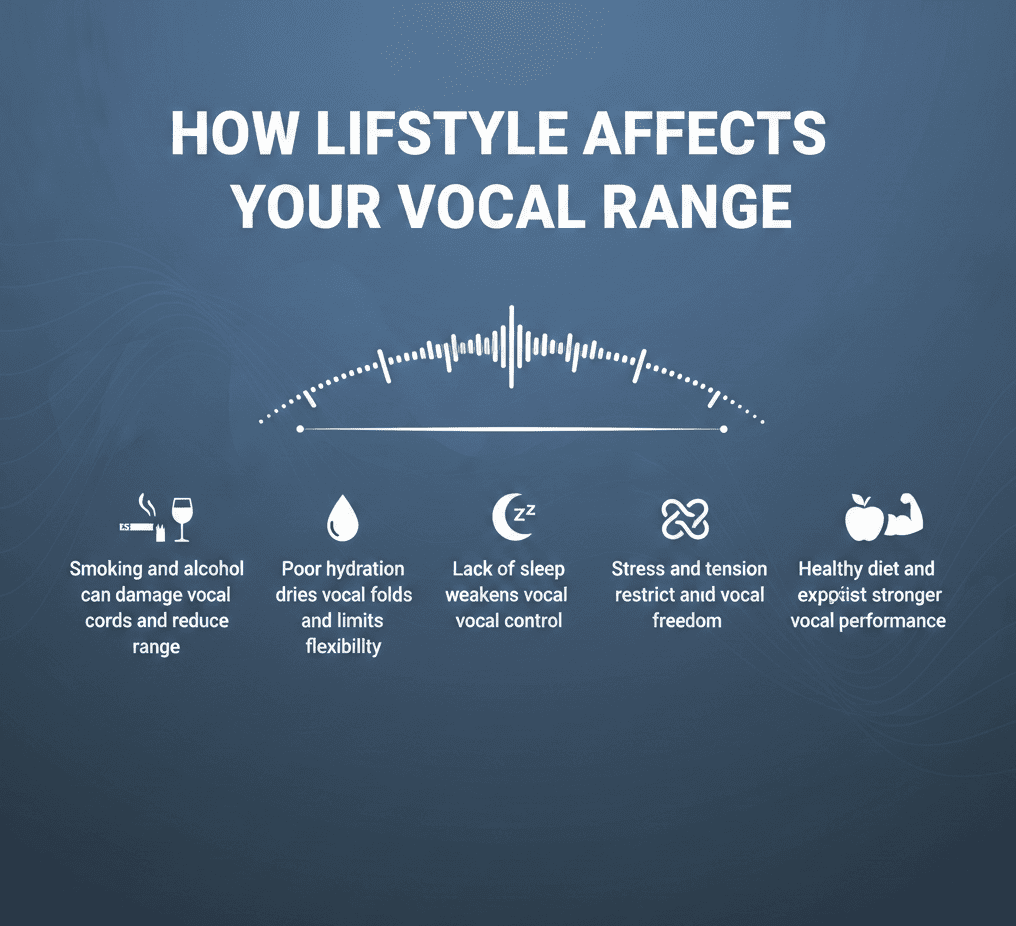
Yes, lifestyle can affect your vocal range—especially the notes you can access comfortably, consistently, and without strain.
Hydration, sleep, stress, illness, vocal overuse, smoking, alcohol, reflux, and environmental irritation can all influence how your voice performs on a particular day. These factors do not usually rewrite your natural vocal anatomy overnight, but they can make part of your usable range temporarily unreliable or difficult to reach.
Long-term irritation or harmful vocal habits can have more serious effects. That is why it is important to distinguish a temporary bad voice day from a persistent change that needs professional attention.
Looking for an easy way to measure your singing ability? Our vocal range tester can help identify your range.
How Lifestyle Influences Vocal Range
Your vocal folds vibrate as air passes through the larynx. To produce different pitches, they adjust their length, tension, thickness, and vibratory pattern. Understanding how vocal folds produce pitch makes it easier to see why fatigue, dryness, irritation, and excess tension can interfere with singing.
Lifestyle can affect several parts of this process:
- How efficiently the vocal folds vibrate
- How well breathing and phonation coordinate
- How much muscular tension surrounds the larynx
- How quickly the voice recovers after heavy use
- How comfortable register transitions feel
- How long you can sing before becoming fatigued
It helps to separate three related ideas:
- Maximum range: The lowest and highest pitches you can produce under suitable conditions.
- Usable range: The notes you can sing with reasonable control and repeatability.
- Comfortable range: The area where you can sustain phrases with consistent tone and limited effort.
Lifestyle usually affects your usable and comfortable range first. Your extreme notes may become less stable even when your underlying vocal potential has not changed.
Lifestyle Factors That Can Help or Limit Your Range
| Lifestyle factor | Possible effect on the voice | Practical response |
|---|---|---|
| Inadequate hydration | Greater dryness, effort or vocal fatigue | Drink fluids consistently throughout the day |
| Poor sleep or physical fatigue | Reduced stamina, coordination and concentration | Prioritize rest and reduce demanding vocal use when exhausted |
| Heavy vocal use | Temporary fatigue, hoarseness or loss of reliable notes | Take voice breaks and avoid singing through discomfort |
| Smoking or vaping | Irritation, coughing and possible long-term tissue changes | Avoid smoke, vapor and second-hand exposure |
| Alcohol | Dry mouth, reflux aggravation and reduced awareness of strain | Limit intake around demanding vocal use |
| Stress | Shallow breathing and excess jaw, neck or throat tension | Use gentle breathing, movement and tension-release strategies |
| Reflux | Throat irritation, coughing, hoarseness or frequent clearing | Identify triggers and seek medical guidance for persistent symptoms |
| Illness or allergies | Inflammation, congestion, dryness or altered resonance | Rest the voice and avoid forcing your usual range |
| Dry or polluted air | Irritation and increased vocal effort | Improve indoor humidity and reduce exposure when possible |
| Poor singing technique | Excess pressure, unstable transitions and fatigue | Work within a comfortable range and develop technique gradually |
These effects differ between individuals. One singer may notice that poor sleep affects high notes, while another mainly experiences reduced stamina or unstable tone.
Hydration and Vocal Range
Good hydration supports the moist tissue environment needed for efficient vocal-fold vibration. When you are inadequately hydrated, singing may feel less responsive, and demanding notes may require more effort.
Drinking water does not directly wash or coat the vocal folds. When you swallow, liquid is directed toward the esophagus rather than through the airway. Hydration works systemically as the body absorbs fluid over time.
Useful habits include:
- Drinking fluids regularly instead of waiting until immediately before singing
- Increasing fluid intake appropriately during exercise or hot weather
- Using a clean humidifier when indoor air is uncomfortably dry
- Balancing alcohol or caffeinated drinks with adequate water
- Reviewing drying medications with a healthcare professional when voice problems occur
The National Institute on Deafness and Other Communication Disorders recommends staying hydrated, getting adequate rest, avoiding smoke, and resting the voice when it is tired or affected by illness in its guidance for taking care of your voice.
Hydration can help remove a temporary obstacle, but it does not guarantee extra notes or permanently expand vocal anatomy.
Sleep, Fatigue and Physical Recovery
A tired body can produce a tired voice. Insufficient sleep may affect breathing coordination, concentration, posture, muscular control, and the ability to judge vocal effort accurately.
After a poor night of sleep, you may notice:
- High notes feel less dependable
- Register transitions become less coordinated
- Pitch control feels slower or less precise
- The voice tires earlier than usual
- You compensate by pushing harder
These effects do not prove that your vocal range has permanently decreased. Range naturally varies with age, health, hormones, training, technique, and other conditions, as explained in this guide to why vocal range changes.
On a fatigued day, reduce the intensity of your practice rather than repeatedly testing extreme notes.
Stress, Muscle Tension and Posture
Stress does not affect every singer in the same way, but it can change breathing and muscular behavior. Some people tighten their jaw, tongue, neck, shoulders, or abdominal muscles when anxious. Others breathe more shallowly or try to control high notes with force.
Excess tension can make register transitions feel abrupt and reduce the reliability of the upper range. Improving your posture for singing may support freer breathing, but posture should feel balanced rather than rigid.
Before singing, try:
- Releasing the jaw without forcing it downward
- Allowing the shoulders to remain relaxed
- Keeping the head balanced over the torso
- Taking quiet, unforced breaths
- Beginning in the middle of your comfortable range
- Reducing volume if a note starts to feel pressed
Stress management can improve consistency, but persistent voice difficulty should not automatically be blamed on anxiety.
Smoking, Vaping and Environmental Irritants
Smoke irritates the vocal folds and respiratory tract. Repeated exposure can contribute to chronic coughing, throat irritation, swelling, hoarseness, and longer-term voice changes. Second-hand smoke is also relevant.
Vaping should not be treated as harmless to the singing voice. Aerosols, heat, flavoring substances, and repeated inhalation may irritate the airway, even though products and individual exposure vary.
Smoking can sometimes make a voice sound rougher or lower. That does not represent a healthy improvement in low range. A deeper, raspy sound caused by irritation or tissue change is different from gaining controlled, usable low notes.
Dust, chemical fumes, allergens, and polluted air can also make the voice feel less stable. Reduce exposure where practical and use appropriate protective measures in occupational environments.
Alcohol, Caffeine and Drying Medications
Alcohol can contribute to dry mouth, worsen reflux for some people, and reduce awareness of how hard the voice is working. Singing loudly after drinking may therefore increase the chance of overlooking strain.
Caffeine is more nuanced. Moderate caffeine intake does not automatically damage the voice or severely dehydrate every singer. Your overall fluid intake, dose, sensitivity, and other health factors matter. If coffee seems to worsen dryness, reflux, or vocal comfort, adjust the amount and observe the result.
Some antihistamines, decongestants, and other medications can cause dryness. Do not stop prescribed medication solely to improve singing. Ask a qualified healthcare professional about alternatives if dryness is persistent and affects your voice.
Diet, Reflux and the Morning Voice
Food does not touch the vocal folds when swallowed, and no specific meal can instantly add notes to your range. Diet is most relevant when it affects hydration, general health, digestion, or reflux.
Gastroesophageal reflux or laryngopharyngeal reflux may irritate the throat and laryngeal area. Possible symptoms include hoarseness, coughing, frequent throat clearing, a lump sensation, or a voice that feels worse after waking. However, morning hoarseness can have several causes, so reflux should not be self-diagnosed from one symptom.
If you suspect reflux:
- Notice whether large or late meals worsen symptoms
- Avoid lying down immediately after eating
- Identify personal triggers instead of banning foods unnecessarily
- Discuss frequent heartburn, throat irritation, or voice changes with a healthcare professional
Common singing-food claims also need perspective:
- Dairy: It may create a thicker mouth or throat sensation for some people, but it does not increase mucus for everyone.
- Cold water: It does not directly contact the vocal folds. Temperature preference is largely about personal comfort.
- Honey and tea: They may soothe the mouth or throat, but they do not directly coat or repair the vocal folds.
- Spicy foods: They are mainly relevant when they trigger reflux or discomfort for the individual.
Choose foods and drinks based on your health, tolerance, and performance comfort rather than universal singer-food rules.
Vocal Overuse and Insufficient Recovery
Long rehearsals, shouting, cheering, speaking over noise, repeated throat clearing, and singing at the extremes of your range can increase vocal load.
Warning signs during or after vocal use include:
- Hoarseness
- Increasing effort
- Loss of easy high notes
- Pain or burning
- Frequent voice breaks
- A weaker or breathier sound
- Needing longer than usual to recover
A gradual sequence of vocal warm-up exercises can prepare coordination for demanding singing, but warming up does not make unlimited vocal use safe. Rest and sensible practice intensity still matter.
If high notes repeatedly require pressure, work on how to sing high notes without straining instead of forcing the same note until it appears.
Pain is not a normal sign of productive range training.
Can Lifestyle Changes Increase Your Vocal Range?
Healthy habits can improve access, endurance, and consistency. A singer who was tired, irritated, dehydrated, or vocally overloaded may recover notes that temporarily became unreliable.
That is different from developing new technical ability.
Lifestyle habits create better conditions for singing, while coordinated practice develops control. If your goal is to increase your vocal range, combine healthy daily habits with gradual technique work rather than expecting hydration, food, supplements, or sleep alone to add octaves.
Avoid promises that a particular routine will add a fixed number of notes. Progress depends on anatomy, training history, vocal health, register coordination, and how “range” is being measured.
How to Check Whether Lifestyle Is Affecting Your Range
A single test cannot reveal a reliable lifestyle pattern. Compare several sessions under controlled conditions.
For more meaningful results:
- Test at approximately the same time of day.
- Use the same microphone and recording environment.
- Complete the same gentle warm-up.
- Keep your distance from the microphone consistent.
- Use comfortable volume rather than shouting extreme notes.
- Record sleep, hydration, illness, stress, reflux symptoms and recent vocal use.
- Stop when notes become painful, heavily pressed or unstable.
- Compare trends across multiple days.
Testing conditions can influence the notes you produce and the pitches a microphone captures. Review the factors that affect vocal range test accuracy before treating a one-day result as your permanent range.
You can then use the Vocal Range Tester under consistent conditions to track whether changes in sleep, hydration, recovery, or vocal load correspond with repeatable differences.
When a Range Change Needs Professional Attention
Do not assume that every lost note is caused by lifestyle. Voice changes can also result from infection, inflammation, vocal-fold lesions, neurological conditions, hormonal changes, medication effects, or other medical issues.
Consider evaluation by an ear, nose and throat doctor or a voice-specialized speech-language pathologist if you experience:
- Persistent hoarseness
- Pain when speaking or singing
- A sudden unexplained loss of range
- Repeated voice loss
- Difficulty breathing or swallowing
- Coughing up blood
- A neck lump
- Symptoms that keep returning
- A voice change that does not improve with appropriate rest
According to NIDCD guidance on hoarseness, a doctor should evaluate hoarseness that lasts longer than three weeks, particularly when it is not associated with a cold or flu.
Frequently Asked Questions
Can dehydration reduce vocal range?
Inadequate hydration may make singing feel less efficient and increase vocal effort or fatigue. It can temporarily affect the notes you can produce comfortably, but drinking water does not automatically expand your anatomical range.
Does poor sleep affect high notes?
Poor sleep can reduce stamina, concentration and coordination, making high notes less reliable for some singers. The effect varies and is usually not evidence of permanent range loss.
Can smoking permanently change a singing voice?
Long-term smoking can contribute to chronic irritation and structural changes that alter pitch, tone and range. A lower or rougher voice caused by smoking should not be viewed as a healthy range improvement.
Does caffeine harm your vocal range?
Moderate caffeine does not necessarily harm every singer’s range. Consider your total fluid intake and whether caffeine personally worsens dryness, anxiety, reflux or vocal comfort.
Why is my vocal range smaller in the morning?
Possible reasons include dryness, insufficient sleep, illness, reflux, stiffness, or testing before the voice is gently prepared. Persistent morning hoarseness deserves medical attention rather than repeated forced singing.
Can lifestyle improve vocal range without training?
Better habits may restore notes that were temporarily difficult to access and improve endurance. Developing additional controlled range usually also requires appropriate technique and gradual practice.