
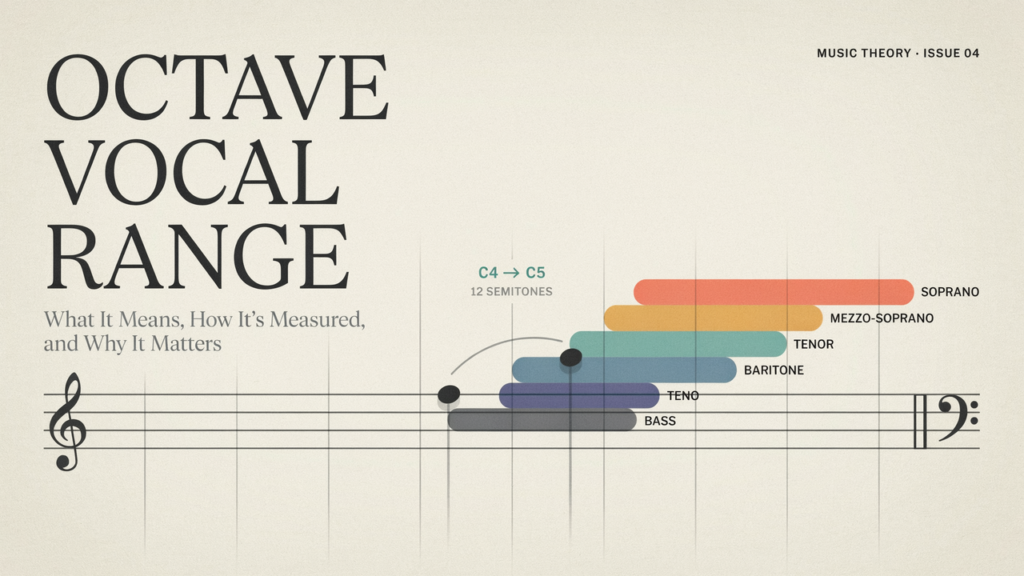
Your octave vocal range is the distance between your lowest and highest notes expressed in octaves. Because one octave contains 12 semitones, a range covering 24 semitones equals two octaves, while 36 semitones equals three octaves.
An octave count describes the width of your voice. It does not reveal where your voice sits, how comfortably you sing, or how much control you have. For a meaningful result, identify whether you are measuring your total demonstrated range, usable range, or comfortable singing range.
What Does Octave Vocal Range Mean?
Your vocal range includes the pitches between the lowest and highest notes you can produce according to a chosen measurement standard.
An octave is an interval between two pitches where the higher pitch has twice the frequency of the lower pitch. Using A4 = 440 Hz tuning:
- A3 is 220 Hz
- A4 is 440 Hz
- A5 is 880 Hz
A3–A4 is one octave, and A3–A5 is two octaves. The letter name repeats at the next octave because the pitches have a closely related musical quality despite having different frequencies.
Western equal-tempered music divides an octave into 12 semitones. This makes semitone counting the simplest way to calculate a vocal range.
How to Calculate Your Vocal Range in Octaves
First, identify your reliable lowest and highest notes. Then count the semitones between them and divide the total by 12:
Octave span = total semitones ÷ 12
| Lowest and highest notes | Semitones | Exact octave range |
|---|---|---|
| C3–C4 | 12 | 1 octave |
| A2–A4 | 24 | 2 octaves |
| C3–G5 | 31 | 2 octaves, 7 semitones |
| E2–E5 | 36 | 3 octaves |
| C2–C6 | 48 | 4 octaves |
Count the steps between notes, including black keys, rather than counting both endpoints as extra steps. For C3–G5, count C3–C5 = 24 semitones, then C5–G5 = 7: the total is 31. C3–B5 is 35 semitones, one short of three octaves. In standard scientific pitch notation, octave numbering changes at C: B3–C4 is just one semitone.
Partial results should not be rounded up. C3–G5 can be reported as two octaves and seven semitones or approximately 2.58 octaves. A decimal is a fraction of an octave, not a count of leftover semitones: 2.5 octaves means two octaves and six semitones, not two octaves and five.
Calculating Octaves From Frequencies
If you know the frequencies of your boundary notes, use this formula:
Octaves = log₂(highest frequency ÷ lowest frequency)
For example:
- 220 Hz ÷ 110 Hz = 2, so the span is one octave.
- 440 Hz ÷ 110 Hz = 4, so the span is two octaves.
- 880 Hz ÷ 110 Hz = 8, so the span is three octaves.
The UNSW acoustics reference on notes and frequencies explains this frequency-ratio calculation. Both inputs must be positive, with the higher frequency divided by the lower. For a calculator without log₂, use log(high ÷ low) ÷ log(2).
How to Measure Your Lowest and Highest Notes
Use a piano, reference tones or our vocal range calculator in a quiet room. Record the note names and octave numbers, not just a final score. This is a practical self-check, not a standardized clinical assessment.
Use this process:
- Warm up gently in the middle of your voice.
- Sing a comfortable note using a steady vowel.
- Descend one semitone at a time.
- Stop when the pitch becomes forced, unclear, or impossible to repeat.
- Return to the middle of your voice.
- Ascend by semitones without pushing.
- If comfortable, hold a candidate boundary note briefly so its pitch can be checked. Two or three seconds is a practical example, not a requirement to push through.
- Check that each boundary note is repeatable without strain; rest between attempts rather than repeatedly pushing at a limit.
- Record which register was used at each extreme.
- Repeat the test on another day.
Do not sacrifice vocal comfort to obtain a larger result. Pain, burning, squeezing, or persistent hoarseness means you should stop.
How to Verify Your Result With Recorded Audio
Record the entire test rather than relying only on what you hear while singing. When reviewing the audio, check whether each boundary note has:
- A recognizable and stable pitch
- A clear vocal sound
- A repeatable onset
- No obvious shouting or squeezing
- Enough duration to evaluate
- The same note shown across repeated attempts
Pitch tools may mistake breath noise, room sounds, accidental squeaks, harmonics, or irregular vocal-fry pulses for the intended fundamental pitch. If a display suddenly jumps exactly one octave while your sung note sounds unchanged, it may have tracked a harmonic or misidentified the fundamental. Check against a reference note and a fresh recording before accepting the result.
Testing on two or three different days helps separate a dependable boundary note from a one-time sound.
Total, Demonstrated, Usable, and Comfortable Range
One octave number can hide important information about the voice. Your result becomes more useful when you specify what was measured.
| Range category | Meaning |
|---|---|
| Produced range | Every identifiable pitch or vocal sound you can make |
| Demonstrated range | Notes you can produce intentionally and repeat |
| Usable range | Notes with reasonable pitch, tone, and control |
| Comfortable range | Notes you can sustain with limited effort |
| Tessitura | The area that remains comfortable across complete phrases |
For example, a singer might report:
- Demonstrated range: A2–E6
- Usable range: C3–C6
- Comfortable tessitura: E3–A5
The demonstrated range is the widest measurement, but the usable range is more relevant to performance. Learning what tessitura means can also help you select songs that remain comfortable instead of sitting near your extremes.
Do Fry, Falsetto, Head Voice, and Whistle Notes Count?
Different vocal registers may count toward your total range when the notes are intentional, identifiable, and repeatable. However, they should be labeled instead of silently combined.
A transparent result might say:
- Modal or chest-dominant range: A2–E4
- Head voice or falsetto extension: F4–C6
- Total demonstrated range: A2–C6
Vocal fry may extend the lower boundary, while falsetto, head voice, or whistle register may extend the upper boundary. These pitches can be legitimate, but they may not have the same volume, tone, or musical function as your modal notes.
A brief creak or accidental squeak should not be counted merely because an app displays a pitch.
What Is a Good Octave Vocal Range?
There is no universal octave number that separates a good singer from a bad one. A controlled one- or two-octave range can be musically valuable, while a larger range may contain weak or unusable extremes.
A practical interpretation is:
| Measured span | What it may indicate |
|---|---|
| 1 octave | A focused range that can still cover many simple melodies |
| 2 octaves | A substantial collection of pitches when controlled |
| 3 octaves | A wide span that may cross several registers |
| 4+ octaves | An extensive demonstrated span needing careful verification |
These descriptions are not skill grades. Our guides to a two-octave singing range and a three-octave singing range discuss practical interpretation. Pitch accuracy, rhythm, phrasing and expression still matter at either width.
Most songs occupy only part of a singer’s maximum range. The important question is not simply how many octaves you can touch, but how effectively you can use the notes required by the music.
Does Octave Range Determine Voice Type?
No. Octave count measures width, while voice type describes where the voice functions most naturally.
Two singers can each have a two-octave range but occupy entirely different pitch areas. C3–C5 and C4–C6 are both two octaves, yet their placement and vocal characteristics differ.
Classical classifications, including the vocal Fach system, consider tessitura, timbre, vocal weight, register transitions and repertoire demands. One extreme note or an octave total cannot classify a voice reliably.
Can Training Increase Your Octave Range?
Training may help you coordinate registers, reduce unnecessary tension, and gain reliable access to notes that were previously unstable. It may also improve the tone and consistency of your existing boundaries.
There is no fixed number of notes or octaves that every singer will gain. Progress depends on anatomy, health, age, experience, and current technique. A useful training plan should prioritize healthy coordination instead of promising a particular octave result.
If you want to increase your vocal range, work gradually with light scales, lip trills, humming, and controlled register transitions. Notes gained through pushing are unlikely to become dependable performance notes.
Range can also vary temporarily with fatigue, illness, tension, hydration, and recovery. Compare results under similar conditions and avoid treating one unusually high or low reading as permanent progress.
Common Octave-Range Mistakes
Avoid these common errors:
- Counting octave labels instead of semitone intervals
- Rounding a partial octave up
- Accepting a one-time sound as a reliable note
- Treating vocal fry and whistle notes as modal notes
- Trusting a single detector reading
- Testing while hoarse or fatigued
- Using octave count to determine voice type
- Comparing total range with another singer’s tessitura
- Forcing extreme notes to improve the result
Use the same testing method each time if you want to track progress accurately.
Frequently Asked Questions
How many notes are in one octave?
A Western equal-tempered octave contains 12 semitone intervals. Counting both boundary notes gives 13 named pitch positions, such as C, C♯, D, and so on through the next C.
Is C3 to C5 two or three octaves?
C3–C5 is two complete octaves. The octave numbers identify pitch locations; they do not directly state the interval count.
Does falsetto count toward octave range?
Falsetto can count toward total demonstrated range when its notes are intentional and repeatable. Report the falsetto extension separately for clarity.
Is a one-octave range enough to sing songs?
Yes. Many melodies fit within one octave or slightly more. Choosing an appropriate key is more important than possessing an unusually wide range.
Why did two vocal range tests give me different results?
Differences may result from warm-up, fatigue, microphone behavior, background noise, register inclusion, or the rules each test uses to accept a pitch.
Does a larger octave range mean a better singer?
No. Range measures available pitch span. Vocal control, musicality, communication, and healthy technique determine how effectively that span is used.
Final Thoughts
Octave vocal range is a useful measurement when it is calculated and reported correctly. Find repeatable boundary notes, count the semitones between them, divide by 12, and identify whether the result represents your demonstrated, usable, or comfortable range.
Treat the octave number as information rather than a ranking. A smaller controlled range is more valuable than a larger span created through strain, accidental sounds, or unreliable detection.

Conan is a vocal analysis and singing tools writer specializing in vocal range testing, pitch recognition, voice classification, and music education for singers, musicians, and beginners. He creates practical, easy-to-understand content focused on vocal analysis tools, singing improvement, and voice training resources.