
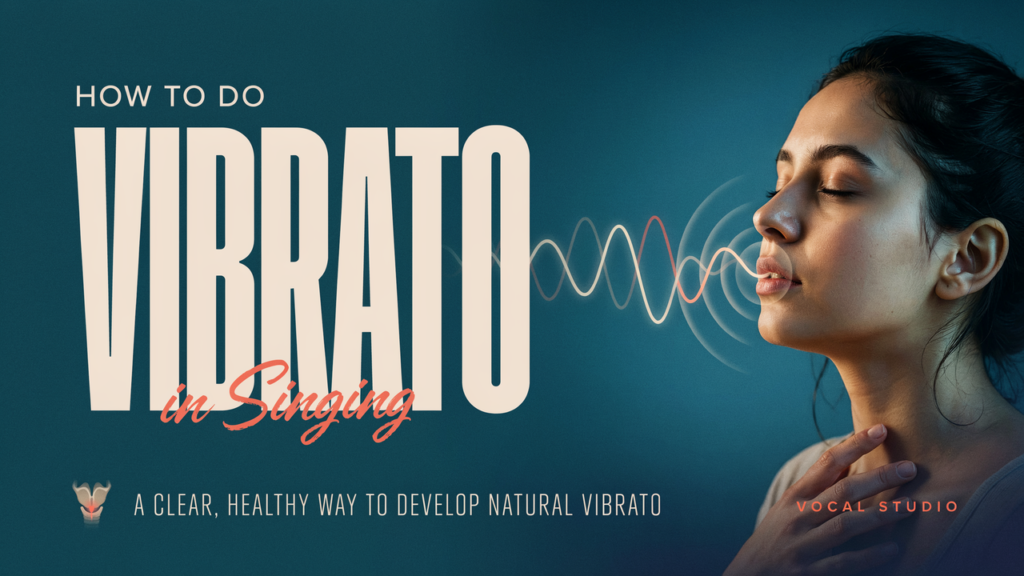
To develop vibrato, begin with a comfortable sustained note, steady airflow, and no unnecessary gripping in your jaw, tongue, neck, or abdomen. Vibrato should not be created by shaking your chin, bouncing your larynx, or pulsing your stomach. It usually develops as your pitch, airflow, and vocal-fold coordination become more balanced.
Start slowly. Your first goal is not to make the voice shake—it is to produce a stable, comfortable tone that remains flexible enough to move.
What Is Vibrato in Singing?
Vibrato is a recurring fluctuation around the center of a sung pitch. It mainly involves small changes in fundamental frequency, although subtle variations in loudness and timbre may occur at the same time.
Vibrato has two important characteristics:
- Rate: How many oscillation cycles occur per second
- Extent: How far the pitch moves above and below its center
Research involving college-level classical singers has found average vibrato rates near five cycles per second in preferred classical production. That number is context—not a rule. Vibrato varies with the singer, pitch, volume, age, genre, and musical intention.
A rate outside a particular numerical range does not automatically indicate unhealthy singing. What matters is whether the sound is controlled, appropriate for the music, and produced without pain or excessive effort.
Understanding how the vocal cords work can help you see why vibrato is a coordinated vocal behavior rather than a muscle you consciously shake.
Is Vibrato Natural or Learned?
Vibrato can be both naturally occurring and trainable. Some singers discover it without formal instruction, while others develop it gradually as their technique and pitch flexibility improve.
It is inaccurate to say that every healthy voice must produce vibrato automatically. Straight tone can also be healthy and stylistically appropriate. Classical singing often uses more continuous vibrato, while pop, folk, musical theatre, and choir singing may alternate between straight tone and vibrato.
The absence of vibrato does not prove that your voice is damaged or excessively tense. You may simply need more experience coordinating sustained notes, airflow, registration, and expressive pitch movement.
What Healthy Vibrato Should Feel Like
Comfortable vibrato should not require obvious pumping or shaking. You may notice:
- A steady central pitch
- A smooth, recurring fluctuation
- An open and responsive jaw
- A tongue that is not pulling backward
- A neck that does not visibly pulse
- Airflow that feels manageable rather than forced
- The ability to stop or reduce vibrato when the music requires it
Do not aim for complete physical relaxation. Singing requires muscular activity. The goal is appropriate coordination without unnecessary effort.
A balanced posture for singing can give your ribs and torso room to respond, but posture alone will not create vibrato.
How to Develop Vibrato Step by Step
1. Warm Up Gently
Begin with five to ten minutes of easy humming, lip trills, voiced fricatives, or comfortable scales. A suitable vocal warm-up routine prepares the voice without pushing it toward extreme volume or range.
Vibrato practice is more productive in the middle of your comfortable range than at your highest or lowest notes.
2. Sustain a Comfortable Note
Choose an easy pitch and sing it on “oo,” “oh,” or “ah” at a moderate volume. Hold the note for three to five seconds.
Listen for a clear central pitch. Do not try to add vibrato yet. If the sound feels pressed, breathy, unstable, or uncomfortable, adjust the volume and pitch before continuing.
3. Check for Unnecessary Effort
Repeat the sustained note while observing your body.
Ask yourself:
- Am I clenching my jaw?
- Is my tongue pressing downward or pulling backward?
- Am I lifting my chin?
- Are my shoulders rising?
- Am I locking my abdomen?
- Am I forcing too much air?
Make small adjustments rather than trying to relax everything at once. Keep the sound easy and repeatable.
4. Explore Slow Pitch Movement
Select two neighboring notes, such as C4 and D4. Move between them slowly on one vowel:
C4–D4–C4–D4
Then choose a smaller interval, such as a semitone. Gradually smooth the transitions so the exercise feels less like two separate notes.
This builds pitch flexibility, but it is not finished vibrato. Do not accelerate the alternation until your throat or jaw begins to shake. Use broader singing exercises to develop coordination alongside vibrato practice.
5. Move From Straight Tone to Release
Sing an easy sustained note with a gentle straight tone. After one or two seconds, reduce any unnecessary holding around the jaw, tongue, and neck while maintaining the note’s center.
Allow a small fluctuation to appear instead of deliberately making one. If nothing happens, finish the note comfortably and try again later. Forcing the result usually creates an artificial pulse rather than freer vibrato.
6. Practice Vibrato at the End of a Phrase
Choose a short phrase that ends on a sustained note. Sing most of the phrase with your usual tone, then allow vibrato near the end.
This approach is often easier than trying to maintain vibrato continuously. It also develops an important musical skill: choosing when vibrato begins instead of applying it automatically to every note.
7. Record and Review
Record several attempts and listen for:
- A recognizable pitch center
- A smooth vibrato onset
- Consistent rather than erratic movement
- No obvious jaw or abdominal pumping
- A sound that suits the phrase
A guide to the best apps for recording singing can help you compare practice sessions without relying only on how the voice feels while you sing.
Common Vibrato Mistakes to Avoid
Do not manufacture vibrato by:
- Shaking your jaw or chin
- Pressing fingers into your throat
- Moving your larynx manually
- Pulsing your abdomen
- Trying to “bounce” the diaphragm
- Rapidly switching between two notes
- Forcing more air through the vocal folds
- Practicing only at extreme pitches
- Copying another singer’s exact speed or width
The diaphragm cannot be directly pumped to create healthy pitch oscillation. Abdominal pulsing may produce repeated changes in airflow or loudness, but that is not the same as coordinated vocal vibrato.
Why Your Vibrato Sounds Fast, Slow, Wide, or Uneven
A noticeably slow or wide oscillation is often called a wobble. A very fast pulsation may be called tremolo, flutter, or fast vibrato, although teachers do not always use these terms consistently.
An unusual vibrato can be influenced by fatigue, excessive effort, volume, pitch, learned habits, age, style, medication, or health conditions. You cannot reliably diagnose the cause by listening to its speed alone.
Try returning to:
- A quieter volume
- A comfortable middle pitch
- A short sustained note
- Gentle semi-occluded exercises
- Fewer repetitions
- Adequate vocal recovery
You can use a pitch detector to observe whether the pitch is moving around a stable center, but a visual graph cannot determine whether your technique is healthy.
How Vibrato Changes Between Singing Styles
Vibrato is an expressive choice, not a decoration that must appear on every note.
Classical singers may use it through much of a sustained phrase. Pop and musical-theatre singers often begin with straight tone and introduce vibrato near the end. Choir singers may reduce its extent to support ensemble blend. Folk, indie, and contemporary styles may use little vibrato or an intentionally irregular version.
Differences between chest voice and head voice may also influence how vibrato feels across your range. Do not expect one identical sensation or sound quality on every pitch.
How Long Does It Take to Learn Vibrato?
There is no dependable timeline. Some singers notice a natural oscillation within weeks, while others need months of broader technical development. Progress depends on your starting coordination, practice habits, musical background, and the reason vibrato is currently absent or inconsistent.
Practice for a few minutes at a time rather than repeating sustained notes until the voice becomes fatigued. A regular, comfortable practice routine is more useful than chasing a dramatic result in one session.
When to Get Professional Help
Consider working with a vocal coach if you cannot distinguish vibrato from deliberate pitch alternation, if your jaw visibly shakes, or if the exercises consistently make your voice tighter.
Seek evaluation from a qualified voice professional if a new or worsening oscillation:
- Appears in both speech and singing
- Develops suddenly
- Is accompanied by persistent hoarseness
- Causes pain or significant fatigue
- Makes pitch increasingly difficult to control
- Does not respond to ordinary technique adjustments
A singing teacher can address musical technique, while persistent symptoms may require a laryngologist or voice-specialized speech-language pathologist.
Frequently Asked Questions
Can everyone learn to sing with vibrato?
Many singers can develop or improve vibrato, but no single exercise or timeline applies to everyone. Some styles and healthy voices also use limited vibrato.
Should vibrato go above and below the note?
Vibrato usually fluctuates around a perceived pitch center. The exact shape and symmetry vary, so singers should focus on musical stability rather than forcing an identical movement above and below the note.
Can I create vibrato by moving my jaw?
No. Shaking the jaw creates visible movement without developing coordinated vocal vibrato and may introduce unnecessary tension.
Should I pulse my stomach to produce vibrato?
No. Abdominal pulsing can change airflow or loudness, but it should not be used as the primary mechanism for vibrato.
Why can I sing vibrato on some notes but not others?
Pitch, vowel, register, volume, and coordination change across the range. Practice first on comfortable middle notes before transferring vibrato higher or lower.
Is straight-tone singing unhealthy?
Not automatically. Straight tone can be a healthy stylistic choice. Problems are more likely when a singer rigidly suppresses movement with excessive effort.
How often should I practice vibrato?
A few focused minutes within a normal practice session are enough. Stop if the voice becomes tight, tired, hoarse, or painful.

Conan is a vocal analysis and singing tools writer specializing in vocal range testing, pitch recognition, voice classification, and music education for singers, musicians, and beginners. He creates practical, easy-to-understand content focused on vocal analysis tools, singing improvement, and voice training resources.