To find your vocal range, identify the lowest and highest notes you can sing comfortably and consistently. The key is not forcing notes, but measuring what your voice can produce cleanly on a normal day.
To find your vocal range, start at a comfortable note and sing up and down a piano or pitch tool until you reach your highest and lowest notes without strain. Your vocal range is the span between those two notes. Use online tests for estimates, or a coach for accuracy.
Why Finding Your Vocal Range Feels Confusing at First
When people first try to find their vocal range, they often expect a clear, permanent answer. In reality, the first attempt usually raises more questions:
- “Why did my range feel smaller than I expected?”
- “Yesterday I could sing higher — today I can’t.”
- “Am I doing this wrong, or is my voice changing?”
We ran into the same issues early on. One of the biggest mistakes was assuming one test equals the truth. It doesn’t.
Your vocal range is measurable, but it’s also variable.
What Vocal Range Actually Means
Your vocal range is the span between the lowest and highest notes you can sing comfortably and reliably, not the notes you can barely hit once.
This distinction prevents frustration later.
If you want a deeper explanation, this connects directly to
👉 what is vocal range
and why usable range matters more than extreme notes.
Small Problems We Faced When Finding Vocal Range (Real Experience)
Before refining the process, we noticed several common issues — even when using good tools.
1. Testing Too Early in the Day
Testing first thing in the morning often produced:
- Weak low notes
- Limited high notes
- Scratchy tone
The voice simply wasn’t warmed up yet.
2. Forcing Notes Out of Curiosity
Another common mistake:
- Pushing higher “just to see”
- Holding strained notes too long
This usually caused:
- False range expansion
- Vocal fatigue
- Inconsistent results the next day
Forcing notes gives bad data.
3. Assuming the First Result Was Final
Early on, we treated the first test as a label. Later, repeated testing showed that patterns matter more than single results.
This realization changed everything.
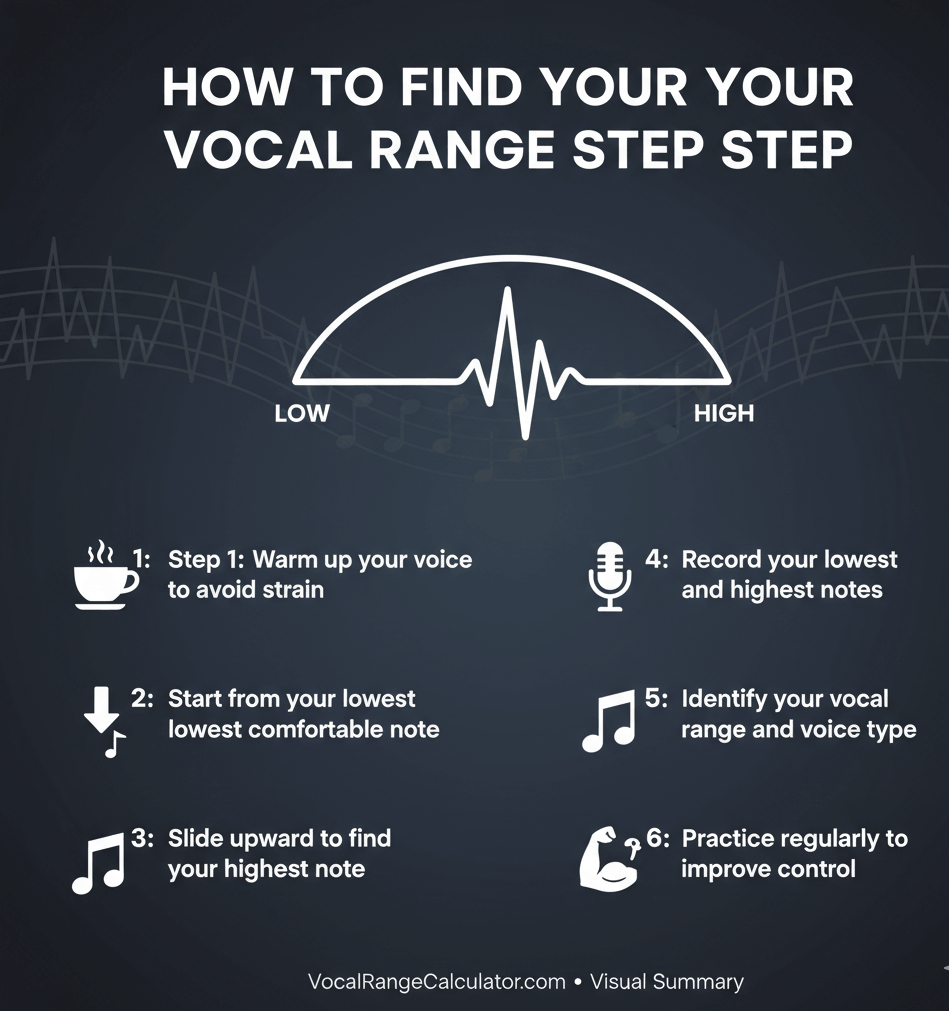
Step-by-Step: How to Find Your Vocal Range Correctly
Step 1: Prepare Your Voice
Before testing:
- Drink some water
- Sit or stand comfortably
- Do light humming or gentle warm-ups
This helps avoid underestimating your range.
Step 2: Find Your Lowest Comfortable Note
Start from a comfortable pitch and move downward slowly.
Stop when:
- The note becomes breathy
- Pitch drops out
- Strain appears
That point — not the forced note — is your true low end.
Step 3: Find Your Highest Comfortable Note
Now move upward gradually.
Stop when:
- The sound thins uncontrollably
- Your throat tightens
- You feel pressure instead of control
Many people lose accuracy here by forcing high notes.
This is where online tools become extremely useful.
Using Online Tools to Measure Vocal Range
Start your vocal range test on VocalRangeCalculator.com. These tools don’t guess — they detect pitch frequency and convert it into musical notes.
Why Your Vocal Range Changes Between Tests
This is where many people assume something is wrong.
In reality, vocal range changes due to:
- Sleep quality
- Hydration
- Stress
- Vocal fatigue
- Warm-up quality
This explains 👉 why vocal range changes even when nothing else seems different.
Accuracy vs Consistency
Here’s the insight that prevents confusion:
One accurate test is less valuable than consistent results across multiple tests.
If your range appears similar:
- Over several days
- Under similar conditions
- Without forcing
Then your measurement is reliable.
This also ties into understanding 👉 vocal range test accuracy before making conclusions.
What to Do After You Find Your Vocal Range
Once you know your range:
- Compare it to 👉 typical vocal ranges
- Avoid labeling yourself too quickly
- Focus on consistency, not extremes
Your range does not lock you into ability or talent.
Finding your vocal range is a process, not a one-time answer.
The most accurate results come from:
- Comfortable singing
- Repeated testing
- Honest interpretation
When people stop forcing and start observing patterns, vocal range becomes clear — not confusing.
Frequently Asked Questions
1. How do I find my vocal range accurately?
By singing comfortably, using pitch-detection tools, and testing multiple times under similar conditions.
2. Should I force high or low notes to find my range?
No. Forced notes distort results and increase strain.
3. Can I find my vocal range at home?
Yes. Online tools make accurate home testing possible when used correctly.
4. Why does my vocal range change daily?
Because your voice responds to sleep, hydration, stress, and fatigue.
5. Do I need a piano to find my vocal range?
No. Pitch detection tools are often more precise than matching piano notes by ear.
6. Is my vocal range permanent?
No. Usable range can expand or shrink based on coordination and recovery.
7. How often should I test my vocal range?
Every few weeks is sufficient unless you’re tracking specific changes.
8. Is my vocal range normal?
Most people fall within common ranges — variation is normal.
9. Does vocal range determine voice type?
Range helps, but voice type depends on more than just highest and lowest notes.
10. Can vocal range improve over time?
Yes. Consistent technique, recovery, and practice often restore or expand usable range.
Visit vocalrangecalculator.com for a free assessment.
- Before testing your voice, it’s important to understand what vocal range actually means in a practical singing context.
- Seeing notes laid out visually can help, which is why many singers reference a vocal range chart while testing.
- Comparing your notes against typical vocal ranges makes it easier to interpret results accurately.
- Understanding how octaves work is essential, so reviewing octave ranges explained can prevent common mistakes.
- For a hands-on approach, you can measure your notes using an interactive vocal range tester.
- Identifying exact pitches becomes easier when using a real-time pitch detector during testing.
- Once your range is clear, confirming your classification with a voice type test adds useful context.