
Typical vocal ranges describe the notes most male and female voices can sing comfortably and consistently. Most people have a 2–3 octave usable range. Ranges above 4 octaves are rare and often misunderstood.
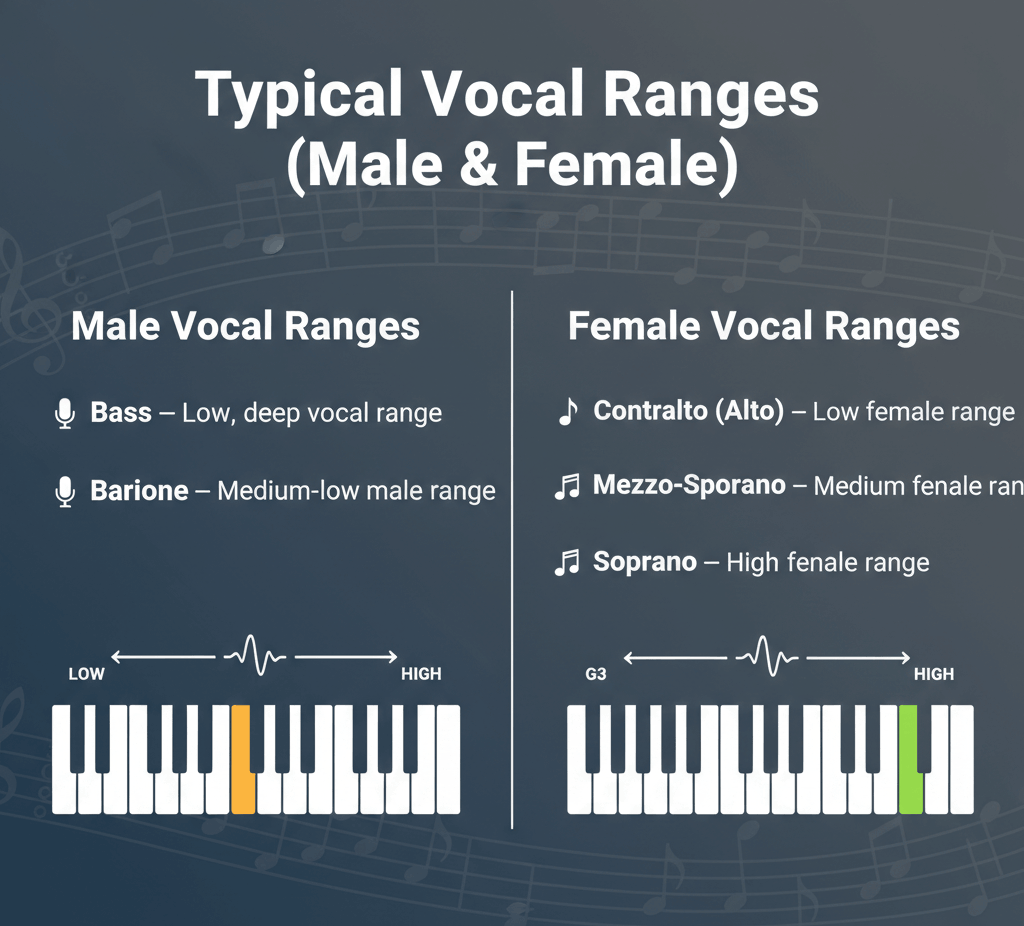
Male vocal ranges usually span Bass (E2–E4), Baritone (A2–A4), and Tenor (C3–C5), while female ranges include Alto (F3–F5), Mezzo-Soprano (A3–A5), and Soprano (C4–C6). Actual range varies by singer, training, and vocal health.
To review your results, return to this site.
Typical Vocal Ranges
Note: These are typical usable ranges, not one-time extreme notes. Overlap is normal.
Typical Male Vocal Ranges
| Voice Type | Common Usable Range |
|---|---|
| Bass | E2 – E4 |
| Baritone | A2 – A4 |
| Tenor | C3 – C5 |
Typical Female Vocal Ranges
| Voice Type | Common Usable Range |
|---|---|
| Contralto / Alto | F3 – F5 |
| Mezzo-soprano | A3 – A5 |
| Soprano | C4 – C6 |
Vocal training becomes easier when you use a singing range calculator.
Why People Get Confused About “Typical” Ranges (Real Experience)
When people test their voice for the first time, reactions are almost always emotional:
- “My range seems smaller than what I see online.”
- “Yesterday I hit higher notes — today they’re gone.”
- “Does this mean I’m the wrong voice type?”
- “Why do famous singers claim 4–5 octaves?”
We ran into the same confusion early on. The mistake wasn’t the test — it was counting every possible sound as part of the range.
What matters is usable range, not rare extremes.
What “Typical Vocal Range” Actually Means
A typical vocal range is the span of notes you can sing:
- Comfortably
- With stable pitch
- Without strain
- On most days
It does not mean:
- The highest note you ever squeaked out
- A shouted or strained sound
- A note you can’t repeat consistently
This distinction alone clears up most confusion.
Small Problems We Faced When Measuring Vocal Range
1. Counting One-Off Extreme Notes
At first, it was tempting to count:
- One strained high note
- One growly low note
But repeated testing showed:
- Those notes didn’t return
- Fatigue increased
- Results became unreliable
If a note doesn’t come back consistently, it shouldn’t define your range.
2. Range Changed From Day to Day
Some days showed a wider range, others a smaller one.
This wasn’t failure — it was normal variability, explained by 👉 why vocal range changes due to sleep, hydration, stress, and warm-ups.
Male vs Female Vocal Ranges
Male and female vocal ranges overlap significantly.
General tendencies:
- Male voices often sit lower due to vocal fold length/thickness
- Female voices often sit higher on average
But:
- Low tenors overlap with baritones
- Mezzos overlap with altos and sopranos
This is why range alone does not define voice type.
For classification, range must be considered alongside tone, comfort zone, and passaggio — explored further in
👉 voice types.
How Many Octaves Do Most People Have?
Most people have:
- 2–3 usable octaves → completely normal
- 3+ octaves → well-developed coordination
- 4+ octaves → rare, often includes falsetto or whistle
- 5–6 octaves → exceptional, not required
This context helps prevent unrealistic comparisons driven by social media claims.
Usable Range vs Extreme Range (Difference)
| Aspect | Usable Range | Extreme Range |
|---|---|---|
| Repeatable | Yes | Often no |
| Comfortable | Yes | Often strained |
| Musically useful | Yes | Sometimes |
| Stable day-to-day | Mostly | Rarely |
Most music is sung inside the usable range, not at the extremes.
How to Test Your Vocal Range Accurately
To get a reliable result:
- Warm up lightly
- Find your lowest comfortable note
- Find your highest comfortable note
- Avoid forcing
- Repeat on different days
Using an 👉 octave range test keeps measurements consistent.
Before drawing conclusions, it’s also important to understand 👉 vocal range test accuracy and its limitations.
Can Typical Vocal Ranges Change?
Yes — usable range can change.
Common reasons:
- Improved coordination
- Reduced tension
- Better recovery
- Lifestyle changes
Your anatomy doesn’t suddenly change — your access does.
How Typical Ranges Are Used Musically
Knowing your typical range helps you:
- Choose songs that fit comfortably
- Avoid chronic strain
- Understand realistic goals
It’s far more practical than chasing octave numbers.
Typical vocal ranges describe what most voices can use comfortably — not what’s rare or extreme.
A strong, healthy voice:
- Uses its range consistently
- Avoids strain
- Prioritizes control over numbers
Most people don’t need more octaves.
They need better access to the ones they already have.
Frequently Asked Questions
1. What is a normal vocal range for men and women?
Most people fall within 2–3 usable octaves.
2. Is a 3-octave range good?
Yes. It’s more than sufficient for most music.
3. Are 4-octave ranges real?
Yes, but they’re rare and often include non-sustained notes.
4. Does vocal range define voice type?
No. Voice type depends on more than range alone.
5. Why does my range change day to day?
Sleep, hydration, stress, and warm-ups affect access.
6. Can vocal range improve over time?
Usable range often improves with coordination and recovery.
7. Do male and female ranges overlap?
Yes — significantly.
8. Should I try to increase my range quickly?
No. Consistency and safety matter more than speed.
9. Are extreme high notes necessary?
No. Musical control matters more.
10. How often should I test my range?
Every few weeks is enough to track trends.
- Understanding what vocal range is provides the foundation for comparing male and female voices.
- Standard classifications become clearer when reviewing common voice types used in singing.
- Seeing how notes are distributed visually helps, which is why many singers use a vocal range chart as a reference.
- Range expectations differ across styles, and exploring choir vocal ranges offers useful context.
- Classical groupings also vary, making choral vocal ranges helpful for ensemble singers.
- Understanding octave spans is easier when you review octave ranges explained alongside classifications.
- To see where your own voice fits, you can test notes using a vocal range tester.