
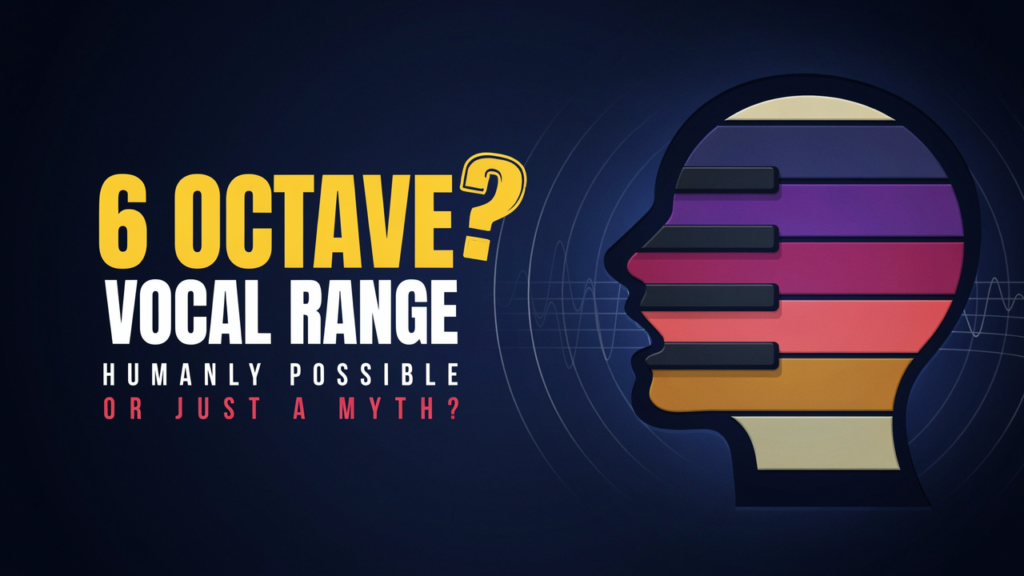
A six-octave vocal range is humanly possible, but it is extraordinarily rare. It spans 72 semitones between the lowest and highest pitches—for example, C1 to C7 or C2 to C8. Singers associated with ranges of this size normally use several forms of vocal production, including modal voice, vocal fry or subharmonics, falsetto, head voice, and whistle register.
The important qualification is that a measurable six-octave range is not necessarily six octaves of comfortable, connected, song-ready singing. Extreme low and high sounds may count toward a total vocal span even when they cannot be used like the notes in the center of the singer’s voice.
What Is a 6 Octave Vocal Range?
An octave is the distance between one pitch and another pitch with twice its frequency. For example, A3 is approximately 220 Hz, A4 is 440 Hz, and A5 is 880 Hz. The frequency doubles every time the pitch rises by one octave.
Six octaves contain 72 semitone intervals. If both endpoints are counted, a complete chromatic sequence from C1 through C7 contains 73 pitches. This is why “72 semitones” is more precise than saying a six-octave range contains 72 notes.
A singer does not need to produce every pitch with identical volume, tone, or vocal registration for the lowest and highest notes to be six octaves apart. However, the way those endpoints were produced must be disclosed before the result can be interpreted properly. Even a five-octave vocal range requires careful definitions, and adding another octave makes verification considerably more difficult.
Is a Six-Octave Vocal Range Actually Possible?
Yes. Documented vocal-frequency records show that humans can produce spans greater than six octaves. Guinness World Records recognizes American singer Tim Storms for a range measured at almost ten octaves, extending from extremely low frequencies to approximately 807 Hz.
That record requires context. Some of Storms’ lowest frequencies fall below the range of ordinary human hearing, and a laboratory-style frequency measurement is not the same as demonstrating every chromatic note in conventional singing. His record nevertheless disproves the claim that producing a six-octave span is biologically impossible.
Other singers, including Adam Lopez and Dimash Qudaibergen, are frequently associated with ranges of approximately six octaves or more. Exact endpoints can vary depending on the recording, notation system, register definitions, and which isolated sounds an analyst accepts.
The accurate conclusion is therefore:
Six octaves are possible as a total demonstrated vocal span, but six consistently musical octaves are exceptionally difficult to establish.
Total Range vs Usable Singing Range
Different definitions can produce very different range claims.
| Range type | What it includes |
|---|---|
| Total or absolute range | Every intentional, measurable vocal pitch |
| Demonstrated range | Notes supported by identifiable recordings or controlled tests |
| Usable range | Notes produced with reasonable stability, tone, and control |
| Comfortable range | Notes that feel dependable without excessive effort |
| Performance range | Notes reliable enough to use in songs or live performances |
A singer might demonstrate six octaves in total while regularly performing within two or three octaves. That does not make the larger measurement false; it means the endpoints serve a different purpose from the singer’s everyday musical notes.
Vocal range should also not be confused with tessitura. Your comfortable vocal tessitura is the area where you can sing repeatedly and sustainably. It often matters more for choosing songs than your single lowest or highest pitch.
Which Vocal Registers Can Create Six Octaves?
The voice does not usually cover six octaves through one uniform vocal quality. Extreme ranges may combine several mechanisms and sound qualities.
Modal voice produces much of ordinary speech and singing. As pitch rises, changes in vocal-fold length, tension, mass, and vibration pattern help increase the fundamental frequency. Learning how the vocal cords produce sound makes it easier to understand why the voice does not behave identically across such a large span.
Vocal fry can produce very low, irregular pulses. Some extreme-range demonstrations also involve subharmonics, in which the detected frequency falls below the singer’s ordinary modal range.
Falsetto and head voice extend the upper range with different patterns of vocal-fold vibration and resonance. Terminology varies between teachers and styles, so these labels should be used carefully.
Whistle register can extend the voice into exceptionally high frequencies. Controlled whistle notes are legitimate vocal pitches, but they should be identified rather than presented as if they were produced in the same way as chest or head voice. A dedicated explanation of the whistle register covers its sound, function, and limitations in greater detail.
Including multiple registers is not cheating. The problem arises only when a range claim hides how the extreme notes were produced or treats every detected sound as equally usable.
Singers Associated With Six-Octave Ranges
Several performers appear repeatedly in discussions of extreme vocal range.
Tim Storms holds a Guinness-recognized record for the widest male vocal range. His result is based on frequency measurements and includes exceptionally low sounds, not ten octaves of conventional melody singing.
Adam Lopez is known for an approximately six-octave span and exceptionally high whistle-register notes. He previously held a Guinness record for the highest vocal note by a male.
Dimash Qudaibergen demonstrates an unusually broad collection of low, modal, head-voice, falsetto, and whistle-register sounds in performance. Online estimates frequently place his complete span above six octaves, although published endpoints are not always consistent.
These examples should be treated as documented or widely reported range analyses rather than a definitive ranking. Estimates for famous performers often change as new recordings appear or analysts apply different criteria. For broader comparisons, review the vocal ranges of famous singers.
How to Evaluate a Six-Octave Claim
A credible extreme-range claim should answer these questions:
- What were the exact lowest and highest pitches?
- Were both pitches intentional and repeatable?
- Were they verified from clean recordings?
- Was the fundamental frequency detected rather than a harmonic?
- Which registers or vocal effects were included?
- Could the singer sustain the notes?
- Are the notes part of a total or usable range?
- Can independent observers reproduce the analysis?
- Was the same pitch-naming system used at both endpoints?
A single screenshot from a phone application is not enough to establish six octaves. Microphones and pitch detectors can misread noise, harmonics, subharmonics, and unstable signals.
Can an Online Tool Detect Six Octaves Accurately?
An octave range test can identify a possible span, but extreme results need additional checking. Consumer microphones may not capture very low or very high frequencies accurately, and pitch-detection algorithms sometimes report an octave above or below the real fundamental.
If a tool returns an unexpected frequency, use a frequency-to-note converter to inspect the corresponding pitch. Repeat the note at different times, record it in a quiet room, and compare results across several attempts.
Very low signals require particular caution. The software may lock onto room noise, electrical hum, a harmonic, or an irregular pulse. The same concern applies to weak whistle tones at the upper edge of a microphone’s useful response. Understanding the accuracy limits of vocal range tests can prevent an impressive-looking result from being mistaken for confirmed evidence.
Does a Six-Octave Range Make Someone a Better Singer?
No. Range measures the distance between two pitches; it does not measure artistry.
Strong singing also depends on:
- Pitch accuracy
- Tone and dynamic control
- Register coordination
- Rhythm and phrasing
- Diction
- Vocal stamina
- Emotional communication
- Stylistic judgment
A singer with two controlled octaves may be more effective than someone who can produce six octaves of disconnected extremes. Most songs use only a fraction of a six-octave span, and performers are judged by how musically they use the required notes.
Can You Train Yourself to Sing Six Octaves?
Training can help singers access notes that were previously unstable, coordinate registers, and improve the usable portion of their range. It cannot guarantee six octaves. Extreme vocal spans depend on unusual anatomy, coordination, and access to specialized vocal mechanisms.
Do not force low growls, subharmonics, or whistle notes to reach a numerical target. Stop if you experience pain, burning, persistent hoarseness, or loss of normal speaking voice. The safer goal is to improve control throughout your natural range rather than imitate a record holder.
Frequently Asked Questions
How rare is a six-octave vocal range?
It is extraordinarily rare, especially when the claim requires repeatable and verified endpoints. A six-octave comfortable performance range would be even rarer than a six-octave total range.
Does whistle register count toward vocal range?
Yes, controlled whistle notes may count toward total range. They should be labeled separately so readers understand how the upper pitches were produced.
Does vocal fry count toward vocal range?
Intentional, repeatable fry or subharmonic pitches may count toward an absolute range. They may not belong to the singer’s usable melodic range.
Who has the widest documented vocal range?
Tim Storms holds a Guinness-recognized record for a vocal-frequency span of almost ten octaves. The result includes extremely low frequencies and should not be interpreted as ten uniform octaves of conventional singing.
Can a beginner have six octaves?
A beginner may discover an unusually large total span, but verifying six octaves requires more than producing isolated extreme sounds. Control, repeatability, and correct pitch detection must be established.
Is a six-octave range necessary for professional singing?
No. Professional singers need dependable technique, musicianship, communication, and a range suited to their repertoire. Six octaves are not a professional requirement.
Conan is a vocal analysis and singing tools writer specializing in vocal range testing, pitch recognition, voice classification, and music education for singers, musicians, and beginners. He creates practical, easy-to-understand content focused on vocal analysis tools, singing improvement, and voice training resources.