
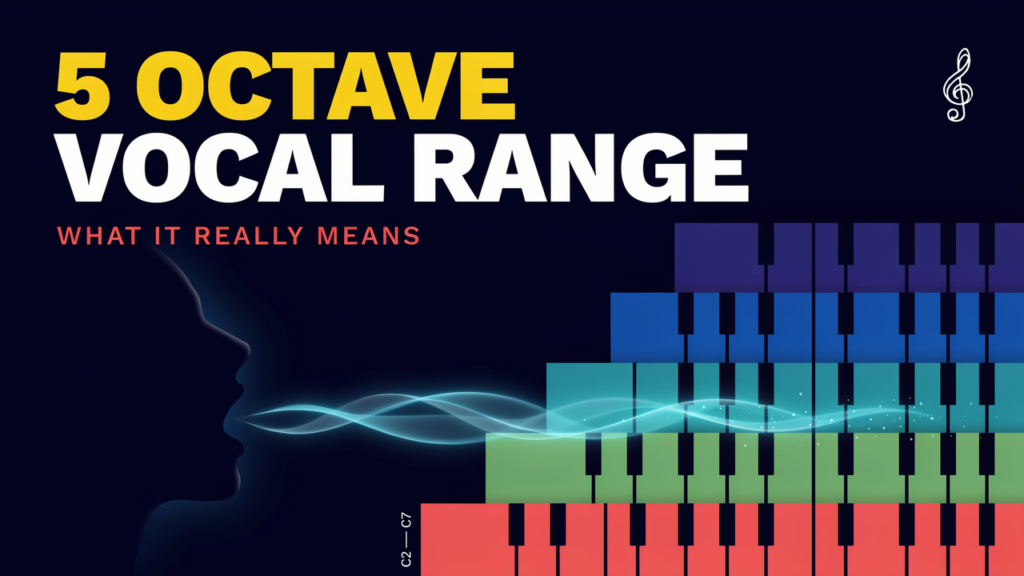
A five-octave vocal range spans 60 semitones from the lowest note to the highest. It is an exceptionally wide demonstrated range, but the number requires context. Most five-octave claims combine multiple vocal registers, and the notes at the extremes may not be as strong, sustainable, or musically useful as those in the middle.
Five octaves are possible, but a total pitch span should not be confused with five equally comfortable octaves. To evaluate such a claim properly, you need to know the exact notes, registers involved, audio evidence, and measurement standard.
What Is a Five-Octave Vocal Range?
A vocal range is the distance between the lowest and highest pitches a person can produce. Because one octave contains 12 semitones, five complete octaves contain 60 semitones.
Examples of exact five-octave ranges include:
- C2–C7
- E2–E7
- A1–A6
- G2–G7
The range can begin on any note. It does not need to start on C, and it does not necessarily need to include a note below C2 or above C7.
When measured by frequency, each octave doubles the frequency of a pitch. Therefore, the highest pitch in a five-octave range has 32 times the frequency of the lowest. For example, C2 is approximately 65.41 Hz, while C7 is approximately 2093 Hz.
A complete octave range guide can help you compare different note spans without mistakenly counting octave labels.
How Rare Is a Five-Octave Vocal Range?
A genuine, repeatable five-octave span is highly unusual, especially when the boundary notes are intentional and clearly pitched. However, there is no reliable population-level percentage showing exactly how many singers possess one.
Online rarity statistics often use inconsistent definitions. One source may count every detectable sound, while another counts only notes that can be performed with control. Some include fry and whistle register, while others count only modal and head-voice production.
For this reason, five octaves should be described as an exceptionally wide demonstrated range rather than assigned a fabricated percentage or worldwide ranking. It is also important to distinguish it from a four-octave vocal range, which covers 48 rather than 60 semitones.
Which Vocal Registers Can Be Included?
A five-octave range normally crosses several areas of vocal production. Depending on the singer, it may include:
- Vocal fry or pulse register
- Modal or chest-dominant voice
- Mixed registration
- Head voice
- Falsetto
- Whistle or flageolet register
Using several registers does not make the result false. Vocal range describes a pitch span, and different registers can produce legitimate pitches within that span.
The problem arises when every note is presented as though it has the same volume, tone, control, and performance value. A quiet fry note and a powerful modal note may both be measurable, but they do not function identically in music.
Do Fry, Falsetto, and Whistle Notes Count?
Fry, falsetto, and whistle-register notes can count toward a total demonstrated range when they are intentional, identifiable, and repeatable. They should nevertheless be labeled separately.
A useful way to report a range would be:
Total demonstrated range: C2–C7, including vocal fry below E2 and whistle register above F6.
This description is clearer than claiming five uniform octaves. It tells the reader where specialized registers contribute to the total.
Whistle notes are not automatically accidental or unusable. Some singers can sustain them, move between them, and use them melodically. Similarly, vocal fry can contain a detectable fundamental frequency. What matters is whether the sound is genuinely voiced and whether the claimed pitch can be reproduced.
Total Range vs. Usable Range
Not every pitch you can produce belongs to your practical singing range.
| Range category | What it measures |
|---|---|
| Produced range | Every identifiable pitch you can make |
| Demonstrated range | Pitches you can intentionally reproduce |
| Usable range | Notes sung with reasonable pitch, tone, and control |
| Tessitura | The area comfortable enough for sustained singing |
| Recorded range | Notes documented across live or studio recordings |
Someone may demonstrate five octaves while using a much smaller range in songs. This is normal. A singer’s tessitura is usually more relevant when choosing repertoire because it shows where the voice can remain comfortable across complete phrases.
What Does a Five-Octave Range Sound Like?
Five octaves do not have one specific sound. The character changes as the singer moves through registers. Low fry may sound creaky or pulsed, modal notes may sound speech-like and full, head voice may sound lighter or more resonant, and whistle pitches may resemble a flute-like tone.
Mariah Carey is widely associated with a five-octave range and is especially known for using whistle register musically. Her official recording of “Emotions” provides an accessible example of controlled upper-register and whistle sounds.
One recording cannot establish every endpoint of a singer’s lifetime range. It can, however, demonstrate how a specialized upper register contributes to a broader documented span.
Celebrity range numbers should always be treated as approximate. Studio processing, layered vocals, key changes, different career periods, and conflicting definitions can all affect the result.
How to Verify a Five-Octave Range
First, learn how to find your vocal range using clean reference pitches. Warm up gently in the middle of your voice before moving toward either extreme.
For a credible five-octave result:
- Record the entire test in a quiet room.
- Start from a comfortable pitch and move by semitones.
- Use a clear, sustained vowel.
- Repeat the lowest and highest notes at least three times.
- Identify the register used for each extreme.
- Test the result again on another day.
- Calculate the exact interval rather than counting note labels.
- Save the unedited audio for comparison.
Listen for pitch stability, audible strain, breath noise, register changes, and whether the boundary notes are clearly voiced. A pitch detector can support the process, but it may mistake background noise, harmonics, subharmonics, or irregular fry pulses for the intended fundamental pitch.
Understanding vocal range test accuracy is especially important when a tool reports unusually high or low notes.
Why Five-Octave Claims Are Often Disputed
A singer’s stated range may be exaggerated when an analysis:
- Counts an accidental squeak as a high note
- Mistakes a harmonic for the fundamental pitch
- Treats microphone noise as a low frequency
- Combines different studio takes without disclosure
- Uses altered or sped-up audio
- Fails to identify vocal registers
- Rounds a partial octave up to the next whole number
- Presents a one-time sound as a repeatable note
A recorded-range compilation may also combine performances separated by many years. That can document a singer’s historical recorded span, but it does not prove that every note was available simultaneously or remains available today.
Singers Associated With Five Octaves
Mariah Carey is one of the most widely recognized examples, with the Recording Academy describing her as a five-octave vocalist and highlighting her signature whistle register.
Other performers are frequently assigned five-octave or wider ranges by media outlets and fan analyses. Exact figures should be treated cautiously unless they are supported by clear endpoint recordings, correct pitch identification, and a stated measurement method.
A famous name does not make a note chart reliable. The evidence should show which pitches were produced, when they occurred, and whether the analysis includes fry, falsetto, or whistle register.
Can Training Give You Five Octaves?
Training may improve coordination, strengthen register transitions, and reveal notes that were previously difficult to access. It cannot guarantee a five-octave result, and there is no fixed amount of range that every singer can gain.
Anatomy, vocal health, age, experience, and registration all influence the available span. For most singers, developing stable pitch and consistent tone within the current range is more useful than forcing extreme notes.
Avoid exercises that cause pain, burning, or persistent hoarseness. Range development should be gradual, and notes gained through squeezing are unlikely to become reliable performance tools.
Does Five Octaves Make Someone a Better Singer?
No. Five octaves describe pitch width, not complete singing ability. Strong singing also depends on:
- Pitch accuracy
- Tone quality
- Breath coordination
- Rhythm
- Diction
- Dynamic control
- Register transitions
- Stamina
- Phrasing
- Musical expression
A singer with a smaller range may be more compelling because they use their notes with greater control and artistry. Vocal range is a capability, not a ranking system.
Even a documented six-octave vocal range does not guarantee better tone, technique, or interpretation.
Frequently Asked Questions
Is a five-octave vocal range possible?
Yes. A human voice can produce pitches spanning five octaves, although the total usually involves multiple registers and does not mean every note is equally usable.
How many semitones are in five octaves?
Five complete octaves contain 60 semitones.
Is C2 to C7 exactly five octaves?
Yes. The interval from C2 to C7 is exactly five octaves.
Does whistle register count toward vocal range?
It can count toward total demonstrated range when the pitches are intentional and repeatable. The whistle portion should be identified separately.
Can an online test confirm five octaves?
A test can identify candidate pitches, but unusual results should be verified with clean audio, repeated notes, reference tones, and careful review for detection errors.
Can vocal training create a five-octave range?
Training may improve or expand an individual’s range, but it cannot guarantee five octaves. Healthy coordination and musical usability should remain the priority.
Final Verdict
A five-octave vocal range is possible and exceptionally wide, but the number needs evidence and context. A credible claim should identify exact boundary notes, explain which registers are included, provide repeatable audio, and separate total range from usable range and tessitura.
Rather than treating five octaves as proof of superior singing, evaluate the quality of the notes: Are they intentional, accurately pitched, repeatable, and produced without strain? Those details make a range measurement meaningful.

Conan is a vocal analysis and singing tools writer specializing in vocal range testing, pitch recognition, voice classification, and music education for singers, musicians, and beginners. He creates practical, easy-to-understand content focused on vocal analysis tools, singing improvement, and voice training resources.