
You can increase your vocal range by improving coordination, reducing tension, and restoring access to notes that already exist — not by forcing your voice beyond its limits.
To increase your vocal range, practice daily warm-ups, strengthen breath support, relax throat tension, and train both low and high notes gradually without strain. Use scales, lip trills, and head-to-chest voice blending to expand range safely over time. To get instant results, try this online tool.
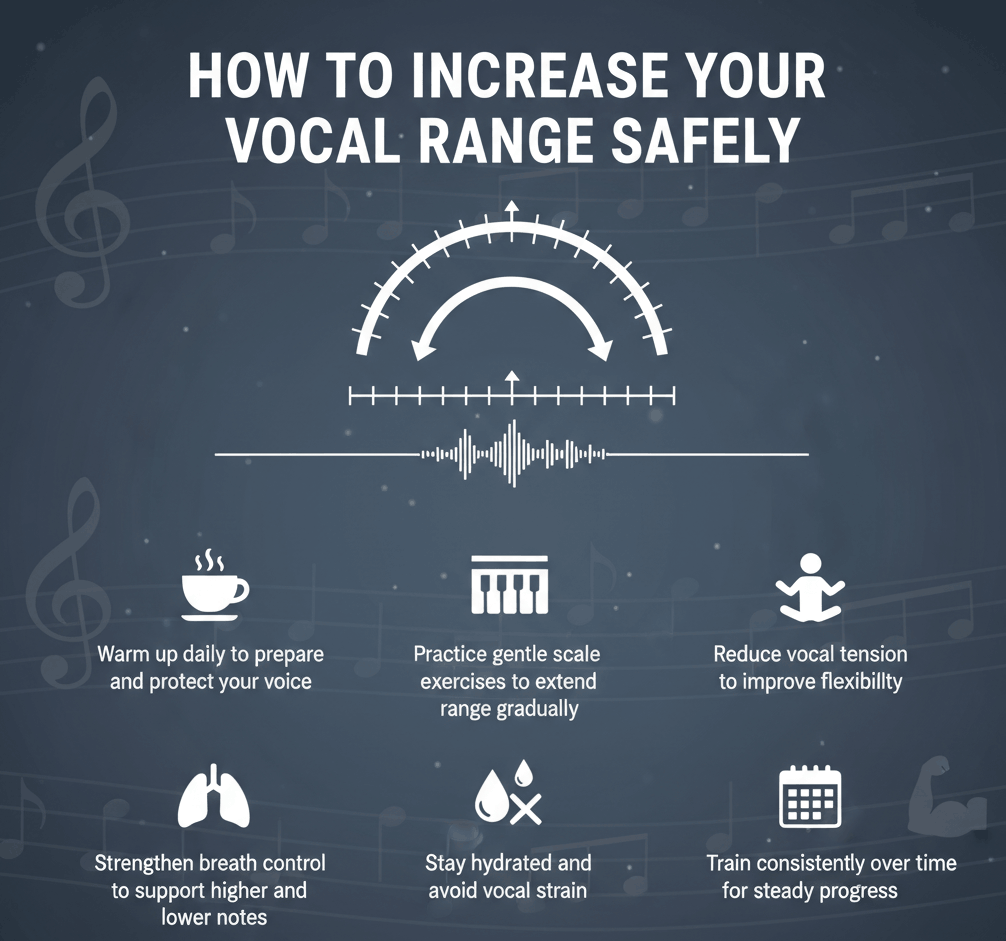
Why Increasing Vocal Range Feels So Difficult
When people first try to increase their vocal range, they usually expect progress to feel obvious and fast. Instead, what we repeatedly see is frustration:
- “I practice, but my high notes still feel blocked.”
- “Some days I can sing higher — other days I can’t.”
- “If I push harder, it works briefly… then my voice feels worse.”
We ran into these same problems early on. One of the biggest mistakes was assuming effort equals progress. In reality, effort often made things worse.
Vocal range doesn’t grow by force. It opens up through efficiency and consistency.
What “Increasing Vocal Range” Actually Means
Increasing vocal range does not mean changing your anatomy.
Your vocal cords already have a physical limit. What usually changes is:
- Coordination
- Tension
- Access to existing notes
This is why many people “gain” notes they didn’t know they had once they stop pushing.
Understanding this starts with knowing 👉 what is vocal range and why usable range matters more than extreme notes.
Small Problems We Faced While Trying to Increase Range
Before progress became consistent, we noticed several recurring issues.
1. Pushing High Notes Too Early
Early attempts often involved:
- Singing louder to go higher
- Forcing chest voice upward
- Holding strained notes
This caused:
- Temporary “success”
- Faster fatigue
- Less range the next day
Pushing didn’t increase range — it locked it down.
2. Ignoring Daily Vocal Condition
Another issue:
- Practicing while tired
- Practicing when dehydrated
- Practicing through stress
Results varied wildly day to day, which made progress feel random.
Later, repeated measurement showed the voice wasn’t shrinking — it was recovering inconsistently.
This connects directly to 👉 why vocal range changes even without changes in practice.
3. Measuring Progress Incorrectly
At first, we judged progress by:
- One “good” high note
- One strong practice session
But repeated testing revealed that consistency across days mattered more than single wins.
Why Vocal Range Feels Blocked (Not Missing)
In most cases, range feels limited because:
- Chest voice is pushed too high
- Head voice isn’t coordinated yet
- Tension blocks transition
This is why understanding 👉 chest voice vs head voice is essential before trying to expand range.
High notes usually fail before range expands — not after.
Safe Ways to Increase Your Vocal Range
1. Prioritize Coordination Over Power
Louder ≠ higher.
High notes require:
- Less force
- Better balance
- Lighter coordination
When volume decreases, range often increases.
2. Use Warm-Ups to Restore Access
Consistent, gentle warm-ups helped more than aggressive practice.
Proper 👉 vocal warm-up exercises reduced cracking, tension, and recovery time.
Warm-ups don’t “build” range — they unlock it.
3. Train Flexibility, Not Just Strength
Heavy singing all the time reinforced stiffness.
Light 👉 singing exercises focused on slides and ease improved flexibility far more effectively.
4. Respect Recovery
Progress stalled whenever recovery was ignored.
Sleep, hydration, and rest directly affected:
- Range access
- Stability
- Endurance
Improvement accelerated once recovery was treated as part of training.
How Long Does It Take to Increase Vocal Range?
This is one of the most common questions.
From real patterns:
- Small improvements: weeks
- Consistent access: months
- Long-term stability: ongoing
Range improvement is gradual, not linear.
Many people regain notes they lost long before they gain new ones.
How to Measure Progress Correctly
Progress is best tracked by:
- Repeated testing
- Similar conditions
- No forcing
Comparing results to 👉 typical vocal ranges helps set realistic expectations and avoid discouragement.
Common Mistakes That Block Vocal Range Growth
| Mistake | What Happens |
|---|---|
| Forcing high notes | Increased tension |
| Singing louder | Reduced coordination |
| Skipping warm-ups | Narrower range |
| Ignoring fatigue | Slower progress |
| Chasing extremes | Inconsistent results |
Avoiding these mistakes often restores range faster than adding new exercises.
Most people don’t need to “add” vocal range — they need to remove what’s blocking it.
When coordination improves and tension decreases:
- High notes feel easier
- Range becomes consistent
- Progress becomes predictable
Vocal range grows through patience, not pressure.
Frequently Asked Questions
1. Can vocal range really be increased?
Yes, usable range can increase by improving coordination and reducing tension.
2. How long does it take to increase vocal range?
Most people notice changes within weeks, but stable improvement takes months.
3. Is it dangerous to try to increase vocal range?
It can be if you force notes. Safe methods focus on ease and recovery.
4. Why do my high notes feel blocked?
Usually due to tension or pushing chest voice too high.
5. Can adults still increase vocal range?
Yes. Age does not prevent coordination improvement.
6. Should I practice every day?
Only if your voice feels recovered. Rest is part of progress.
7. Can vocal range shrink over time?
Yes, if recovery and technique are ignored — but it’s often reversible.
8. Do exercises really work?
Yes, when they reduce tension rather than increase effort.
9. How do I know I’m making progress?
Range becomes easier and more consistent, not just higher.
10. Should I stop if my voice feels tight?
Yes. Tightness is a signal to reduce effort, not push harder.
- Expanding your voice starts with understanding why vocal range changes over time and with training.
- A structured approach is outlined in our guide on how to extend your vocal range safely and effectively.
- Consistent practice with targeted vocal exercises to increase range helps build flexibility without strain.
- Improving range also depends on coordination between registers, especially when balancing chest voice and head voice.
- Proper alignment and breath support play a major role, making good singing posture essential for progress.
- Warming up correctly before pushing limits reduces risk, which is why vocal warm-up exercises matter.
- To track improvement objectively, many singers check their progress using a vocal range test.