To sing high notes without straining, you must reduce effort, stop pushing chest voice upward, and allow lighter coordination (head voice) to take over. High notes require less force, not more.
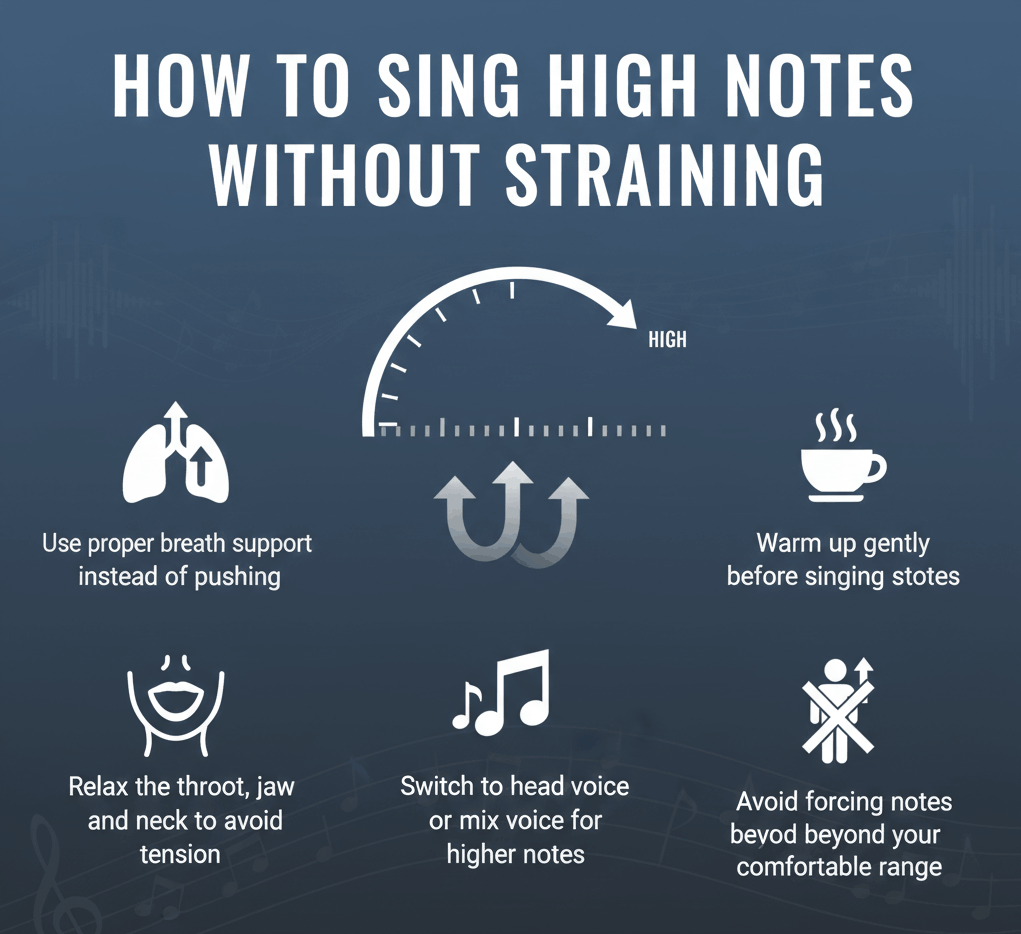
To sing high notes without straining, use proper breath support, relax your throat and jaw, avoid pushing volume, and shift into head voice or mixed voice. Warm up with scales, lip trills, and light resonance to keep high notes controlled and tension-free.
Why Singing High Notes Feels So Hard
When people try to sing high notes, the same frustrations come up again and again:
- “My throat tightens as soon as I go higher.”
- “If I don’t push, the note disappears.”
- “High notes work once, then my voice feels tired or sore.”
- “I’m afraid I’m damaging my voice.”
We faced the same issues early on. The biggest mistake was believing that more effort equals higher notes. In reality, more effort was exactly what caused the strain.
High notes didn’t become easier when we worked harder — they became easier when we stopped forcing them.
What Vocal Strain Actually Is
Vocal strain happens when muscles around the throat and larynx tighten to force pitch higher instead of letting the vocal cords coordinate efficiently.
Strain is not:
- A lack of talent
- Weak vocal cords
- Something “wrong” with your voice
Strain is:
- Excess tension
- Too much volume
- Chest voice being pushed too high
Why High Notes Create Tension So Quickly
As pitch rises:
- Vocal cords must thin
- Airflow must balance
- Coordination must shift
Most people panic at this point and respond by:
- Singing louder
- Tightening the throat
- Forcing chest voice upward
This blocks the exact coordination needed for high notes.
Understanding 👉 chest voice vs head voice is critical here. High notes rely on head-voice coordination — not chest-voice power.
Small Problems We Faced While Learning to Sing High Notes
1. Singing Too Loud
We noticed high notes felt “possible” only when singing louder. This worked briefly, then caused:
- Faster fatigue
- Less range the next day
- Throat discomfort
Lowering volume actually increased range access.
2. Skipping Warm-Ups
Testing high notes without preparation led to:
- Immediate tension
- Cracking
- Strain even on familiar notes
Consistent
👉 vocal warm-up exercises
reduced strain dramatically.
3. Ignoring Daily Vocal Condition
Some days high notes felt easy. Other days, impossible.
Sleep, hydration, stress, and vocal use explained these swings — a key reason
👉 why vocal range changes
even without practice changes.
How to Sing High Notes Without Straining (Step-by-Step)
1. Reduce Volume First
High notes need less air pressure, not more.
If a note requires shouting, coordination is already off.
2. Let Head Voice Take Over
If chest voice feels heavy or tight, stop pushing.
High notes should feel:
- Lighter
- More flexible
- Less physical effort
This doesn’t mean weak — it means efficient.
3. Warm Up Before Attempting High Notes
Warm-ups don’t build range — they unlock access.
Gentle slides and light sounds prepare coordination without tension.
4. Stop When Tightness Appears
Tightness is a signal — not a challenge.
If the throat tightens:
- Lower the pitch
- Reduce volume
- Reset coordination
Pushing through tightness trains strain.
How High Notes Relate to Vocal Range
Many people think they “can’t sing high,” when those notes already exist in their range.
Using a 👉 vocalrangecalculator often shows that high notes appear inconsistently — a sign of coordination issues, not missing range.
This is also why improving ease often leads naturally to 👉 increasing vocal range without aggressive training.
Signs You Are Singing High Notes Correctly
You’re on the right track if:
- The throat stays relaxed
- Volume stays moderate
- Notes feel repeatable
- Fatigue decreases over time
Progress shows up as consistency, not just higher notes.
When to Stop and Rest
Stop singing if:
- Pain appears
- Hoarseness follows
- Tightness doesn’t release with lighter singing
Rest and recovery are part of progress, not setbacks.
High notes don’t require more strength — they require less interference.
When effort decreases and coordination improves:
- Strain disappears
- High notes stabilize
- Confidence returns
Most singers don’t need to “push harder.”
They need to get out of their own way.
Many teachers point students toward VocalRangeCalculator.com for pitch tracking.
Frequently Asked Questions
1. Why do high notes strain my voice?
Because tension increases when chest voice is pushed too high instead of shifting coordination.
2. Is vocal strain normal?
It’s common, but not healthy. Strain is a sign of inefficient coordination.
3. Can straining damage my voice?
Repeated strain can lead to fatigue and irritation. It’s best avoided.
4. Should I sing louder to hit high notes?
No. Loudness increases tension and blocks coordination.
5. Can beginners sing high notes safely?
Yes, with light coordination and proper warm-ups.
6. Does head voice reduce strain?
Yes. Head-voice coordination uses less mass and tension.
7. How long does it take to stop straining?
Many people notice improvement within weeks once pushing stops.
8. Why do high notes feel easier some days?
Sleep, hydration, stress, and recovery all affect coordination.
9. Should I stop singing if my throat hurts?
Yes. Pain is a clear signal to rest and reset.
10. Can warm-ups really prevent strain?
Yes. They prepare coordination and reduce tension before high notes.
- Singing high notes safely starts with understanding how the vocal cords work during pitch elevation.
- Many strain issues come from poor register coordination, which is why mastering chest voice vs head voice is essential.
- Breath support and alignment play a major role, making best posture for singing a foundational skill.
- Range limitations often improve with consistency, especially when using focused singing exercises designed for control.
- Warming up before reaching higher notes reduces tension, which is why vocal warm-up exercises are critical.
- Some singers struggle because they push beyond comfort, so understanding why vocal range changes helps set realistic expectations.
- You can monitor pitch accuracy while practicing high notes by using the pitch detector for real-time feedback.