
Online vocal range tests can be accurate, but only when you understand their limitations and use them correctly. Most “wrong” results come from testing conditions, not from broken tools.
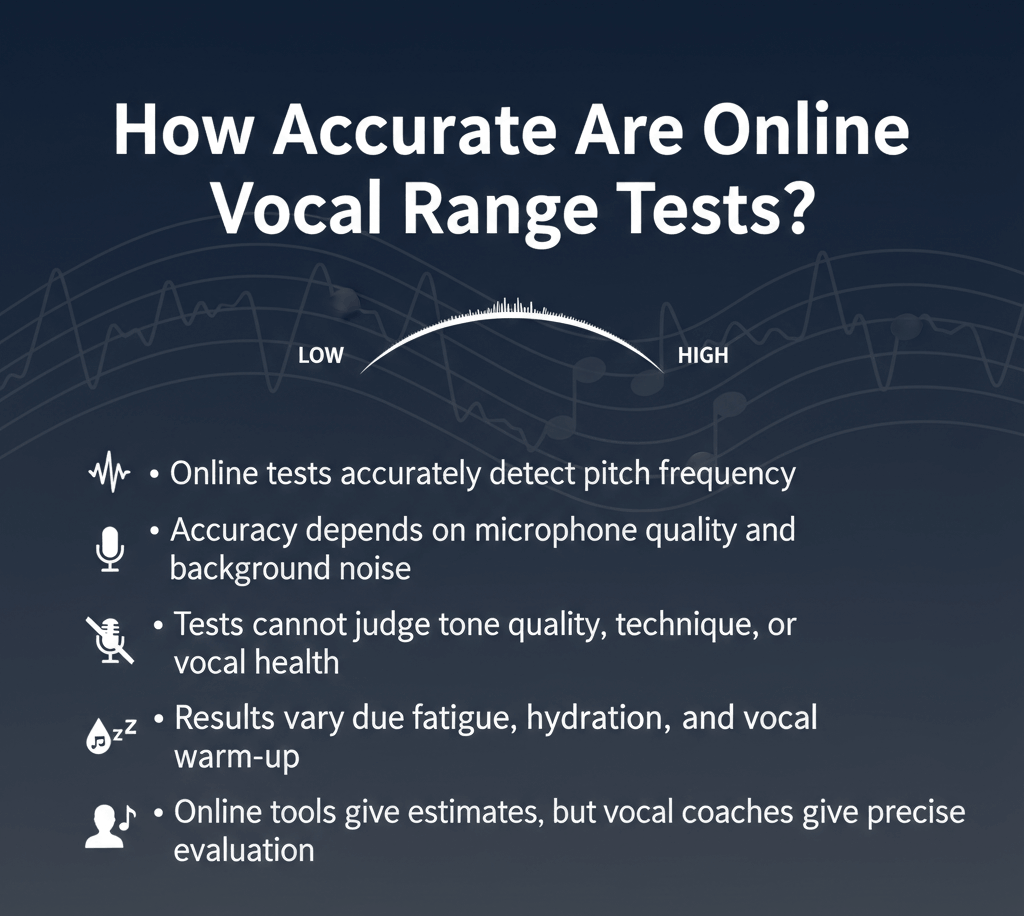
Online vocal range tests are moderately accurate for estimating your range, but results can be affected by microphone quality, pitch detection errors, room noise, and singing technique. They’re best for practice tracking, not as precise as a vocal coach or studio test.
What We’ve Actually Seen From Real Vocal Range Testing
When people first use an online tool, The vocal range calculation tool provides fast results, Their reaction is often the same:
- “Why did I get a different result this time?”
- “This says my range is lower than I expected.”
- “Yesterday I had more notes — today they’re gone.”
- “Is this tool wrong, or is my voice changing?”
We’ve faced the same confusion ourselves while testing and re-testing voices under different conditions. Early on, the biggest mistake was assuming one test equals truth.
It doesn’t.
Online vocal range tests measure what your voice produces at that moment — not your permanent limits.
How Online Vocal Range Tests Actually Work
Online tests don’t guess.
They detect pitch frequency from your voice and convert it into musical notes.
This process is based on:
- Sound input from your microphone
- Pitch detection algorithms
- Frequency-to-note conversion
Tools like a 👉 pitch detectorand a 👉 frequency to note work the same way — they read what you produce, not what you intended to sing. This distinction matters more than most people realize.
Small Problems That Commonly Ruin Test Accuracy
These are not technical failures — they’re real-world issues we repeatedly ran into while testing.
1. Testing While Tired or Unwarmed
One of the first mistakes we noticed:
- Testing first thing in the morning
- Testing after heavy talking
- Testing without any warm-up
Result?
- Reduced high notes
- Unstable pitch
- Underestimated range
The tool wasn’t wrong — the voice wasn’t ready.
2. Pushing for Notes That Aren’t There That Day
Another common problem:
- Forcing high notes
- Shouting instead of phonating cleanly
- Holding strained sounds
This often causes:
- False note detection
- Inconsistent results
- Vocal fatigue mid-test
Online tools can’t tell if a note was strained — they only know it happened.
3. Environment and Microphone Issues
We’ve tested the same voice with:
- Laptop mic
- Phone mic
- External mic
- Quiet room vs noisy room
Results always varied slightly.
Background noise, mic sensitivity, and distance all affect detection accuracy.
Accuracy vs Consistency
Here’s the key insight most sites miss:
Accuracy is not about one perfect test — it’s about consistent patterns across tests.
If your results are:
- Similar across multiple sessions
- Taken under similar conditions
- Reproducible over time
Then the test is doing its job.
This is why users who repeatedly test often notice trends — a core reason
👉 why vocal range changes feels more understandable once measurement is repeated.
Why Results Change Even When the Test Is Accurate
This is where many people assume the tool is broken.
In reality, your vocal range fluctuates based on:
- Sleep
- Hydration
- Stress
- Vocal load
- Warm-up quality
So when results change, it usually reflects real vocal variability, not a faulty test.
Can Online Vocal Range Tests Be Trusted?
Yes — when used correctly.
Online tests are best for:
- Tracking progress over time
- Comparing results under similar conditions
- Understanding usable range
- Supporting voice type exploration
They are not perfect for:
- Defining permanent limits
- Diagnosing vocal issues
- Replacing professional evaluation
This context matters, especially when users rely on results for a
👉 voice type test without understanding daily variability.
How to Get the Most Accurate Vocal Range Test Results
Based on repeated testing experience, these steps matter most:
- Test when rested
- Hydrate before testing
- Use a quiet room
- Warm up lightly
- Avoid forcing notes
- Repeat the test on different days
Treat results as data points, not verdicts.
Online Tests vs Guessing Your Vocal Range
Even with limitations, online tests are far more reliable than guessing.
They provide:
- Objective measurement
- Repeatability
- Pitch-accurate feedback
Used correctly, they help users understand their👉 typical vocal ranges instead of relying on assumptions.
Online vocal range tests are accurate tools — but imperfect mirrors.
They reflect:
- Your voice
- Your condition
- Your coordination at that moment
When people stop expecting a single test to define them and start looking for patterns, online vocal range testing becomes extremely useful — not confusing.
Frequently Asked Questions
1. How accurate are online vocal range tests?
They are accurate at detecting pitch, but results depend heavily on testing conditions and vocal readiness.
2. Why do I get different results every time?
Because your voice changes daily based on fatigue, hydration, stress, and warm-up.
3. Can a vocal range test be wrong?
The pitch detection is usually correct. Misinterpretation happens when results are taken out of context.
4. Does microphone quality affect vocal range tests?
Yes. Poor microphones and background noise reduce detection accuracy.
5. Can beginners trust online vocal range tests?
Yes, as long as they understand results reflect current ability, not permanent limits.
6. Should I test multiple times?
Absolutely. Consistent patterns matter more than single results.
7. Can fatigue lower my measured vocal range?
Yes. Fatigue often reduces high-note access and stability.
8. Do online tests show my true vocal limits?
They show usable range, not absolute anatomical limits.
9. Are online tests better than guessing?
Yes. Objective measurement is always more reliable than perception.
10. How should I interpret my vocal range test results?
As a snapshot, not a label. Look for trends over time, not one-off results.
- To evaluate reliability properly, it helps to understand how vocal range is defined before trusting any online test.
- Many users question digital tools, which is why we break down vocal range test accuracy in detail.
- Test results can vary depending on technique, especially when comparing chest voice vs head voice usage.
- Knowing your classification improves interpretation, making voice types an important reference point.
- Accurate detection depends on pitch recognition, which is explained in our guide to how vocal cords produce pitch.
- For real-world testing, many singers rely on a dedicated vocal range tester instead of generic apps.
- You can cross-check results by identifying exact notes using the pitch detector during multiple sessions.