The whistle register is one of the most misunderstood parts of the human voice.
When I first encountered it, it wasn’t through formal vocal study—it was through clips online suggesting that hitting whistle notes meant you had a “rare” or “elite” voice. I tried to imitate those sounds, expecting something dramatic. What I actually got was inconsistent tone, throat tension, and no real control.
That experience reflects a larger issue: most explanations of the whistle register focus on hype instead of function.
This guide explains what the whistle register actually is, how it differs from other vocal registers, and—most importantly—why most singers never need it.
The whistle register is the highest vocal register, producing extremely high, flute-like notes using tightly stretched vocal cords. It sounds light, airy, and piercing, and is rare, requiring advanced technique, control, and careful training to avoid strain.
You can start by checking your voice using this tool.
What Is the Whistle Register?
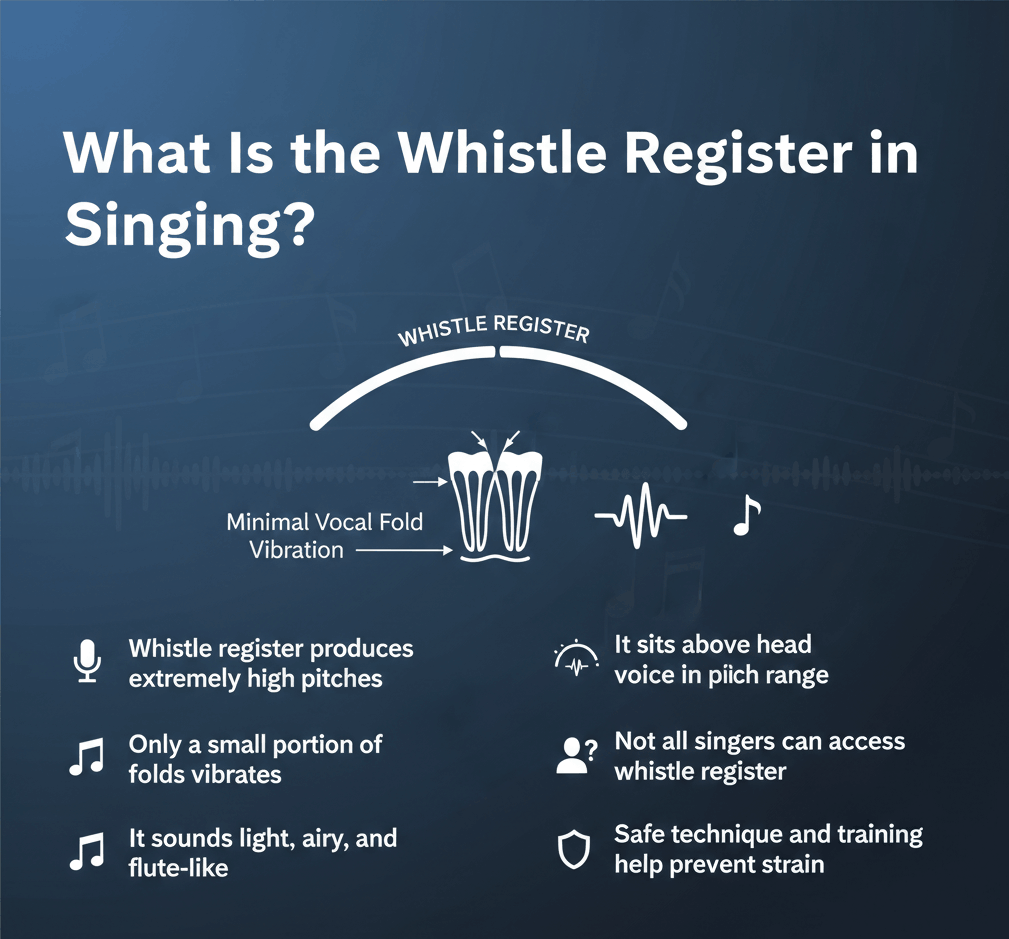
The whistle register is an extremely high vocal register produced with minimal vocal fold contact and very restricted airflow, creating pitches above the typical head voice range.
It is not a required singing skill, and it does not indicate vocal quality, range strength, or talent.
Where the Whistle Register Fits in the Vocal Range
The whistle register sits at the extreme upper edge of vocal production, above head voice.
In practical terms, whistle tones are often:
- Very light and flute-like
- Short and difficult to sustain
- Unstable in pitch and volume
Because of this instability, whistle notes are hard to measure accurately and are frequently misidentified.
👉 Foundational context: What Is Vocal Range
How the Whistle Register Works (Without Overcomplication)
In whistle register production:
- Only a small portion of the vocal folds vibrates
- Airflow is highly restricted
- Pitch increases due to fold tension and configuration, not volume or resonance
This is fundamentally different from chest and head voice, where broader vocal fold contact and resonance play a larger role.
Whistle Register vs Other Vocal Registers
Vocal Register Comparison Table
| Register | Pitch Level | Vocal Fold Contact | Control Level | Typical Use |
|---|---|---|---|---|
| Chest Voice | Low–Mid | Full | High | Speech, singing |
| Head Voice | Mid–High | Moderate | High | Singing |
| Falsetto | High | Light | Moderate | Stylistic |
| Whistle Register | Very High | Minimal | Low | Rare, ornamental |
This explains why whistle register often feels fragile and inconsistent, even in trained singers.
👉 Related comparison:
Chest Voice vs Head Voice
Whistle Register vs Head Voice
One mistake I made early on was assuming:
“If the note is extremely high, it must be whistle register.”
In most cases, it wasn’t.
Many sounds labeled as “whistle notes” are actually:
- Light but controlled head voice
- Falsetto at the top of range
- Brief, unsupported pitch spikes
True whistle register is rare, difficult to sustain, and hard to control dynamically.
Is the Whistle Register Safe?
Safety depends entirely on how it’s approached.
- Accidental or brief whistle tones → generally harmless
- Forcing whistle notes intentionally → increases strain risk
Because whistle register requires extreme coordination, attempting to force it often leads to throat tension rather than improvement.
This is why many experienced vocal coaches recommend not targeting whistle register directly, especially for beginners.
Do You Need the Whistle Register to Be a Good Singer?
No — and this deserves to be stated clearly.
Many excellent singers:
- Never use whistle register
- Never train it
- Never need it
Vocal quality depends far more on:
- Pitch accuracy
- Consistent tone
- Control across registers
- Healthy range usage
👉 Range context:
Typical Vocal Ranges
Why Some Singers Have Whistle Notes
A small number of singers naturally access whistle register due to:
- Vocal fold anatomy
- Neuromuscular coordination patterns
- Style-specific vocal demands
This ability cannot be reliably predicted by voice type or standard range testing.
👉 Examples & context:
Vocal Range of Famous Singers
Is Whistle Register Part of Vocal Range?
Technically, whistle tones can exist above measured vocal range, but they are usually excluded from:
- Functional vocal range
- Tessitura
- Practical voice classification
That’s why most tools focus on repeatable, usable notes, not extreme outliers.
👉 Measurement transparency:
Vocal Range Test Accuracy
Common Whistle Register Myths
| Myth | Reality |
|---|---|
| Whistle register means elite singing | False |
| Everyone can train whistle register | False |
| Whistle notes define vocal range | False |
| Whistle register is necessary | False |
Most misinformation comes from social media exaggeration, not vocal science.
Frequently Asked Questions
What is the whistle register?
An extremely high vocal register with minimal vocal fold contact.
Is whistle register the same as head voice?
No. Whistle register sits above head voice and functions differently.
Can everyone sing in the whistle register?
No. Many singers never access it, even with training.
Is the whistle register dangerous?
It can be if forced. Gentle, accidental tones are usually safe.
How high is the whistle register?
It varies and often exceeds standard measurable vocal range.
Do you need whistle register to sing well?
No. Most singers never use it.
Why do some singers have whistle notes?
Due to natural anatomy and coordination, not effort alone.
Is whistle register part of vocal range?
It’s usually excluded from usable range measurements.
Final Takeaway
The whistle register is real, but it is also optional, rare, and widely misunderstood.
Most singers don’t need it. Many shouldn’t pursue it. And no one should judge their vocal ability based on whether they can produce whistle notes.
When you focus on control, comfort, and consistency, the whistle register becomes what it should be:
an interesting curiosity — not a goal.
- Whistle tones rely on unique cord behavior, which becomes clearer when learning how vocal cords produce pitch and how registers shift during a vocal register test.
- Many singers access whistle notes after mastering transitions between chest voice vs head voice and expanding flexibility through singing exercises.
- Since whistle tones sit outside most classifications, reviewing typical vocal ranges alongside octave vocal range provides useful perspective.
- Some singers explore whistle sounds using controlled techniques explained in how to do whistle voice and advanced how to do whistle tones guides.
- Because whistle notes can inflate perceived ability, it’s important to compare results using vocal range comparison rather than relying only on extremes measured by a vocal range tester.
- You can verify whether a note truly falls into whistle territory by checking frequency with a pitch detector and confirming note placement using a frequency to note converter.