Chest voice and head voice are not two separate voices. They are two different ways your voice coordinates as pitch changes. The difference is not where the sound comes from, but how the vocal cords adjust and resonate.
Most people don’t struggle because they “lack” head voice — they struggle because the transition between the two feels unfamiliar and uncomfortable.
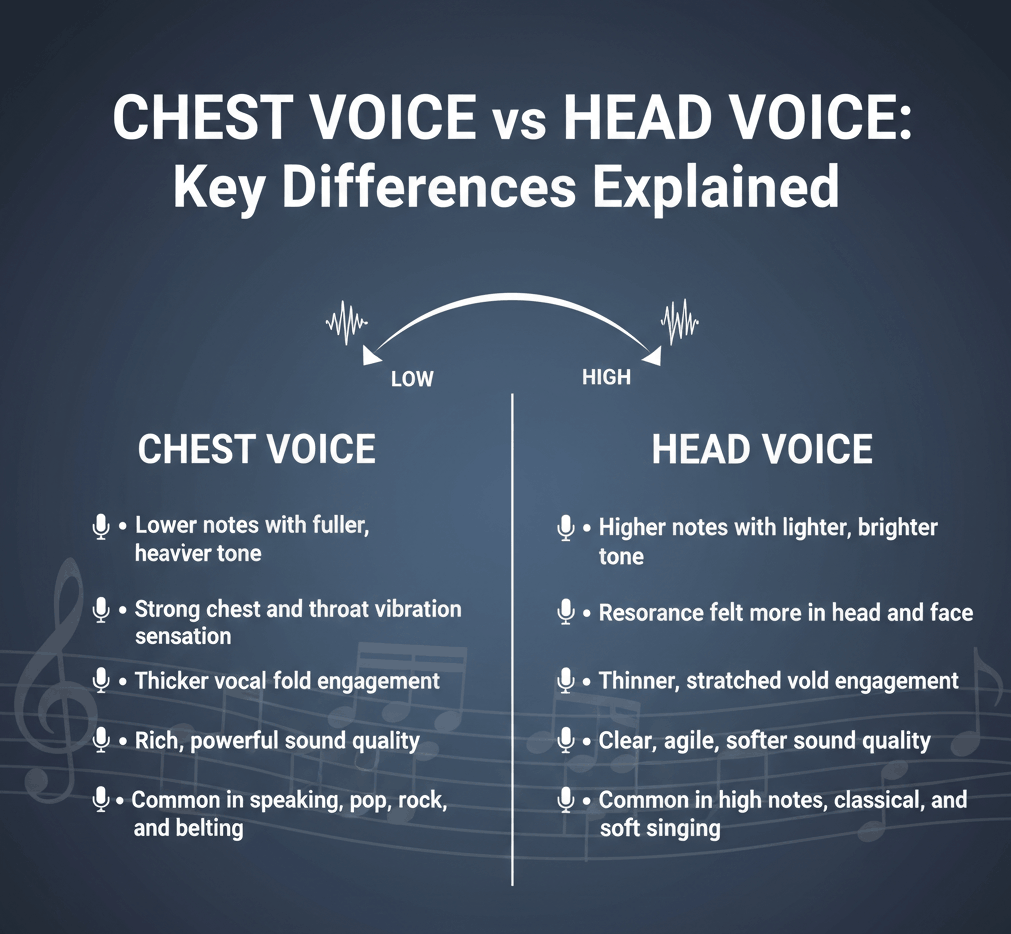
Chest voice is the lower register with a fuller, stronger tone that feels resonant in the chest, while head voice is a higher, lighter register with more flexibility and resonance in the head. Both are essential for vocal range and control.
What People Actually Experience
When people test their voice using a 👉 vocal range test we see the same reactions again and again:
- “My low notes feel strong, but high notes feel fake.”
- “My voice cracks right in the middle.”
- “Head voice feels weak — like it’s not really my voice.”
- “If I push harder, it sometimes works… until it doesn’t.”
This isn’t lack of talent.
It’s normal coordination behavior.
The voice isn’t breaking — it’s changing strategy.
Why This Confusion Happens So Often
Chest voice is how most people speak all day.
Head voice is rarely used intentionally.
So when the voice starts to lighten:
- Sensations change
- Control feels reduced
- Confidence drops
Many people assume something is wrong — when in reality, the voice is doing exactly what it’s supposed to do.
What Is Chest Voice?
Chest voice is the coordination your voice naturally uses for lower pitches and speech.
From experience, chest voice:
- Feels strong and familiar
- Vibrates in the chest and throat
- Feels easy to control
- Works well at lower pitches
The problem isn’t chest voice — it’s trying to drag it higher than it wants to go.
What Is Head Voice?
Head voice is a lighter coordination your voice uses as pitch rises.
What people often feel:
- “It sounds thin”
- “It doesn’t feel powerful”
- “It feels disconnected”
What’s actually happening:
- Vocal folds are thinning
- Less mass is used
- Efficiency increases
Head voice isn’t weak — it’s under-trained.
Chest Voice vs Head Voice Comparison
| Aspect | Chest Voice | Head Voice |
|---|---|---|
| Pitch range | Low to mid | Mid to high |
| Sensation | Heavy, grounded | Light, lifted |
| Familiarity | Very high | Often unfamiliar |
| Common mistake | Pushing it too high | Avoiding it |
| Real role | Strength | Flexibility |
The Real Difference: Coordination, Not Location
Despite the names:
- Sound doesn’t come from your chest
- Sound doesn’t come from your head
The difference is how vocal cords produce pitch as tension and thickness change.
👉 How vocal cords produce pitch explains why pushing harder never fixes the transition.
Why the Voice “Breaks” in the Middle
The break happens when:
- Chest voice stops working efficiently
- Head voice hasn’t fully taken over yet
Most people respond by:
- Pushing harder
- Raising volume
- Tightening the throat
This increases strain and makes the break more dramatic.
The break isn’t damage — it’s a coordination gap.
How Chest Voice and Head Voice Affect Vocal Range
From repeated testing patterns:
- Chest voice limits how high you feel comfortable
- Head voice determines how high you can actually go
Many people think they don’t have high notes when those notes already fall inside their
👉 typical vocal ranges but aren’t accessible yet.
Why Some Days Feel Worse Than Others
This is one of the most frustrating experiences users describe.
On “bad” days:
- Transitions crack more
- Head voice feels unreachable
- Chest voice feels tight
Stress, fatigue, and hydration directly affect coordination — which explains
👉 why vocal range changes even without training differences.
Can You Improve the Chest–Head Transition?
Yes — and safely.
What consistently helps:
- Gentle slides instead of forced notes
- Light vocal warm-ups
- Reducing volume on higher pitches
This is where structured 👉 vocal warm-up exercises make a measurable difference.
Why This Causes Voice Type Confusion
Many people rely only on chest voice when testing.
If head voice isn’t coordinated:
- Upper range appears missing
- Voice type seems lower than expected
This leads to confusion during a 👉 voice type test even though nothing is “wrong.”
Chest voice and head voice are not competing — they are complementary.
Chest voice gives strength and grounding.
Head voice gives range and flexibility.
When they work together:
- Cracking decreases
- High notes feel easier
- Vocal range becomes reliable
Frequently Asked Questions
1. What is the main difference between chest voice and head voice?
The difference is coordination. Chest voice uses thicker vocal fold mass for lower pitches, while head voice uses lighter coordination for higher pitches.
2. Why does my voice crack between chest and head voice?
Because your voice is shifting coordination. The crack happens when chest voice stops working but head voice hasn’t fully engaged yet.
3. Is head voice the same as falsetto?
No. Falsetto is a specific coordination. Head voice can be connected, controlled, and strong when trained properly.
4. Why does head voice feel weak?
Because it uses less vocal fold mass and unfamiliar sensations. Weakness usually comes from lack of coordination, not lack of ability.
5. Should I sing high notes in chest voice?
No. Forcing chest voice upward increases strain and limits range. Higher notes require head voice coordination.
6. Can everyone access head voice?
Yes. All healthy voices can access head voice, even if it feels unfamiliar at first.
7. Does pushing chest voice damage the voice?
Repeatedly pushing can cause strain and fatigue. It’s not immediately dangerous, but it’s inefficient and limiting.
8. How long does it take to smooth the transition?
It varies. Many people notice improvement within weeks once they stop forcing and start coordinating properly.
9. Why does the transition feel harder on some days?
Stress, poor sleep, dehydration, and fatigue all affect coordination and make transitions less stable.
10. Can warm-ups really help with chest to head voice?
Yes. Gentle warm-ups reduce tension and prepare coordination, making transitions smoother and safer.
- To fully grasp vocal production, it helps to understand how the vocal cords produce pitch at different registers.
- Many singers confuse registers with range, so learning what vocal range is adds essential clarity.
- Register transitions become easier when singers practice targeted singing exercises consistently.
- Strengthening upper notes often requires focused techniques to sing high notes without strain.
- Some advanced singers explore extremes like the whistle register after mastering chest and head voice.
- Understanding where your voice sits naturally starts with identifying your voice type.
- You can hear how chest and head voice affect your range by testing notes with the pitch detector.