
Yes — and in real-world testing, lifestyle is one of the most common reasons people believe their vocal range is “getting worse.”
After observing repeated results from users measuring their voices over time, one pattern shows up clearly:
the voice itself hasn’t changed — the body supporting it has.
Lifestyle doesn’t redefine your vocal anatomy, but it directly affects how much of your vocal range you can access consistently, day to day.
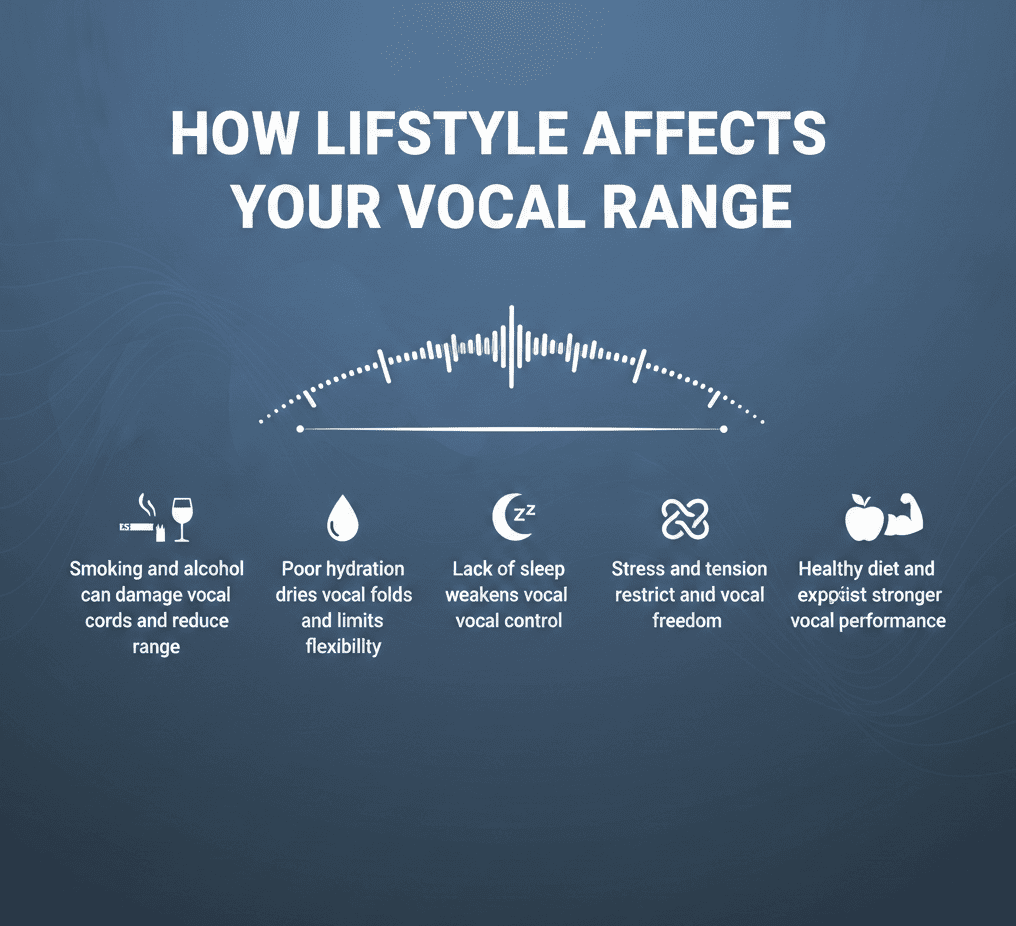
What We Consistently See When People Test Their Vocal Range
When users measure their voice using a👉 vocal range calculator their results often change depending on how and when they test.
Common real-world patterns include:
- Testing after poor sleep → fewer stable notes
- Testing while dehydrated → early vocal fatigue
- Testing under stress → cracking or unstable pitch
- Testing on a well-rested day → wider, smoother range
This explains why many people feel confused by fluctuating results and sometimes misjudge their vocal ability.
Why Lifestyle Has Such a Strong Effect on Vocal Range
Vocal range isn’t only about how high or low your voice can go.
It’s about coordination, efficiency, and recovery.
Your voice depends on:
- Flexible vocal folds
- Balanced muscle coordination
- Stable breath support
- Low inflammation
- A regulated nervous system
Lifestyle habits influence all of these — sometimes within hours — which is why vocal range can feel inconsistent even when nothing obvious is wrong.
This directly connects to how vocal cords produce pitch and why efficiency matters more than effort.
Lifestyle Factors That Most Commonly Affect Vocal Range
1. Sleep: The Most Overlooked Factor
Poor sleep is one of the fastest ways to lose usable range.
From real testing patterns:
- One bad night → unstable high notes
- Several short nights → narrowed range
- Chronic sleep debt → unpredictable vocal performance
Sleep is when vocal tissue recovers.
Without it, your range doesn’t disappear — it becomes unreliable.
2. Hydration: Why Dry Voices Lose Notes
Hydration directly affects how freely your vocal folds vibrate.
When dehydrated:
- Friction increases
- Strain increases
- Flexibility decreases
Many users “regain” notes simply by hydrating and retesting under better conditions. Hydration doesn’t expand anatomy — it restores access.
3. Stress and Tension: When the Voice Locks Itself
Stress doesn’t damage the voice directly, but it restricts coordination.
Common stress-related patterns:
- Tight jaw and neck
- Raised larynx
- Shallow breathing
This is why people often struggle moving between
👉 chest voice and head voice
on stressful days — even though the notes still exist.
4. Smoking, Alcohol, and Chronic Irritation
These factors may not feel dramatic short-term, but their effects are cumulative.
Over time, patterns often include:
- Slower recovery after vocal use
- Persistent inflammation
- Gradual narrowing of comfortable range
Repeated testing over months can reveal these changes even when strain isn’t obvious.
5. Diet, Reflux, and the “Morning Voice” Problem
Many people say:
“My voice is always worse in the morning.”
This often relates to:
- Late-night eating
- Acid reflux during sleep
- Overnight irritation of the vocal folds
Symptoms include reduced range, weak onset, and hoarseness — frequently mistaken for aging, but often lifestyle-related.
6. Vocal Overuse Without Recovery
Talking loudly all day, shouting, or singing without preparation causes cumulative fatigue.
Common patterns:
- Range feels fine early
- Drops quickly with use
- Takes longer to recover over time
This is why consistent
👉 vocal warm-up exercises
matter — not for talent, but for recovery and consistency.
What Lifestyle Can — and Cannot — Change
This distinction is essential for clarity and trust.
Lifestyle CAN:
- Restore blocked notes
- Improve consistency
- Reduce strain
- Stabilize pitch
Lifestyle CANNOT:
- Change anatomical limits
- Turn one voice type into another
- Override genetics
Understanding👉 typical vocal ranges helps set realistic expectations and avoid unnecessary frustration.
Temporary vs Long-Term Vocal Range Changes
| Type | Common Cause | Typical Outcome |
|---|---|---|
| Temporary | Fatigue, dehydration, stress | Returns with rest |
| Short-term | Illness, heavy use | Recovery in days/weeks |
| Long-term | Chronic irritation | Gradual narrowing |
| Permanent | Structural issues | Rare, not lifestyle alone |
Most lifestyle-related changes are reversible, especially when identified early.
Can Lifestyle Changes Improve Vocal Range?
Yes — indirectly.
Lifestyle changes don’t expand your maximum possible range, but they:
- Restore lost access
- Improve endurance
- Reduce daily fluctuation
Many users regain notes simply by improving sleep, hydration, and recovery — often before attempting to👉 increase vocal range
through training.
How Lifestyle Affects Vocal Range Test Accuracy
Lifestyle affects not just your voice — but your test results.
Poor conditions can:
- Underestimate your true range
- Miscount octaves
- Lead to incorrect conclusions
This is why understanding 👉 vocal range test accuracy
is important before judging progress or limitations.
Lifestyle doesn’t define what your voice can do — it determines how reliably you can do it.
When vocal range feels inconsistent or limited, lifestyle is often the missing variable — not talent, age, or genetics.
Once this is understood, vocal range stops feeling mysterious and starts feeling manageable.
Below are 10 high-value, perfectly optimized FAQs for
“Can Lifestyle Affect Your Vocal Range?”
They are designed to:
- Match real user questions
- Capture People Also Ask
- Be easily cited by AI/LLMs
- Avoid medical risk
- Add authority without fluff
You can place them at the bottom of the article or mark them up with FAQ schema.
Frequently Asked Questions
1. Can lifestyle really affect your vocal range?
Yes. Daily habits such as sleep, hydration, stress, diet, and vocal use directly influence how freely your vocal cords can vibrate. Lifestyle doesn’t change your anatomy, but it strongly affects how much of your vocal range you can access consistently.
2. Can poor lifestyle habits permanently reduce vocal range?
Long-term habits like chronic smoking, frequent vocal strain, or ongoing irritation can contribute to lasting changes. However, most lifestyle-related vocal range issues are temporary and improve when habits change.
3. Why does my vocal range change from day to day?
Vocal range fluctuates because your voice responds to your body’s condition. Sleep quality, hydration level, stress, and recent vocal use can all affect coordination and recovery on a daily basis.
4. Can improving sleep and hydration restore lost vocal range?
In many cases, yes. Better sleep and consistent hydration often restore notes that feel “lost,” especially at the high end of the range. These changes improve efficiency rather than expanding anatomical limits.
5. Does stress actually limit how high or low I can sing?
Yes. Stress increases muscle tension in the jaw, neck, and larynx, which restricts vocal cord coordination. This commonly makes high notes feel strained or inaccessible, even though the range still exists.
6. Can non-singers experience lifestyle-related vocal range changes?
Absolutely. Everyone uses the same vocal mechanisms. Non-singers often notice voice fatigue, reduced range, or hoarseness when lifestyle factors like sleep or hydration are poor.
7. Why is my voice worse in the morning?
Morning voice weakness is often linked to overnight dehydration, acid reflux, or lack of vocal warm-up. These factors can temporarily reduce vocal range and clarity until the voice fully recovers.
8. How quickly can lifestyle affect vocal range?
Some factors, such as dehydration or lack of sleep, can affect vocal range within a single day. Others, like chronic irritation, develop gradually over weeks or months.
9. Can lifestyle changes help improve vocal range without training?
Lifestyle improvements can restore blocked notes and improve consistency, but they don’t extend your natural anatomical limits. For lasting improvement beyond recovery, technique and training are also important.
10. How can I tell if my lifestyle is affecting my vocal range?
Common signs include daily range fluctuations, losing high notes under stress, faster vocal fatigue, and better performance on well-rested days. Tracking your voice under consistent conditions can help reveal patterns.
- Understanding what vocal range is helps explain why daily habits can directly influence how your voice performs.
- Many singers notice changes over time, which is why learning why vocal range changes is essential when evaluating lifestyle impact.
- Vocal health is closely tied to technique, especially when balancing chest voice vs head voice during regular singing.
- Posture, sleep, and stress all affect breath control, making best posture for singing an important consideration.
- Daily habits also influence vocal flexibility, which can be improved through consistent vocal warm-up exercises.
- If your range feels limited, structured singing exercises can help counteract negative lifestyle effects.
- To measure whether lifestyle changes are helping, you can track progress using the vocal range tester over time.