
The best singing exercises for beginners are gentle vocal exercises that reduce tension, improve pitch control, and build coordination without forcing volume or high notes.
Beginner singing exercises include lip trills, humming, sirens, scale runs, and breath control drills. These warm up the voice, improve pitch accuracy, build vocal strength, and reduce strain. Practice daily for better tone, range, and control.
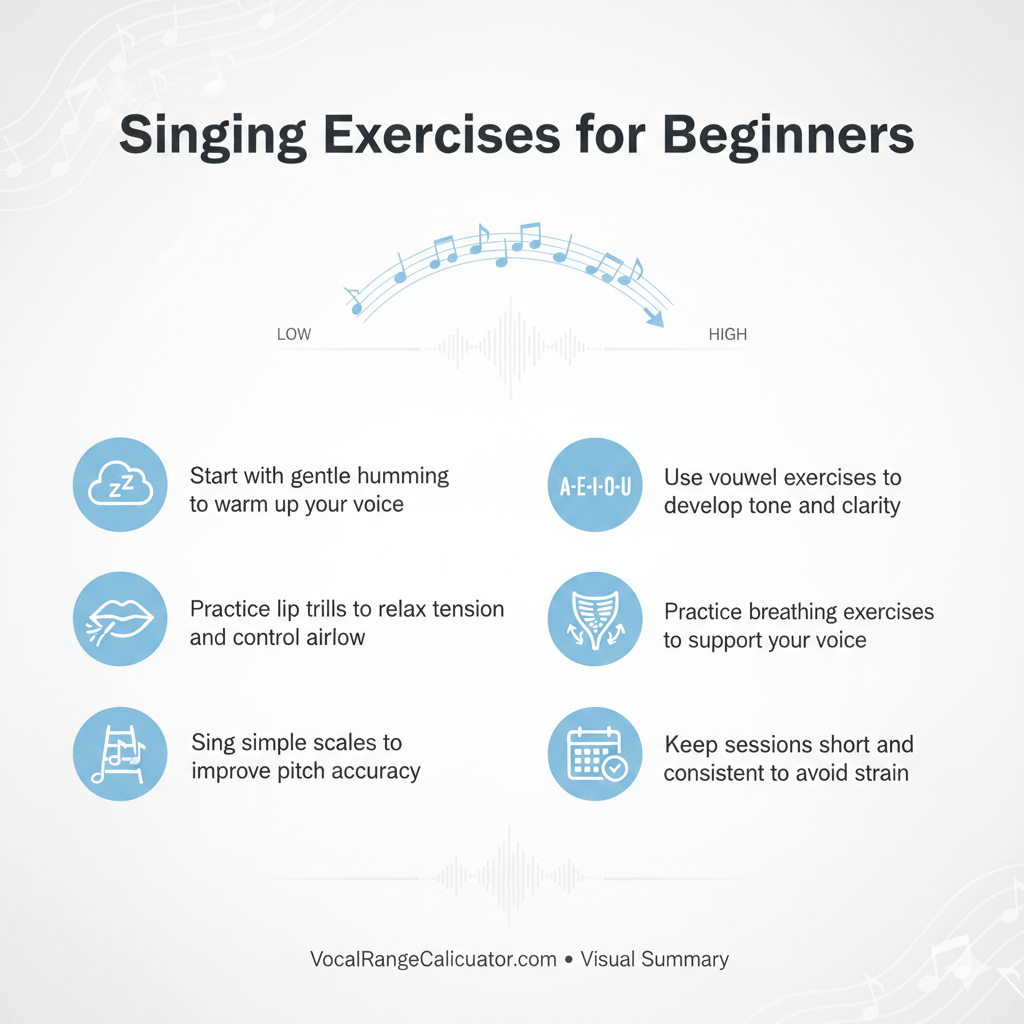
Beginners don’t need complicated drills. They need exercises that feel easy and repeatable. Using a voice range calculator supports better song choice.
Why Singing Exercises Feel Awkward at First (Real Experience)
Almost every beginner feels the same discomfort in the first few weeks:
- “Why do these exercises sound weird?”
- “I feel silly making these noises.”
- “My throat tightens after a few minutes.”
- “Am I doing this wrong?”
We felt this too.
The biggest early mistake was assuming good exercises should sound good immediately. They usually don’t. Good exercises often sound strange — but feel comfortable.
Comfort matters more than sound quality at the beginning.
What Singing Exercises Are Actually Training
Singing exercises are not meant to impress.
They exist to train coordination, not performance.
Specifically, they help:
- Vocal cords vibrate more efficiently
- Pitch become more stable
- Throat tension reduce
- Breath and voice work together
This makes much more sense once you understand👉 how vocal cords produce pitch
and why pushing harder never fixes pitch problems.
Small Problems We Faced as Beginners (And What Fixed Them)
1. Singing Too Loud to “Feel” Progress
Early practice often involved singing louder to feel powerful.
What happened:
- Faster fatigue
- Tight throat
- Less control
Lower volume immediately improved pitch accuracy and comfort.
2. Trying High Notes Too Early
We wanted to “test” the voice constantly.
Result:
- Cracking
- Frustration
- Fear of damaging the voice
Learning the difference between👉 chest voice vs head voice
explained why high notes need lighter coordination, not more force.
3. Skipping Warm-Ups
Skipping warm-ups felt harmless — until it wasn’t.
This caused:
- Reduced range
- Unstable pitch
- Immediate tension
Warm-ups didn’t make singing harder — they made it possible.
Best Singing Exercises for Beginners (Step-by-Step)
1. Gentle Humming
Why it works:
Humming naturally reduces tension and stabilizes pitch.
How to do it:
- Hum softly on a comfortable note
- Keep lips relaxed
- No pushing, no volume
This is one of the safest exercises for beginners.
2. Lip Trills (Buzzing Lips)
Why it works:
Lip trills balance airflow and vocal cord vibration automatically.
How to do it:
- Relax lips
- Blow air gently to create a “brrr” sound
- Slide up and down slowly
If it stops, airflow is too strong.
3. Sirens (Low-to-High Slides)
Why it works:
Sirens train smooth pitch changes without breaking.
How to do it:
- Start low
- Slide upward slowly
- Keep volume light
This directly helps with
👉 singing high notes
without strain.
4. Simple 5-Note Scales
Why it works:
Short scales improve pitch accuracy without overwhelming the voice.
How to do it:
- Use “OO” or “EE”
- Stay in a comfortable range
- Stop before tension appears
How Long Beginners Should Practice
More practice is not better.
Recommended:
- 10–15 minutes
- 3–5 times per week
- Stop if tightness appears
Short, relaxed sessions outperform long, forced ones.
How Beginners Can Track Progress Without Guessing
Progress doesn’t show up as “sounding professional” quickly.
Better signs:
- Less throat tension
- Easier pitch control
- More consistent notes
Understanding 👉 why vocal range changes also prevents panic when results vary day to day.
Common Beginner Mistakes That Slow Progress
| Mistake | Why It Causes Problems |
|---|---|
| Singing too loud | Creates tension |
| Forcing high notes | Blocks coordination |
| Skipping warm-ups | Reduces control |
| Practicing while tired | Increases strain |
| Comparing to others | Kills confidence |
Avoiding mistakes often improves singing faster than adding new exercises.
What Beginners Should Expect (Realistic Timeline)
Beginners often expect:
- Big range increases fast
- Strong tone immediately
- No cracking
Reality:
- Comfort improves first
- Control comes before power
- Confidence builds gradually
This is normal and healthy.
Beginner singing exercises should feel easy, not impressive.
If exercises:
- Reduce tension
- Improve coordination
- Stay comfortable
Progress becomes steady — and confidence follows naturally.
Frequently Asked Questions
1. Are singing exercises safe for beginners?
Yes, when they’re gentle and not forced.
2. How long should beginners practice singing?
10–15 minutes per session is enough.
3. Should beginners sing high notes?
Only lightly. Forcing causes strain.
4. Why does my voice crack during exercises?
Coordination is developing — it’s normal.
5. Do exercises sound bad at first?
Often yes. Comfort matters more than sound.
6. Can beginners practice every day?
Only if the voice feels rested.
7. Is humming really effective?
Yes. It reduces tension and stabilizes pitch.
8. Should beginners use online tools?
Yes. Tools help track progress objectively.
9. Why does my voice feel different every day?
Sleep, hydration, and stress affect coordination.
10. When will singing feel easier?
Usually within a few weeks of consistent practice.
- Before starting any routine, beginners should understand what vocal range is and how exercises support it.
- Simple routines work best when combined with proper vocal warm-up exercises to avoid strain.
- Many beginner mistakes come from poor alignment, which is why best posture for singing matters early on.
- Learning how registers function helps beginners control sound, especially when practicing chest voice vs head voice.
- As confidence grows, structured singing exercises help build consistency and strength.
- Beginners can track improvement by checking notes with a pitch detector during practice.
- Once comfortable, testing progress with a vocal range test provides clear feedback.