
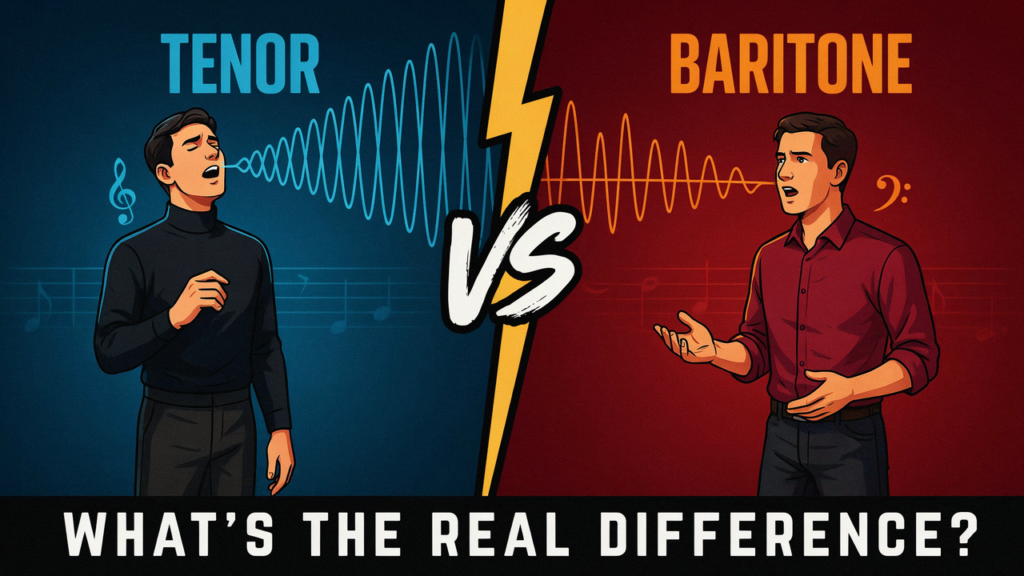
Short answer: Tenor is higher than baritone. A tenor is the highest common male voice, with a typical range of about C3 to C5; a baritone is the middle male voice, about A2 to A4, three semitones lower. They share most of their notes, so the real difference is where the voice is comfortable, where it changes register and how it sounds: bright and ringing on top for a tenor, warm and full in the middle for a baritone.
Tenor vs Baritone Range
Typical ranges: Tenor C3–C5, Baritone A2–A4. They share 22 notes (C3–A4), so range alone rarely decides. Choose your lowest and highest comfortable notes to see which fits you.
- Tenor C3–C5 · 131 Hz–523 HzHighest common male voice; bright and ringing
- Baritone A2–A4 · 110 Hz–440 HzMiddle male voice; warm and full
Typical classical ranges; many voices go beyond them. Range is one part of voice type: tone colour, tessitura and where your voice changes register matter too.
Tenor vs Baritone at a Glance
| Tenor | Baritone | |
|---|---|---|
| Typical range | C3–C5 (131–523 Hz) | A2–A4 (110–440 Hz) |
| Comfortable zone (tessitura) | About E3–A4 | About C3–E4 |
| Highest notes in full voice | A4–C5 (“high C”) | About F4–G4 |
| Register change | Around E4–G4 | Around C4–E4 |
| Sound | Bright, ringing, light to powerful | Warm, rich, fuller in the middle |
| How common | Less common | The most common male voice |
| Choir part | Tenor | Bass, or Tenor 2 in some pieces |
Is Tenor Higher Than Baritone?
Yes. The typical tenor range starts and ends a minor third (three semitones) above the baritone’s: C3 against A2 at the bottom, C5 against A4 at the top. That sounds like a small gap, and it is: the two voices share everything from C3 to A4, which is 21 of the tenor’s 24 semitones. That is why the lowest and highest notes you can reach are poor clues on their own, and why tenor and baritone is the most common borderline of all voice types.
What Is a Tenor?
The tenor is the highest common male voice. Tenors switch into head voice later than lower voices, which lets them sing high melodies in full voice around G4 to B4, the notes that make pop choruses and opera arias sound exciting. A tenor’s voice sounds its best from about E3 to A4, and it can feel thin or weak below C3. Types of tenor, famous tenors and why some women sing tenor are covered in the tenor voice guide.
What Is a Baritone?
The baritone sits between tenor and bass and is the voice most men have. Baritones sound full and warm in the middle of the range, speak a little lower than tenors, and can sing up to about F4 or G4 in full voice before the sound becomes strained or they need to change register. Trained baritones reach A4 and higher, but they can’t stay up there as long as a tenor. How a baritone differs from the voice below it is explained in baritone vs bass.
Why Your Highest Note Doesn’t Decide It
Many baritones can hit a tenor’s A4 once, and many tenors can growl down to a baritone’s A2. What they can’t do is live there. A tenor can sing a whole song around E4 to G4 and sound better for it; a baritone gets tired, pushes or cracks. A baritone can sing a whole song around C3 to E3 with a full sound; a tenor sounds weak and breathy. That comfortable zone is called tessitura (see what tessitura is), and it matters more than any single note.
Famous singers show the same thing. On this site’s singer pages, Chris Cornell, a baritone, reaches A5, higher than Adam Levine, a tenor, whose top is E5. Cornell’s A5 is a rock scream at the edge of his voice; Levine’s high songs sit comfortably high for three minutes at a time.
The Register Change: The Best Single Clue
Every voice has a point where the chest voice has to hand over to a lighter head voice, called the passaggio or register change. It is set by the size of the vocal folds, so it barely moves with training, which makes it a more reliable clue than range. Tenors change around E4 to G4; baritones lower, around C4 to E4. If your voice starts to flip, thin out or strain around D4, you are probably a baritone; if you can sing F4 in a strong, easy chest or mixed voice, you may be a tenor. The vocal register test maps where your chest and head voice meet.
How They Sound
- Tenor: bright and ringing, with a clear top that cuts through a band or an orchestra. The middle can sound light.
- Baritone: warm, rich and full in the middle; the top sounds darker and heavier, and often more intense because it takes more effort.
- Speaking voice: tenors usually speak a little higher, but many tenors speak low, so speech alone is a weak clue.
Types of Tenor and Baritone
| Voice | Character | Example role |
|---|---|---|
| Light lyric tenor (leggero) | Light, agile, very high | Nemorino, L’elisir d’amore |
| Lyric tenor | Warm and sweet, the most common tenor | Rodolfo, La bohème |
| Dramatic tenor / Heldentenor | Heavy, dark, powerful; close to a baritone in colour | Siegfried, Wagner |
| Lyric baritone | Light, flexible, easy top | Figaro, The Barber of Seville |
| Verdi baritone | Big, dark, with a strong high range | Rigoletto |
| Bass-baritone | Baritone top with a bass’s depth | Wotan, Wagner’s Ring |
A dark dramatic tenor and a bright lyric baritone can sound more alike than two tenors do. The full classical system of voice sub-types is explained in the vocal Fach system.
What Is a Baritenor?
An informal name, mostly used in musical theatre and pop, for a singer with a baritone’s warm middle and a tenor’s easy top. It is not a classical voice type. Most so-called baritenors are high baritones or low tenors whose voices have been trained to cover both kinds of songs.
Famous Tenors and Baritones
| Tenors (reported range) | Baritones (reported range) |
|---|---|
| Adam Levine (C3–E5) | Freddie Mercury (F♯2–G5) |
| Benson Boone (E3–F5) | David Bowie (C2–E5) |
| Billy Joel (A2–C5) | Chris Cornell (C♯2–A5) |
| Brendon Urie (D2–D6) | Post Malone (E2–F5) |
| Bruno Mars (G♯2–A5) | Kurt Cobain (F2–C5) |
| The Weeknd (F2–G♯5) | Bob Dylan (C2–D5) |
Ranges and voice types are the headline figures on this site’s singer pages; like many pop and rock singers, several extend their range with growls at the bottom and falsetto or screams at the top. That is why some tenors show lower notes than some baritones.
Is Adam Levine a tenor or baritone?
A tenor (C3–E5). His songs sit high, around E4 to A4, and his light, bright tone is typical of a lyric tenor.
Is Billy Joel a tenor or baritone?
Classified as a tenor (A2–C5). His later, lower-key performances make many listeners call him a baritone, a good example of how blurry the line is in pop.
Are Benson Boone and Brendon Urie tenors?
Yes, both are classified as tenors: Benson Boone E3–F5, known for high belted notes, and Brendon Urie D2–D6, whose four-octave range includes very low and very high extremes.
Tenor and baritone in the same opera
To hear the difference in one style and language, compare the tenor and baritone leads of one opera: Nemorino and Belcore in L’elisir d’amore, Rodolfo and Marcello in La bohème, or Don José and Escamillo in Carmen. The tenor gets the high, lyrical love songs; the baritone the lower, weightier music.
Tenor and Baritone in a Choir
Four-part choir music has two male parts, tenor (about C3–A4) and bass (about E2–D4), and no baritone part. Most baritones sing bass, and high baritones sing Tenor 2 when a choir is short of tenors or the part sits low. The ranges of every part are in choral vocal ranges.
Can a Baritone Become a Tenor?
Training adds notes at the top and makes the register change smoother, so a baritone can learn to sing many tenor songs, often in a slightly lower key. It doesn’t change the size of the voice. Some singers are re-classified because they were labelled too early: Lauritz Melchior began his career as a baritone and became one of the great Wagner tenors, and Plácido Domingo started as a baritone, became a star tenor and returned to baritone roles late in his career. Such moves happen over years with a teacher, not by forcing high notes.
Am I a Tenor or a Baritone?
- Warm up for a few minutes, then find your lowest and highest comfortable notes.
- A comfortable top around A4 and weak notes below C3 point to tenor; a top around F4–G4 and a full sound down to A2 point to baritone.
- Sing a song that stays around E4–G4: easy and ringing for a tenor, tiring for a baritone.
- Note where your voice changes register: around E4–G4 (tenor) or C4–E4 (baritone).
- Test again on another day and trust the result you can repeat.
The voice type test measures your range and shows how closely you match each voice type. For your exact notes, octaves and the famous singers with the closest range, use the vocal range calculator. If your top stops around E4, compare tenor vs bass too.
Frequently Asked Questions
Which is higher, tenor or baritone?
Tenor. Its typical range is about three semitones higher, and its comfortable zone sits higher still.
Is baritone the most common male voice?
Yes. Most men are baritones; true tenors and true basses are both less common.
What is between tenor and baritone?
No official voice type. Singers in between are called high baritones, low tenors or, informally, baritenors.
Can a tenor sing baritone songs?
Usually yes, though the lowest notes may sound thin. Singing them a few semitones higher often suits a tenor better.

Conan is a vocal analysis and singing tools writer specializing in vocal range testing, pitch recognition, voice classification, and music education for singers, musicians, and beginners. He creates practical, easy-to-understand content focused on vocal analysis tools, singing improvement, and voice training resources.