
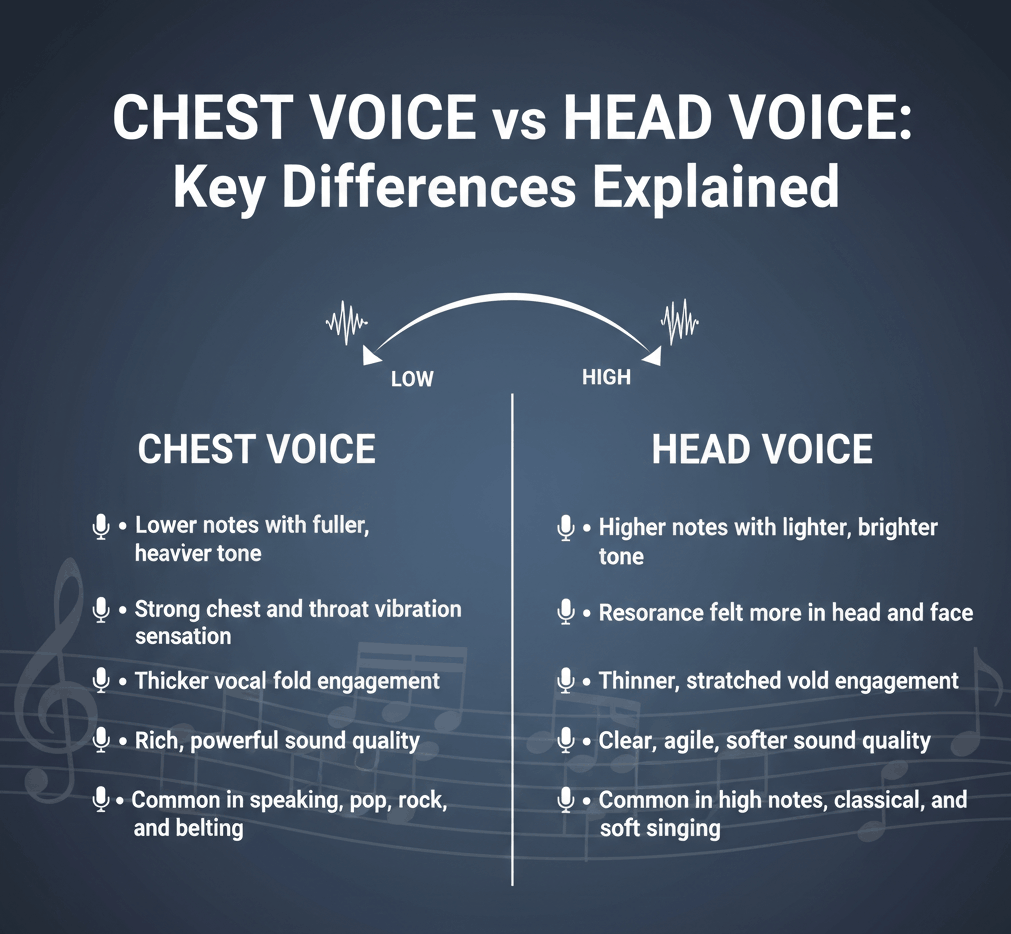
Chest voice and head voice are two ways the singing voice coordinates as pitch, volume, vowel shape and tone change. Chest voice usually sounds fuller and more speech-like and is common on lower notes. Head voice usually feels lighter and more flexible and helps singers reach higher notes without carrying excessive vocal weight upward.
Despite their names, sound is not produced separately in your chest or head. It begins with vibration at the vocal folds and is shaped by the vocal tract. “Chest” and “head” partly describe the sensations singers may notice while using different vocal coordinations.
Use this voice range calculator to get a better understanding of the notes within your singing range.
Chest Voice vs Head Voice: Quick Comparison
| Feature | Chest Voice | Head Voice |
|---|---|---|
| Typical pitch area | Lower to middle range | Middle to upper range |
| Sound quality | Full, warm, speech-like | Lighter, brighter or more ringing |
| Vocal-fold behavior | Generally thicker configuration with more closure | Generally thinner, lengthened configuration |
| Common sensation | Vibration in the chest, mouth or throat | Vibration around the face or head |
| Typical use | Speech-like singing, strong lower phrases | Higher melodies, sustained upper notes |
| Common mistake | Pulling excessive weight too high | Making the sound unnecessarily breathy |
| Main strength | Depth and solidity | Flexibility and upper-range access |
These are tendencies, not rigid rules. A trained chest voice can be light, and a developed head voice can sound strong. The same pitch may also be produced with different tone qualities depending on the singer, vowel, volume and musical style.
What Is Chest Voice?
Chest voice is the fuller, speech-like coordination commonly used for lower and middle pitches. If you say “hey” at a comfortable volume and then sustain that pitch, the resulting sound will probably resemble your chest voice.
In this coordination, the vocal folds generally remain relatively thick and make firm contact during each vibration cycle. This can create a sound with strong lower harmonics and a clear, substantial tone.
Singers often experience chest voice as:
- Familiar and close to the speaking voice
- Full or grounded in tone
- Easy to project at comfortable pitches
- Accompanied by vibration around the sternum, throat or mouth
Feeling vibration in the chest does not mean the chest is producing the note. The vocal folds create the initial sound, while the throat, mouth and other parts of the vocal tract shape it. You can learn more about how vocal folds produce and change pitch before that sound is filtered into a recognizable voice.
Chest voice is not harmful by itself. Problems are more likely when a singer tries to preserve the same heavy, loud coordination as the melody rises beyond a comfortable point.
What Is Head Voice?
Head voice is a lighter coordination often used in the middle and upper parts of the range. The vocal folds generally lengthen and become thinner as pitch rises, allowing them to vibrate more quickly.
Head voice may sound:
- Clear and ringing
- Light or flute-like
- Less speech-like than chest voice
- Flexible on higher notes
- Focused without necessarily being loud
Some singers feel vibration behind the eyes, around the cheekbones or near the top of the head. Others notice little vibration in those areas. Sensation can help you explore your voice, but it is not a reliable test on its own.
Head voice is not inherently weak, fake or feminine. Singers of any voice type may use a lighter upper-register coordination. Its strength and tone depend on training, vocal-fold closure, resonance choices, pitch and volume.
If you are unsure which coordination you are producing, a vocal register test can help you observe where the sound changes as you move through your range.
What Actually Changes Between Chest and Head Voice?
Both sounds are produced by the same vocal folds. What changes is their coordination.
Chest-register production is often associated with a greater contribution from the thyroarytenoid muscles, a thicker vocal-fold configuration and a longer closed phase. Head-register production generally uses a thinner, lengthened configuration with a greater relative contribution from the cricothyroid muscles.
However, the muscles do not operate as simple on-and-off switches. Both muscle groups can remain active while their balance changes. Vocal-fold closure, breath pressure, vowel choice and vocal-tract shape also influence the resulting sound.
Some teachers call these coordinations Mode 1 and Mode 2. Others use terms such as chest register, head register, modal voice, falsetto or upper register. Because terminology differs among vocal traditions, two teachers may use “head voice” differently even when describing similar sounds.
The Voice Foundation’s overview of voice production explains how airflow initiates vocal-fold vibration and how the vocal tract then modifies the sound.
How to Tell Whether You Are Using Chest or Head Voice
Try this simple exploration at a comfortable volume:
- Speak “hey” naturally and sustain the vowel on the same pitch.
- Sing a short descending pattern from that note.
- Notice whether the sound remains full and speech-like.
- Next, imitate a gentle “woo” or quiet owl hoot on a comfortable higher note.
- Slide downward slowly without adding extra volume.
- Compare the weight, tone and effort of the two sounds.
The speech-like “hey” will usually encourage chest-dominant coordination. The gentle “woo” often makes a lighter head-register sound easier to find.
Do not judge the result only by where you feel vibration. Listen for differences in vocal weight, tone, airflow and ease. A recording can reveal changes that are difficult to hear while you are singing.
Chest Voice vs Head Voice vs Falsetto vs Mixed Voice
| Coordination | Typical sound | Vocal-fold contact | Common use |
|---|---|---|---|
| Chest voice | Full, speech-like and substantial | Generally firmer | Lower phrases and speech-like singing |
| Head voice | Light, clear and ringing | Usually more complete than a breathy falsetto | Flexible upper notes |
| Falsetto | Airy, soft or flute-like | Often less complete | Light upper notes and stylistic effects |
| Mixed voice | Balanced or blended quality | Varies along a continuum | Smoothing the transition between lower and upper coordination |
The distinction between head voice and falsetto is not described identically in every teaching system. Some teachers separate a connected head voice from a breathier falsetto. Others use “falsetto” or Mode 2 for a broader group of upper-register sounds.
Mixed voice is also not two physical voices playing simultaneously. It describes a coordinated balance that preserves some chest-like strength while allowing the vocal folds and vocal tract to adjust for higher pitches.
Why Your Voice Cracks Between Chest and Head Voice
The transition area between registers is often called the passaggio, bridge or vocal break. Its location varies with anatomy, voice type, pitch, vowel, volume and the coordination being used.
A crack can occur when the voice changes abruptly from one strategy to another. Common triggers include:
- Carrying a heavy chest coordination too high
- Increasing volume as the pitch rises
- Tightening the jaw, tongue or throat
- Using a vowel shape that becomes inefficient
- Delaying the register adjustment
- Trying to prevent every audible change
An occasional crack is not necessarily evidence of vocal damage. It may simply reveal an uncoordinated transition. Persistent pain, hoarseness, loss of voice or an unusual change in singing ability deserves more attention.
How to Switch From Chest Voice to Head Voice Smoothly
The goal is not to eliminate every difference between the registers. It is to make the adjustment gradual enough that the voice remains comfortable and the musical line stays controlled.
Begin with a few gentle vocal warm-up exercises rather than testing your highest notes immediately.
Lip-Trill or Straw Siren
Make a lip trill, or phonate gently through a singing straw, while sliding from a comfortable low note to a comfortable high note and back down.
Keep the volume moderate and allow the sound to become lighter as it rises. This semi-occluded exercise can make the transition easier to explore without demanding a loud tone.
Light “Woo” Slide
Sing “woo” on a gentle ascending and descending slide. Use a small, easy sound rather than trying to preserve the weight of your speaking voice.
If the voice cracks, reduce the volume and shorten the slide. Do not squeeze the throat to hide the change.
Descending Head-Voice Pattern
Begin with an easy head-voice note and sing a five-note descending scale on “oo” or “ee.” Try to retain some of the upper register’s ease as you descend.
Starting above the transition can be helpful because it avoids the habit of pushing chest voice upward. Additional targeted singing exercises can gradually develop control across different parts of the range.
Stop if an exercise causes pain, burning, persistent throat tightness or worsening hoarseness. When high notes repeatedly require force, use techniques designed to help you sing high notes without straining or work with a qualified voice teacher.
When to Use Chest Voice, Head Voice or a Mix
There is no universal note where every singer should switch. The most suitable coordination depends on:
- The pitch and vowel
- Required volume
- Musical style
- Desired tone or emotion
- The singer’s anatomy and training
- Notes immediately before and after the transition
Chest voice may suit a grounded, speech-like phrase. Head voice may suit a flexible or sustained upper line. A mixed coordination can help retain clarity and intensity through the middle and upper range without carrying unnecessary weight.
Belting, classical singing, choral music and conversational pop singing may use different registration and resonance strategies. The objective is not to make every style sound identical—it is to produce the intended sound efficiently.
Common Mistakes to Avoid
- Pulling chest voice upward: More effort does not automatically create a better high note.
- Treating head voice as falsetto by default: A head-register sound does not have to be weak or excessively airy.
- Adding volume to prevent a crack: This often increases pressure and makes the transition harder.
- Copying another singer’s switching note: Passaggio locations are individual and can change with technique and vowel.
- Judging by vibration alone: Physical sensations vary and do not provide a complete diagnosis of register.
- Practising through pain: Productive training may feel unfamiliar, but it should not cause persistent pain or worsening hoarseness.
The American Speech-Language-Hearing Association recommends attention to warning signs such as persistent hoarseness and pain or discomfort during speaking or singing. A laryngologist or voice-specialized speech-language pathologist can assess ongoing symptoms.
How Registers Affect Your Vocal Range
Vocal range and vocal register are related but not identical. Your range is the span between the lowest and highest notes you can produce under defined conditions. A register describes a pattern of vocal production within part of that span.
If you test only with a speech-like chest coordination, your upper result may underestimate notes available in head voice. Conversely, producing one extreme upper note does not prove that the note is comfortable, repeatable or musically useful. Understanding what vocal range means helps separate total range from tessitura and usable singing range.
When you find your vocal range, record the registers used for your lowest and highest notes. This provides more context than reporting two note names alone. Singers who want to develop their vocal range gradually should focus on coordination and consistency rather than forcing extreme notes.
Frequently Asked Questions
What is the main difference between chest voice and head voice?
Chest voice is generally fuller and more speech-like, while head voice uses a lighter vocal-fold coordination suited to higher pitches. Both are produced by the same vocal folds.
Is head voice the same as falsetto?
Not in every teaching system. Many teachers describe head voice as a more connected upper-register sound and falsetto as breathier, but terminology varies across vocal traditions.
Is head voice weaker than chest voice?
Not necessarily. An undeveloped head voice may initially sound quiet, but trained singers can produce clear and resonant upper notes without making them heavy.
Why does my voice crack when I sing higher?
A crack often occurs when the voice changes abruptly between registration strategies. Excessive volume, tension, vowel choice and delaying the adjustment can make the transition more noticeable.
Can chest voice be used for high notes?
Chest-dominant qualities can extend upward, especially in contemporary styles, but trying to keep the same heavy coordination indefinitely can create unnecessary effort. Higher notes usually require some adjustment in vocal-fold and vocal-tract coordination.
Where should I switch from chest voice to head voice?
There is no single switching note for everyone. The transition depends on the singer, vowel, volume, style and intended tone.
Can everyone improve the transition between registers?
Many singers can improve register coordination through gentle, consistent practice. The pace and result vary, and persistent discomfort or voice changes should be evaluated by an appropriate voice professional.