
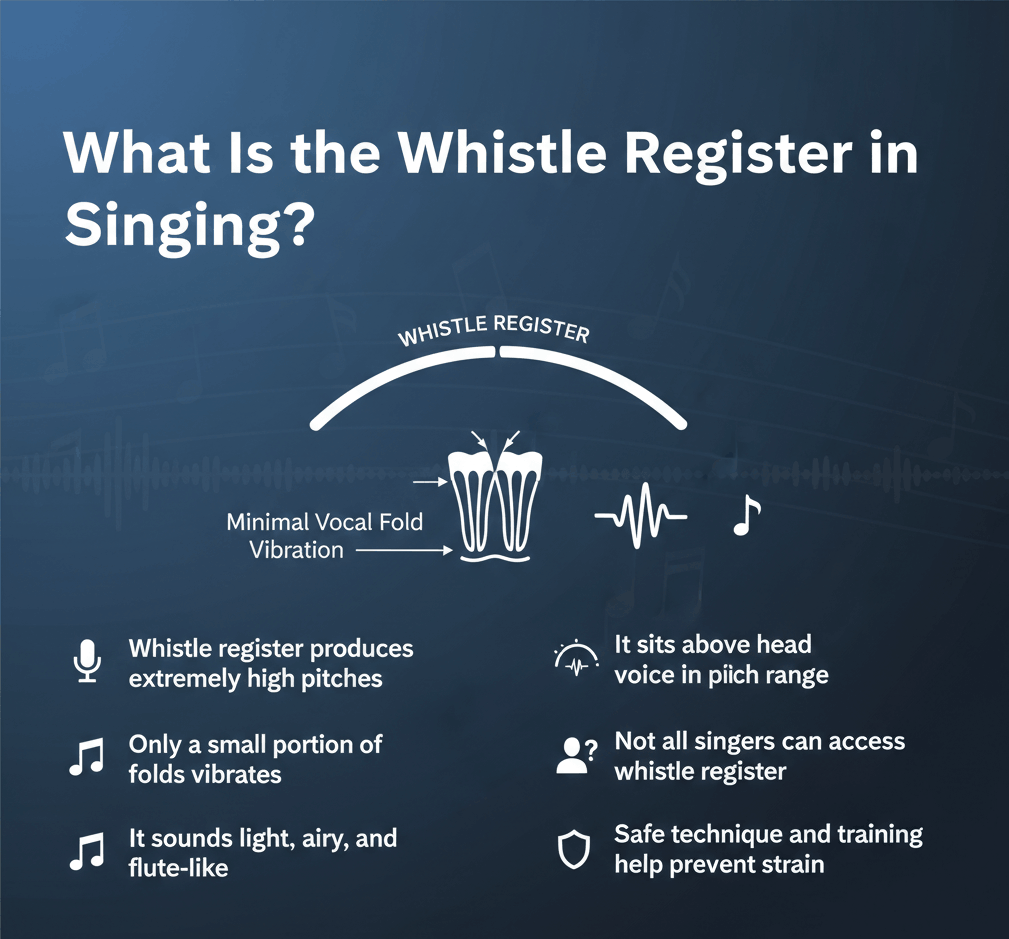
The whistle register is generally considered the highest register of the human singing voice. It produces extremely high, bright tones that can resemble a whistle or flute. It is also called whistle voice, flute register, flageolet register, or M3 in some voice-science frameworks.
Whistle notes are commonly heard above the upper head-voice range, often around C6 or D6 and higher. However, there is no universal note at which every voice changes into whistle register. A high pitch alone does not prove which vocal mechanism produced it.
Whistle register is impressive, but it is not required for good singing. It also should not be confused with a singer’s comfortable range, tessitura, or voice type.
Want to know the full range of notes you can sing? Try our online vocal range calculator to measure your range.
What Is the Whistle Register?
A vocal register is a group of tones produced with a broadly similar pattern of vocal-fold behavior and acoustic quality. That makes the whistle register different from simply reaching an unusually high note.
Whistle-register tones usually have several recognizable qualities:
- An extremely high pitch
- A bright, narrow or flute-like sound
- Relatively little audible weight
- Limited vowel clarity
- A tone that may feel separate from ordinary singing
- Less dynamic flexibility than chest or head voice
The whistle register is only one part of the larger system described in our guide to what vocal range means. A singer may produce one isolated whistle note without being able to use it reliably in a song.
What Does Whistle Register Sound Like?
A whistle note often sounds clear, piercing and almost instrument-like. Its spectrum may contain a strong fundamental frequency with fewer prominent overtones than lower vocal registers, contributing to its comparatively pure tone.
However, sound quality alone cannot confirm whistle register. Several other sounds may be mistaken for it:
- A very high, light head-voice note
- Falsetto at the upper edge of the range
- A brief squeak or pitch break
- An inhaled vocal sound
- Air whistling somewhere above the larynx
A recognizable musical pitch produced intentionally and repeatedly provides better evidence than a single uncontrolled squeak. Even then, directly identifying the vocal-fold mechanism generally requires specialized observation rather than listening alone.
What Is the Whistle Register Range?
Whistle register is often discussed as beginning around C6 or D6, approximately 1,047–1,175 Hz. Some singers may transition into a whistle-like mechanism below or above that area.
The following notes provide useful reference points, not fixed register boundaries:
| Note | Frequency | General Context |
|---|---|---|
| C6 | 1046.50 Hz | A common reference point for extremely high singing |
| D6 | 1174.66 Hz | Frequently cited near the beginning of whistle territory |
| F6 | 1396.91 Hz | Reachable in high classical singing without necessarily being whistle |
| C7 | 2093.00 Hz | Clearly within the extreme upper vocal range |
| D7 | 2349.32 Hz | One octave above D6 |
The same note may be produced differently by different singers. A trained soprano, for example, may sing a pitch around C6 or above using an extended head-register coordination, while another singer may transition into a whistle-like mechanism at a lower pitch.
For that reason, statements such as “every note above C6 is a whistle note” are inaccurate.
How Does the Whistle Register Work?
Ordinary vocal sound begins when airflow from the lungs interacts with the vocal folds in the larynx. Changes in vocal-fold length, tension, vibrating mass and airflow affect how quickly the folds oscillate and therefore affect pitch. Our explanation of how vocal cords produce pitch covers this relationship in more detail.
Whistle-register physiology is still being investigated. High-speed imaging studies have documented vocal-fold oscillation during extremely high phonation, but researchers do not yet agree on one complete mechanism for every whistle-like sound.
Proposed explanations include:
- Only a small or effectively shortened section of the folds participating in vibration
- Extremely shallow vibration involving very little tissue mass
- Specialized vocal-fold tension and closure patterns
- Interactions between the sound source and a very small vocal-tract resonance
The National Center for Voice and Speech describes several competing hypotheses and notes that production at frequencies of several thousand hertz remains incompletely understood. Therefore, claims that whistle register always comes from one tiny section of the vocal folds should be presented as a hypothesis or observed pattern—not a universal fact.
Whistle Register vs Head Voice and Falsetto
Whistle register commonly occurs above head voice and falsetto, but the boundaries may overlap. Pitch alone cannot reliably separate them.
| Feature | Head Voice | Falsetto | Whistle Register |
|---|---|---|---|
| Typical pitch area | Upper singing range | Upper light range | Extreme upper range |
| Sound | Resonant, light or strong | Often lighter and breathier | Bright, narrow and flute-like |
| Dynamic control | Usually flexible with training | Moderate | Often more limited |
| Vowel clarity | Usually recognizable | Usually recognizable | May become restricted |
| Vocal-fold behavior | Associated with upper-register coordination | Often lighter vocal-fold contact | M3-like behavior; exact mechanics remain debated |
| Identified by pitch alone? | No | No | No |
The terminology used for head voice and falsetto varies between teaching traditions. The practical comparison in chest voice vs head voice can help clarify the broader register system.
How Can You Identify a Whistle Note?
A possible whistle-register tone usually combines an extreme pitch with a distinctly narrow, flute-like quality. It may appear after the upper head voice has reached its limit or after an obvious shift in coordination.
Useful clues include:
- The note is extremely high for the singer.
- The sound is small, clear and whistle-like.
- The singer can reproduce an identifiable pitch.
- The tone does not require yelling or heavy volume.
- There is a noticeable change from the preceding head voice or falsetto.
These clues are not a clinical test. A pitch detector can identify frequency and musical note, but it cannot see the vocal folds or determine which register produced the pitch.
Do Whistle Notes Count Toward Vocal Range?
A verified whistle note can be included in a singer’s total demonstrated range, especially when the singer produces it intentionally, accurately and repeatedly. It should still be labelled as a whistle-register note so readers understand the context.
That does not automatically make it part of the singer’s:
- Comfortable range
- Consistently usable range
- Tessitura
- Voice-type classification
A singer’s tessitura is the area where the voice functions most comfortably and effectively over time. One isolated whistle note reveals almost nothing about that area.
Extreme notes can also produce misleading range-test results. Background noise, harmonics, unstable phonation and brief pitch spikes may be recorded incorrectly, which is why understanding vocal range test accuracy matters when measuring whistle tones.
Does Everyone Have a Whistle Register?
It is not possible to guarantee that every person can produce a controlled whistle register.
Some singers discover whistle-like tones naturally. Others develop more control through careful instruction, while many never gain reliable access to the register. Anatomy, coordination, training history and how the term “whistle register” is defined can all affect the answer.
This does not mean that singers without whistle notes are less talented. Pitch accuracy, tone, musical expression, register balance and comfortable control are far more important to most singing.
Can Men Sing in Whistle Register?
Whistle-register production is not restricted to women. Male singers can also produce extremely high M3 or whistle-like tones, although it is less commonly required in typical male repertoire.
A singer’s sex or conventional voice type does not establish whether a particular note is whistle register. The mechanism, sound and individual vocal behavior matter more than a label such as soprano, tenor or baritone.
Famous Singers Known for Whistle Notes
Whistle tones are strongly associated with singers such as:
- Minnie Riperton
- Mariah Carey
- Ariana Grande
- Betty Wright
- Dimash Qudaibergen
Minnie Riperton’s “Lovin’ You,” Mariah Carey’s “Emotions,” and Ariana Grande’s “Imagine” are frequently discussed examples of extremely high, whistle-like singing.
Recordings can demonstrate pitch and sound, but they do not always provide direct physiological evidence of the register used. Comparisons should therefore distinguish a documented pitch from assumptions about vocal-fold behavior. Our overview of the vocal ranges of famous singers explains why extreme notes need context.
Is Whistle Register Safe?
Whistle register is not automatically harmful, but trying to force an extreme note can lead to unnecessary tension, fatigue or irritation.
Stop immediately if an attempt causes:
- Pain or burning
- Throat squeezing
- Persistent hoarseness
- Sudden loss of range
- Coughing or vocal fatigue
- A strained speaking voice afterward
The National Institute on Deafness and Other Communication Disorders advises against singing when the voice is hoarse or tired and recommends avoiding harmful overuse of vocal extremes.
Before exploring very high notes, use gentle vocal warm-up exercises and make sure your normal upper range feels comfortable. Do not use extra air pressure, lift the chin or squeeze the throat to chase a pitch.
Singers who deliberately want to develop this coordination should consider working with a qualified voice teacher experienced in extreme upper-register technique. The separate guide on how to do whistle tones safely covers practical exploration without turning extreme pitch into the measure of success.
Common Whistle-Register Myths
| Myth | More Accurate Explanation |
|---|---|
| Every note above C6 is whistle register | Register cannot be determined from pitch alone |
| Everyone can learn controlled whistle notes | Access and control vary considerably among singers |
| Whistle notes determine voice type | Voice type depends more on tessitura, timbre and transition areas |
| More air creates higher whistle notes | Excessive airflow and pressure may interfere with coordination |
| Whistle register proves exceptional technique | One extreme note does not demonstrate overall vocal control |
| Whistle notes never count as vocal range | Verified notes can count toward demonstrated range but may not be usable range |
Frequently Asked Questions
What is another name for the whistle register?
It is also called whistle voice, flute register, flageolet register and, in some scientific classification systems, M3.
What note does whistle register start on?
It is commonly discussed around C6 or D6 and above, but there is no universal starting note. The transition varies by singer and vocal coordination.
Is whistle register higher than falsetto?
Whistle register generally occupies a higher pitch region than falsetto, although their possible ranges can overlap.
Does everyone have a whistle register?
Not everyone can reliably access and control recognizable whistle-register tones. It should not be assumed that training will produce the same result for every voice.
Can male singers produce whistle notes?
Yes. Male singers can produce whistle-like or M3 tones, although these sounds are less common in conventional male repertoire.
Do whistle notes count toward vocal range?
A controlled, repeatable whistle note can count toward total demonstrated range. It should not automatically be treated as part of comfortable range, tessitura or voice type.
Can a pitch detector identify whistle register?
No. A pitch detector can measure frequency and identify the nearest note, but it cannot determine the vocal-fold mechanism used to produce it.
Is whistle register necessary for good singing?
No. Most songs do not require it, and many excellent singers never use it. Consistency, expression, pitch accuracy and healthy control are more valuable than an isolated extreme note.