
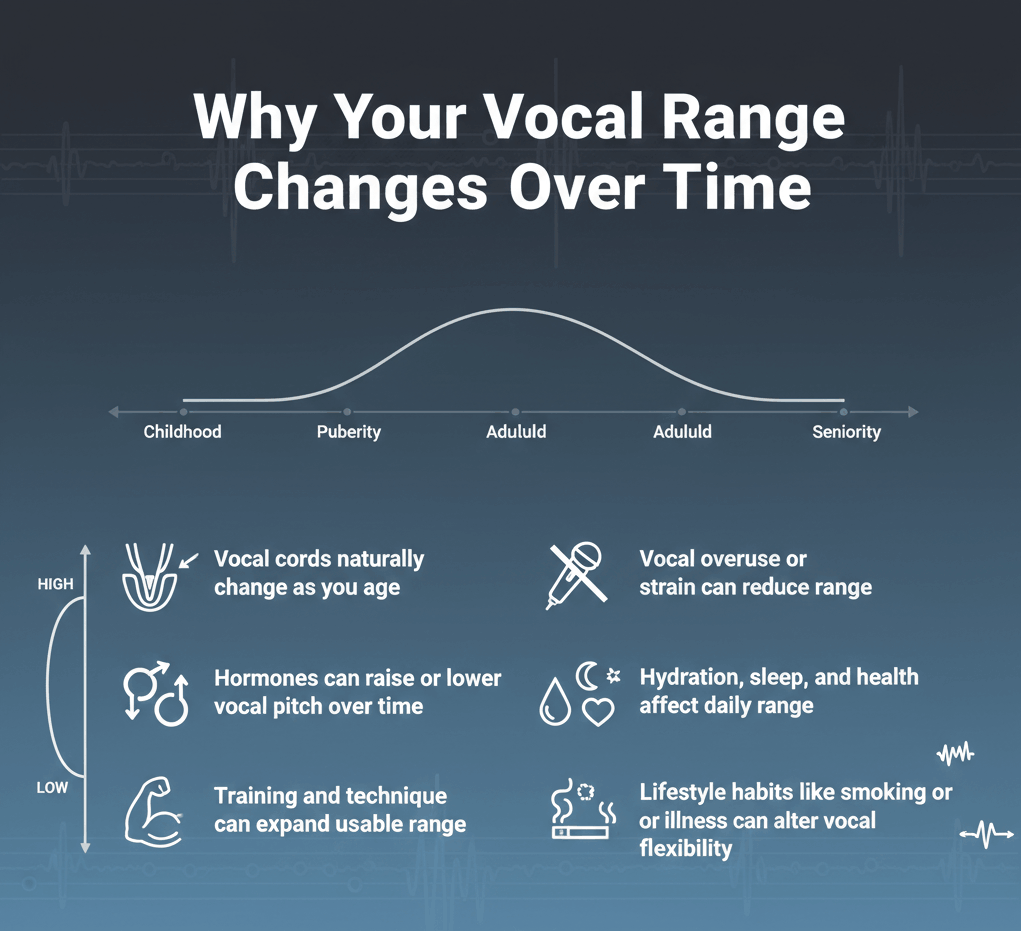
Your vocal range can change from one day to the next because the voice is affected by fatigue, illness, hydration, muscular tension, recent vocal use and how you test it. It can also change gradually because of puberty, hormonal shifts, aging, vocal training or a health condition.
A smaller range on one occasion does not necessarily mean you have permanently lost notes. Sometimes the notes remain physically possible but are temporarily harder to produce with control. However, sudden, painful or persistent changes should not be dismissed as normal variation.
Want to see how wide your range is? Check it with our online tool.
Is It Normal for Your Vocal Range to Change?
Some variation is normal. You may have easier access to high notes after a suitable warm-up, more difficulty after a demanding rehearsal, or a slightly different lowest note when you first wake up. The important question is whether the change is brief and situation-specific or continues across multiple days under comparable testing conditions.
The voice is produced when air from the lungs sets the vocal folds into vibration. Pitch changes as the vocal folds adjust their length, tension, thickness and vibration pattern. Understanding how the vocal folds produce pitch helps explain why small physical or coordination changes can affect the notes available to you.
A single range test is only a snapshot. It reflects the condition of your voice and the way you tested it at that moment.
Did Your Range Change—or Did the Test Change?
Before assuming that your voice has changed, distinguish among four related measurements:
- Total vocal range: The distance between the lowest and highest pitches you can produce under defined conditions.
- Usable range: Notes you can produce repeatedly with reasonable control and tone quality.
- Tessitura: The part of your range that feels comfortable and sustainable across musical phrases.
- Measured range: The result recorded during one particular test.
These are not interchangeable. An isolated squeak, fry note or unstable falsetto pitch may extend your measured extremes without belonging to your usable singing range. Likewise, a failed pitch-detection attempt does not prove that your body cannot produce the note.
Testing conditions that can change the result include:
- Microphone quality and distance
- Background noise
- The vowel used
- Singing volume
- Whether falsetto, head voice or vocal fry is included
- The amount and type of warm-up
- Recent singing or speaking
- How aggressively you approach the range limits
If your results frequently differ, review the main factors that influence vocal-range test accuracy before interpreting the variation as a physical change.
| Change pattern | Possible explanation | Sensible next step |
|---|---|---|
| One unusual test result | Testing or pitch-detection variation | Repeat the test consistently on another day |
| Smaller range after heavy singing | Vocal fatigue or irritation | Reduce vocal load and avoid forcing notes |
| Change during a cold or allergy episode | Temporary inflammation, congestion or dryness | Allow recovery and monitor symptoms |
| Gradual change over months or years | Development, hormones, training, aging or health | Track the trend and consider its context |
| Sudden or persistent loss | Possible voice-health problem | Seek an appropriate professional assessment |
Common Reasons Your Range Changes From Day to Day
Vocal fatigue and overuse
Long rehearsals, loud singing, shouting and extended speaking can make the voice feel less responsive. Coordination may become less precise, and notes near the edges of the range may require more effort.
Trying to recover those notes by pushing harder can increase strain. If the voice feels tired, reduce the load instead of repeatedly testing the highest and lowest possible pitches.
Colds, allergies, irritation and reflux
Respiratory infections, allergies and other sources of laryngeal irritation can change voice quality and pitch control. Swollen or irritated vocal folds may not vibrate as efficiently as usual, potentially making certain notes harder to produce.
Reflux can also irritate the throat or larynx in some people. Vocal-range loss alone cannot identify its cause, so persistent symptoms should be evaluated instead of self-diagnosed.
Hydration, dry air and medications
Adequate hydration supports normal vocal-fold function, while dry air and mouth breathing may make the throat feel dry or uncomfortable. Some medications, including certain antihistamines and decongestants, may also have drying effects.
Drinking water is useful general voice care, but it does not instantly add notes or reverse an injury. Sleep, smoking, vocal load and environmental exposure are among the other lifestyle factors that can affect vocal range.
Stress and muscular tension
Stress can influence breathing, posture and muscular coordination. Excessive tension around the jaw, tongue, neck or larynx may make register transitions less efficient and cause the range to feel restricted.
The solution is not to force the voice through the tension. Gentle movement, easier exercises and reduced intensity are safer than repeatedly attacking an unavailable note.
Warm-up and time of day
A suitable warm-up may improve coordination, airflow management and comfort, allowing you to access notes that initially feel difficult. It does not permanently expand your anatomy or guarantee that every missing note will return.
The voice may also feel different at various times of day. Sleep, dryness, recent talking, meals and individual routines can all contribute, so there is no universal rule that everyone’s range must be lower or higher in the morning.
If your voice feels healthy, begin with comfortable vocal warm-up exercises rather than immediately testing extreme notes.
Why Vocal Range Changes Over Months or Years
Puberty and physical development
During puberty, growth of the larynx and vocal folds can produce noticeable changes in pitch, timbre, register transitions and vocal control. The voice may feel unpredictable while coordination adapts to these physical changes.
Although the average pattern differs between people, temporary cracking or instability can occur during development. A singer may need time and suitable guidance to coordinate the changing instrument.
Hormonal changes
The larynx can respond to hormonal changes across the lifespan. Menstrual-cycle changes, pregnancy, menopause and other hormonal transitions may affect vocal comfort, stability or perceived range in some people, but the effect is not identical for everyone.
Hormonal influence should therefore be described as a possible contributor, not an automatic explanation for every range change.
Aging
The vocal folds, respiratory system, muscles and mucosal tissues change with age. Some people notice reduced power, endurance, flexibility or access to the extremes of their range. Others retain a broad usable range through continued healthy voice use and appropriate training.
A major or rapid change should not be attributed to age without considering other causes.
Training, technique and detraining
Consistent training may improve coordination, registration, breath management and control near the edges of the voice. As a result, usable range may expand even though training does not alter every anatomical limitation.
The reverse can also occur. After a long period without singing, notes that were once coordinated may feel less reliable. They may return with gradual practice, but progress should not involve pain or force.
If your goal is deliberate development rather than explaining an unexplained loss, follow a structured approach to increasing your vocal range safely.
Ongoing irritation or medical conditions
Persistent inflammation, vocal-fold lesions, neurological conditions and other health problems can affect pitch control or range. Range measurements cannot diagnose these conditions.
The National Institute on Deafness and Other Communication Disorders identifies lost high notes, hoarseness, throat strain and increased effort when speaking among the signs that a voice may be unhealthy. Its voice-care guidance also recommends avoiding smoking, staying hydrated and resting the voice when sick.
Why Do High Notes Sometimes Disappear First?
Producing higher pitches generally requires the vocal folds to lengthen, become thinner and adjust tension with considerable precision. Fatigue, irritation, swelling or inefficient coordination can interfere with these adjustments, making the top of the range feel unreliable.
High notes are also where singers may be most tempted to increase volume, raise the larynx excessively or recruit unnecessary neck and jaw tension. These compensations can make the note harder rather than easier.
Register coordination matters as well. A note that feels impossible in a heavy chest-dominant setup may become manageable with a more appropriate balance. Learning the functional differences between chest voice and head voice can help you understand why an apparent range limit may sometimes be a registration issue.
High-note loss does not have one universal cause. If it appears suddenly, persists or comes with hoarseness or discomfort, avoid assuming that technique alone is responsible.
Can a Lost Vocal Range Come Back?
It may, depending on why the range changed.
- Fatigue or recent overuse: Access may improve after an appropriate reduction in vocal load.
- Temporary illness: Range may return as inflammation and other symptoms resolve.
- Testing inconsistency: The apparent loss may disappear when conditions are standardized.
- Technique or detraining: Gradual practice may rebuild coordination and consistency.
- Hormonal or age-related change: The voice may require adjustment rather than returning to an earlier configuration.
- A medical condition: Recovery depends on the underlying cause and appropriate treatment.
Do not test recovery by repeatedly forcing the missing note. A note is not functionally restored if it can be produced only with pain, severe tension or uncontrolled volume.
How to Track Vocal-Range Changes Reliably
Use a repeatable process so that you compare your voice rather than changing test conditions.
- Test at approximately the same time of day.
- Use the same gentle warm-up before each session.
- Keep microphone distance and room conditions consistent.
- Test with the same vowel and similar volume.
- Decide in advance which registers count.
- Record recent illness, sleep and vocal workload.
- Stop if you feel pain, burning or increasing strain.
- Compare several sessions instead of focusing on one extreme result.
For a consistent baseline, follow the same method each time you find your vocal range. You can then use the online vocal range tester under similar conditions and record the lowest and highest controlled notes.
A simple tracking log might include:
| Date | Lowest controlled note | Highest controlled note | Voice condition | Recent vocal load |
|---|---|---|---|---|
| Monday | A2 | E4 | Comfortable | Light |
| Wednesday | A2 | C4 | Tired and slightly hoarse | Long rehearsal |
| Saturday | A2 | E4 | Comfortable | Rested |
The purpose is to identify a pattern, not to compete with your previous maximum every day.
When Should You Get Professional Help?
Brief variation without pain may only require rest, consistent retesting and a reduction in demanding voice use. Consider working with a qualified singing teacher when the issue appears related to technique, registration or practice habits but the voice otherwise feels healthy.
Consult an ear, nose and throat doctor—ideally a laryngologist experienced with voice—when a change is sudden, unexplained or persistent. A voice-specialized speech-language pathologist may also assist with assessment and rehabilitation when appropriate.
According to NIDCD guidance on hoarseness, you should seek medical evaluation if hoarseness lasts more than three weeks, particularly when it is not associated with a cold or flu. Seek earlier help if you experience:
- Difficulty breathing or swallowing
- Pain when speaking or swallowing
- A lump in the neck
- Coughing up blood
- Complete voice loss lasting more than a few days
- A significant change that prevents professional voice use
Severe breathing difficulty requires urgent medical attention. Online tests and articles cannot determine the cause of these symptoms.
Frequently Asked Questions
Is it normal for vocal range to change every day?
Small variations can occur because of vocal load, fatigue, illness, hydration, tension, preparation and testing conditions. Large, painful or persistent changes are not something to ignore.
Why can’t I hit notes that I could sing yesterday?
Your voice may be tired, irritated, insufficiently prepared or being tested differently. Avoid forcing the notes and compare your range again after appropriate recovery under similar conditions.
Does vocal range decrease with age?
It can change with age because of changes in the vocal folds, muscles, breathing system and coordination. The direction and extent of the change vary, and a sudden decline should not automatically be blamed on aging.
Can hormones change a singing voice?
Hormonal transitions can affect vocal tissues, pitch stability, comfort or range in some people. The effect differs between individuals and cannot be identified from an online test alone.
Can vocal training permanently increase range?
Training may increase usable range by improving coordination, registration and efficiency. It cannot guarantee a specific number of new notes, and gains should be developed without pain or excessive force.
How long should I wait before testing my range again?
There is no single waiting period for every situation. If you are fatigued or sick, allow the voice to recover rather than testing repeatedly. For general tracking, compare multiple sessions performed under consistent conditions.
When should lost vocal range be checked by an ENT?
Arrange an evaluation when the loss is sudden, persists, repeatedly worsens or occurs with pain, hoarseness, breathing difficulty, swallowing problems or another concerning symptom. Professional singers should consider earlier assessment when a change prevents them from working.
Your vocal range is not a perfectly fixed daily number. It reflects your anatomy, coordination, current vocal condition and testing method. Track meaningful trends, avoid forcing unavailable notes and seek qualified help when a change is persistent, painful or unusually sudden.