
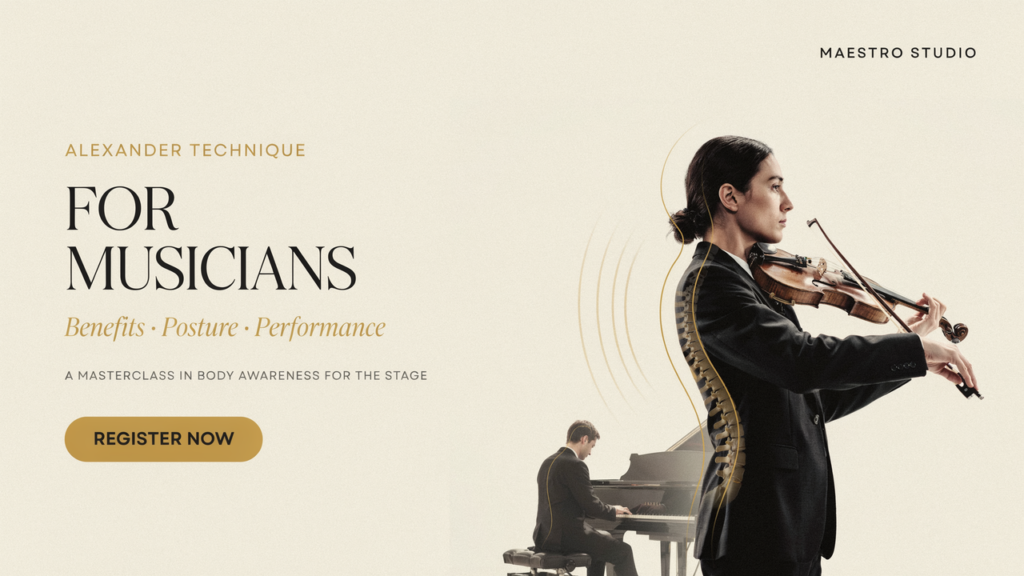
The Alexander Technique for musicians is an educational approach to noticing habitual effort while playing or singing. In lessons, musicians explore how they prepare for a note, support an instrument and respond to difficult passages, aiming for more adaptable coordination rather than a fixed posture.
It is not medical treatment, a posture-correction system or a guaranteed way to prevent injury. Research suggests it may help some musicians manage performance anxiety and improve awareness, but evidence for direct improvements in musical performance, breathing and posture remains inconclusive.
What Is the Alexander Technique?
The Alexander Technique teaches awareness of how thought, movement and muscular effort interact. Instead of forcing the body into an “ideal” position, students learn to recognize habitual reactions—such as tightening the neck before playing, raising the shoulders during inhalation or gripping an instrument harder when a passage becomes difficult.
The objective is not complete relaxation. Musicians need appropriate muscular activity to sing or play. The aim is to reduce effort that does not contribute to the musical task while preserving the energy needed for control, projection and expression.
What Does the Research Show?
A 2014 systematic review of Alexander Technique studies in musicians included 12 studies, five of them randomized controlled trials. It found a possible benefit for performance anxiety, while effects on musical performance, respiratory function and posture remained inconclusive. Its literature search ended in February 2014; it should not be presented as a complete review of all subsequent research.
The review used studies with different methods and outcomes, including theses and conference reports. These limitations reduce confidence in broad claims. A musician feeling less tense does not by itself demonstrate improved breathing capacity, injury prevention or a better performance as judged by listeners.
Why Musicians Explore the Technique
A musician may become interested in the Alexander Technique after noticing:
- Jaw, neck or shoulder tension while performing
- Breath-holding before difficult entrances
- Excessive pressure through the fingers, hands or embouchure
- Rigid sitting or standing
- Fatigue during long rehearsals
- Physical tightening related to performance anxiety
- A habit of repeating difficult passages with increasing effort
These patterns do not automatically indicate an injury. They can, however, interfere with comfort, adaptability and attention.
Awareness, Inhibition and Direction
Three ideas frequently appear in Alexander Technique lessons.
Awareness means observing what happens before and during movement without immediately trying to correct it. Inhibition refers to pausing instead of automatically performing a familiar response. Direction involves maintaining an intention for coordinated movement without physically forcing the body into position.
For example, a pianist may notice that every difficult chord is preceded by a raised shoulder. Instead of pushing the shoulder down, the pianist can pause, reconsider the movement and attempt the chord at a slower tempo with less preparation effort.
Musicians who want to explore these principles at home can begin with six beginner Alexander Technique exercises.
Applying It During Practice
Before playing or singing, notice your contact with the chair, floor and instrument. Observe the jaw, neck, shoulders and breath without demanding instant relaxation. Pause before the first note and begin with an easy phrase.
If a passage repeatedly fails, stop before frustration increases. Ask what changes in your body as you anticipate the difficult section. Reduce the tempo, simplify the task and resume without forcing a particular posture.
A balanced setup should permit movement. For vocalists, that means seeking balanced singing posture without rigid alignment rather than holding the chest high or locking the knees.
Alexander Technique for Singers
Singers may use the technique to notice jaw pressure, tongue retraction, shoulder lifting or neck tightening before inhalation and phonation. The goal is not to manufacture an “open throat” or force the breath downward. It is to identify preparation habits that may make singing feel more difficult.
This awareness can complement vocal instruction, but it does not teach every singing skill. For example, work on vibrato coordination is a separate technical task; noticing tension should not become an attempt to force vibrato or manipulate the throat.
Wind, Brass and String Players
Wind and brass players can observe what happens before inhalation, how firmly they form the embouchure and whether they brace the torso while supporting the instrument. Alexander work does not prescribe one breathing method; it encourages musicians to recognize effort that may restrict their options.
String players may examine instrument support, head and neck responses, bow preparation, fingering pressure and visual fixation. Instead of imposing symmetry on an inherently asymmetrical activity, the musician can look for a setup that allows adjustment and movement.
Pianists and Guitarists
Pianists can explore bench height, distance from the keyboard, reaching patterns and the tendency to sit rigidly. The spine does not need to remain frozen for the hands to be accurate.
Guitarists may consider instrument height, fretting pressure, prolonged downward looking and uneven weight distribution. The purpose is not to eliminate asymmetry but to prevent one fixed arrangement from becoming the only available option.
Percussionists and Conductors
Percussionists and conductors perform large, repeated gestures that can invite breath-holding, locked knees or excessive arm preparation. They can practice noticing the whole-body response before initiating a stroke or cue.
Reducing unnecessary preparation does not mean making the gesture weak. A coordinated movement may still be powerful, fast and expressive.
Performance Anxiety and Stage Preparation
Performance anxiety can trigger rapid breathing, gripping, raised shoulders and narrowed attention. The Alexander Technique may help a musician recognize these reactions without trying to suppress every sensation.
Before performing, feel the floor, retain awareness of the room and pause briefly before the first note. Avoid making major physical or technical changes immediately before going onstage. The goal is to remain responsive while allowing nervous energy to exist.
Using the Technique in Recording and Rehearsal
During recording, check whether headphones, microphone position, music stands, seating or repeated takes are changing your coordination. Take regular breaks and separate equipment problems from performance habits.
Singers creating practice recordings can choose an app for singing and recording sessions, but playback should not be used to diagnose physical or vocal conditions.
Keep a brief practice note: the passage, tempo, setup, perceived effort and any discomfort. Compare similar sessions rather than assuming a good or bad day came entirely from one technique.
What Happens in a Lesson?
A lesson may include discussing the musician’s goals, observing everyday movements and briefly playing or singing. The teacher may offer verbal directions, suggest setup experiments or use light hands-on guidance with consent.
A good teacher should collaborate rather than impose a single correct position. Musicians seeking voice-specific support should also understand what personalized vocal coaching can address.
Choosing a Teacher
Ask where the teacher trained, how you can verify their professional membership or qualification, and whether they have experience with your instrument. Confirm the lesson fee and cancellation terms. Ask whether you can bring your instrument, work on a specific passage and decline hands-on contact. Credentials in Alexander teaching are not medical qualifications.
Avoid anyone promising to cure an injury, guarantee better performance or correct every problem within a fixed number of lessons.
Safety and Medical Boundaries
The Alexander Technique cannot diagnose or treat an injury. Seek an appropriate healthcare professional for persistent or worsening pain, numbness, tingling, weakness, swelling, recurrent headaches, breathing difficulty, sudden voice changes or hoarseness that continues.
It should not replace medical care, physical therapy, psychological treatment or voice rehabilitation when those services are needed.
A Short Practice Experiment
Choose a familiar, comfortable phrase rather than your hardest passage. Play or sing it once at an easy tempo, then pause. Notice one preparation habit, such as gripping before an entrance. Repeat the same phrase at the same tempo while allowing time before starting; do not force a different joint position or alter essential instrument support.
Compare both effort and musical outcome. Was the entrance more reliable? Did the tone or timing change? Could you repeat it without extra strain? If attention to your body makes the phrase less fluent, simplify the task or return to listening to the music. Constantly monitoring every muscle is not the goal.
Bring that observation to your music teacher or Alexander teacher. A useful goal is specific—for example, starting a phrase without an extra shoulder lift—rather than “fixing all tension.” Stop if the experiment provokes pain, and do not use an easier sensation as a reason to extend practice beyond your usual limits.
Frequently Asked Questions
What is the Alexander Technique for musicians?
It is an educational approach that helps musicians observe habitual tension and experiment with different ways of moving, sitting, standing and preparing to perform.
Is it scientifically proven?
The 2014 review discussed above found possible benefits for performance anxiety, with inconclusive results for performance, posture and breathing. It does not establish a guaranteed benefit for an individual musician.
Can it prevent musicians’ injuries?
It should not be presented as an injury-prevention guarantee. Appropriate technique, workload management, rest and professional healthcare remain important.
Can it improve musical performance?
Some musicians report improvements, but controlled research has not established consistent performance benefits.
Does it help performance anxiety?
It may help some musicians manage physical and attentional responses associated with performance anxiety.
Is it useful for singers?
Singers may use it to observe jaw, tongue, neck, shoulder and breathing habits, ideally alongside qualified vocal instruction.
What happens during a lesson?
Lessons commonly include observation, verbal guidance, movement experiments and optional consent-based hands-on guidance.
How many lessons do musicians need?
There is no universal number. Progress varies according to the musician’s goals, habits, practice and teacher.
When should a musician see a healthcare professional?
Professional assessment is appropriate when pain persists or worsens, or when symptoms include weakness, numbness, tingling, swelling, breathing difficulty or continuing voice changes.

Conan is a vocal analysis and singing tools writer specializing in vocal range testing, pitch recognition, voice classification, and music education for singers, musicians, and beginners. He creates practical, easy-to-understand content focused on vocal analysis tools, singing improvement, and voice training resources.